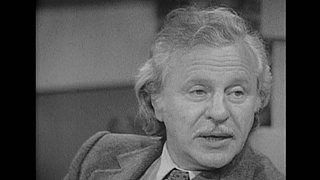
Christian ZUBER discusses the actions of WWF, "World Wildlife Fund" in French. "I have been working with them for three years now, and it has changed my life," he says.
Jean BRONCAR (Peugeot) explains the reasons for the success of Diesel vehicle sales in France and the consequences for the Peugeot plant in Sochaux, the only one in France to supply engines of this type: "Since the oil crisis, demand for diesel has increased considerably, doubled on the 504 and tripled on the 204... But unfortunately, we are dependent on our subcontractors who supply us with injection pumps and they are not equipped to meet our current demand..."
Meeting with a farmer from the Vosges who is not affected by the oil crisis in France, thanks to a system he has developed for 25 years: by recovering methane gas from the fermentation of manure, he has a heating method that costs him nothing!
In Provins, in the Seine-et-Marne region, a woman who heats herself with wood explains the importance of her energy savings: "45 francs a month for wood, instead of 108 francs for conventional central heating..."
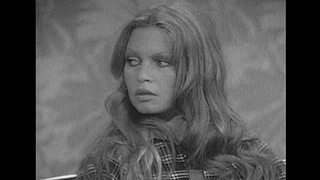
Pierre MASQUELIER of the SPA speaks about article 528 of the civil code (in 1973) which defines the animal as "a piece of furniture that moves by itself". Brigitte BARDOT, shocked, wonders what it takes to change the law. Intervention of a viewer, Anne-France DAUTHEVILLE: "In France, we live in the Middle Ages... an animal doesn’t count."
The veterinarian Michel Klein advocates the prohibition of hunting because this practice is no longer relevant and has no use. The animal population is necessary for human life: "Man destroys himself, destroying animals."
In the forest of Brocéliande rub shoulders with Arthurian legend and the students of the biological station of the forest of Paimpont, the latter is attached to the faculty of science of the University of Rennes. It provides an opening on nature for naturalist students studying behavioural sciences and the environment, as explained by its director, Professor Gaston RICHARD.
Testimony from a farmer who is concerned about the risks of using pesticides but cannot afford not to treat his crops at the risk of losing his harvest.
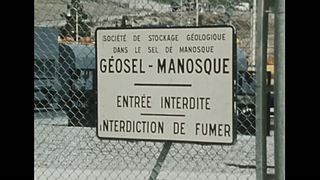
Presentation of the underground storage site for hydrocarbons Géosel. Located in Manosque, in the Alpes-de-Haute-Provence, it is the most important storage center in Europe. Dug in the heart of former salt mines, the immense oil reserves offer maximum safety and space saving on the surface. Comment on images of installations.
To combat air pollution, the Ministry of the Interior has set up an anti-pollution police brigade to monitor car exhaust. Example of police controlling a vehicle.
The artificial lake of Der, located on the edge of the Marne, Haute Marne and Aube, has the function of regulating the rivers upstream from Paris, including the Marne, tributary of the Seine. The aim is to avoid floods and floods in the Paris region and, if necessary, to supply the capital and its surroundings with water. For its water supply, three villages will disappear. With its 12 kilometers long and 7 kilometers wide, the artificial lake of Der is the fourth largest lake in France. In the future it will become a tourist hotspot in the region.
Presentation in images of measuring instruments and a control room to assess the level of toxic substances in the air, which makes it possible to alert the surrounding plants.
The Amar Circus has been the target of attacks on animal abuse. Roger Jacob, director of the Amar Circus, responds to these attacks. He predicts that he himself is a lover of animals.
Report in Brie (Deux-Sèvres) on a farm owned by the FUZEAU family, which has been growing melon for about ten years. A success despite a catastrophic first season. Interviews with an employee and Pierre FUZEAU.
Interviewed during a fishing trip in the Durance, two fishermen talk about how they feel when they fish. One of them explains: "...the world no longer exists, the world is abolished when we fish, it’s relaxation, it’s total forgetfulness, it’s the return to total freedom".
Jean LABOUREUR is a hunting guide and has a reserve in the Central African Republic, a reserve he has for the photo safari. Meeting with a hunter, from France, hunting big game guided by Jean Laboureur whose he says: "...he is a protector of nature and that is how I understand hunting". Interviewed in turn, Jean LABOUREUR returns to the slaughter of animals linked to industrial hunting: "...we live the last years of the great hunting...".
A farmer whose land is close to the Saint-Laurent-des-Eaux nuclear power plant is wondering about a plant accident. If by chance there was an accident the reactor would melt; But if the reactor melted at an accelerated rate of about 20 degrees per second, it would disappear into the ground and the entire groundwater from the Loire to the mouth would be polluted. This situation of the establishment of the plant seems to him to be abhorrent.


 The INA Galaxy