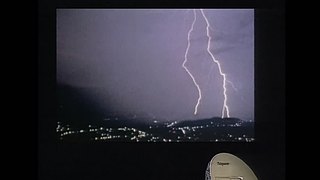
Thunderstorms occur after high heat and often cause damage in the city or in the countryside. Lightning is scary but fascinates storm chasers who travel miles to capture the best shots of lightning.
Nearly 700,000 lightning strikes have been recorded since the beginning of the year. A record since 1995 in France. Lightning also means 15,000 fires, 1 million electrical incidents, and 20,000 animals struck by lightning. Scientific explanations by Jérôme CERISIER, forecaster Météogroup and Jean JOUZEL, climatologist, vice-president of the IPCC "the same amount of water falls on a somewhat shorter period, and that, it will intensify".
We follow two storm chasers, Aurélie and Olivier FERREUX, watchmakers during the day, they photograph lightning crisscrossing France: "it feels good for the morale, there are some who need sun...me I need thunderstorms and lightning". They learned under the clouds, hail falls, gusts, rain curtains. On a website they follow live lightning strikes, and must constantly replace themselves.
Report in Ile de France, where public transport is disrupted due to the flooding of the Seine. On the RER C, water seeped all over the tracks. All traffic is interrupted between Austerlitz station and Versailles. The metro stations are also flooded. In Saint Michel or Cluny La Sorbonne, all entrances are closed. A complicated situation for travelers. The floods are in addition to the strike that strikes the SNCF. Guillaume PEPY, its president, this evening calls on the unions to resume work in solidarity. Despite this call, the unions voted to strike. Commentary on factual images alternating with a micro-sidewalk on the quays of the RER and with the interview of Guillaume PEPY, president of the SNCF.
Waterspouts fell today in Paris; cars were blocked, roads cut; metro stations had to close and RER traffic was disrupted. The firemen are overwhelmed and the police of the 17th district have had to transfer people under arrest.
In 2005, a huge hail storm wiped out the entire Robert ASTRUC crop. A year later, the hail was again present and leaves black traces on the fruits which lose a large part of their value. They will be sold at low prices to make fruit juices. Global warming would be at fault to explain that he has been suffering from these weather conditions for ten years: "My father did arboriculture for 30 years, he has never known this...and I, in the last ten years, I hail every year".
Report on the violent storms that fell on Paris this afternoon around 4:45 pm affecting more particularly the 14.15, 16 th arrondissements of Paris, provoking interruptions of the car traffic, water spouts also fell in the metro stations with water in the stairs and corridors of the stations. Alternation of factual images.
The bad weather in Marseille and its region has already killed three people in traffic accidents. Commentary on factual images in various neighborhoods of Marseille and on the Old Port submerged by the waters, alternating with the testimonies of the inhabitants.
While many storms have hit the south of France, explanation of the lightning phenomenon and ways to protect oneself from it. The characteristics of lightning are studied in an EDF laboratory. Dominique ESCALE, engineer at Meteo France specifies: "Lightning is an electric discharge between two clouds or between a cloud and the earth."
The violent storm that hit Paris yesterday was responsible for power outages, various floods paralyzing the metro and causing monster traffic jams and affecting the transmission cabinets of the RATP which interrupted traffic on some metro lines as a precaution. EDF employees repair the installation after pumping the water. Interview Gérard DAGNICOURT (EDF) explains that the water inlet detectors were inoperative and M PORTIER (RATP Chief Operating Officer) on the exceptional character of the storm that surprised them.
Meeting with Mr HERZOG? of the Prefecture of Paris, in his office, he reviews the measures taken by his administration to cope with floods during severe weather in the Paris region. It evokes the various devices put in place to manage the excess waters of the Parisian basin. The report begins with various plans of the Cité metro station in Paris during the floods and the Notre Dame district of Paris.