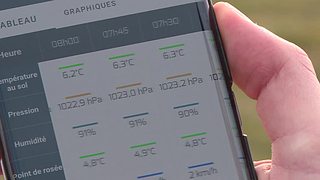
Romain Weber is the creator of the site lyonméteo.com, and at 27 years old he inaugurated his first weather station in Mions, following an order placed by the town hall which wanted to have very precise and localized surveys. The establishment of this station is one more step in the professionalization of Romain, who has always been passionate about weather and forecasts. About twenty companies and associations use it, such as the racecourses of Parilly and the Carré de Soie. Interviews with Romain Weber, Claude Cohen, mayor of Mions and Romain Garin, general manager of the Lyon racecourses.
The Pau-Uzein Météo France station will close its doors in a few days. It was open since 1921. From now on, we will need to contact Biarritz to get the forecasts. Interviews with Didier Sigonneau and Philippe Valat, forecasters for 35 years and 36 years, and Bruno Giraud, chief pilot instructor of the Civil Security, they deplore this closure and fear a degradation of the service.
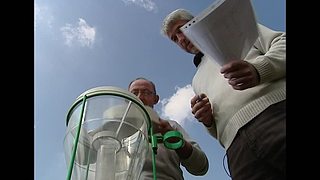
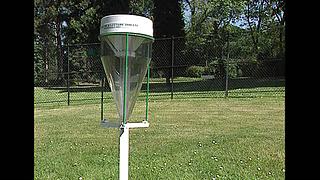
In the region of Gaillac, Jean-Michel Vaysettes is a forecaster for Météo France and runs the campaign to mechanically collect information from weather stations and compare it with computer analyses. The report follows his journey from a small automatic station installed in the middle of vineyards to that of the airport, the most important in the region, then to a winemaker who has been collecting data from his station by hand for 10 years. Explanations and interviews of the forecaster Météo France Jean-Michel Vaysettes and Gérard Rotier, winemaker and volunteer observer.
It is now possible to know the weather 7 days in advance. This is a progress that we owe to computer forecasting techniques: techniques often poorly known but which Météo France will unveil tomorrow by organizing "open days" in the centers of the region. Example of the first French weather station, that of Parc Montsouris.
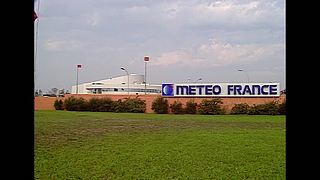
The national meteorology installed in Paris since 1855 moved to Toulouse making the city a meteopole, a relay center of world meteorology. Images of Paul Quilès, Minister of Equipment, Transport and Space, activating the button that switches the entire operational system of Météo France to Toulouse. Explanations by Jean-Alfred Bedel, head of the computer center, on the loop that goes around the earth and connects international meteorological centers, and interview with Paul Quilès on the evolution in forecasts.
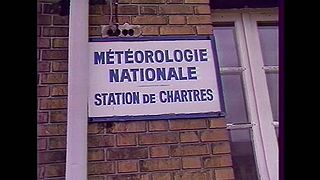
Report on the organization of Météo France with the example of the station of Chartres and the national center for calculating forecasts of the avenue Rapp in Paris. In Chartres, Jean Trideau, the station head, records the weather report for the answering machine; a technician takes measurements of the various devices installed outside the station and then transmits them via a keyboard. In Paris, printers and computers receive data and edit forecast maps.
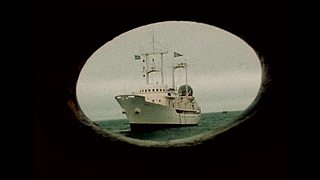
Report on the two French meteorological ships France I and France II, which have been constantly monitoring the Atlantic for 19 years. Explanations on the position of the boat at sea in relation to other countries and the operation of the radar, launch of a sounding balloon from the deck by two technicians.
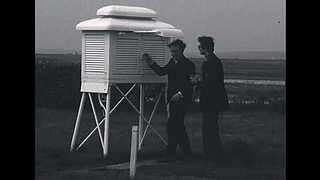
Raymond Lefrais, head of the Bordeaux-Mérignac observation station, presents various meteorological measurement instruments: thermometers embedded in the ground, others under cover in a formwork, recording devices: hygrometer, psychrometer, a tank used to measure evaporation, an anemometer.
A company manager responsible for public works, subscribed to the services of the Arnage meteorological center, explains why the station’s forecasts are useful and essential for the smooth running of its projects.
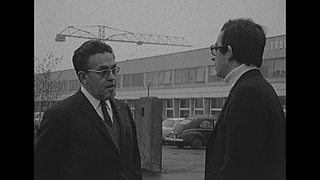
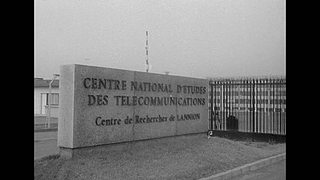
The meteorological center of Lannion receives the first photos sent by the weather satellite TIROS-8, it will make it possible to better forecast the weather. - VG of the entrance to the National Center for Telecommunications Studies in Lannion - VG departure of an American Delta rocket - Drawings showing the orbiting of TIROS-8 - Two VGs from outside the Lannion Study Center - Various plans of the interior installations (control room equipment) - VG of a search radar - Drawings showing the satellite’s trajectory, the taking of photos, and their transmission to the Lannion station - VG of a radar following the satellite - Various plans of the devices receiving the photographs - Technicians reproducing on a card the information provided by TIROS-8 - Drawings reproducing on a map the information given by TIROS-8 - Drawings showing the location of clouds on the Iberian Peninsula - Photo of Cyclone Ruth - Photo of cyclone Ana.
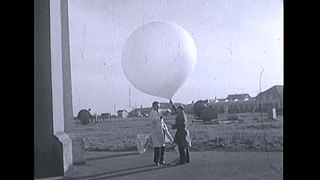
Explanatory report on the operation of a weather balloon associated with a radar in meteorology: operators attach the box equipped with sensors to the balloon and let it fly into the atmosphere, the radar antenna rotating on itself and the screen that spots the balloon, an engineer dictates the values indicated by the box to the weather station.


 The INA Galaxy