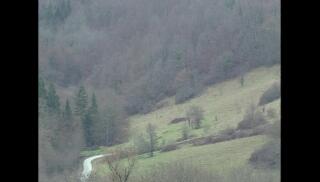
Example of a farmer Michel SEON who has chosen new directions in his fieldss to respect nature. It has moved away from corn production and reduced grain production to prairie. Fertilization requires few chemicals, encourages hedges to be replanted and slows down soil erosion. In addition, it allows the sheep to be fed; This orientation was born as Michel SEON explains "from the reflection that the more we produce, the more we consume intermediate elements, the more we must feed the earth, the more we must make hours of tractor and work". The niche was to manage the land but also the herd. The lambs have a farmer’s label. That is what environmentalists call sustainable agriculture. According to Philippe PONTEREAU, agro-forestry engineer (Solagro association), sustainable agriculture plans will be the plans of tomorrow.
Philppe PONTERAEAU tries to put into practice the concept of sustainable agriculture in the Doubs with a dozen farmers from the valley. After a diagnosis of each farm scenarii are considered to allow them to be profitable, preserve nature and rural fabric. Geneviève REY and her brother Jean-Marie have a herd of 70 dairy farmers and are tempted by the experience. But you don’t change direction overnight. Geneviève sells her milk by going to customers every morning during a tour in the Castres region to sell part of their production, The idea is to get rid of subsidies.
The IFREMER Institute recently carried out a monitoring campaign showing the impact of plastic bags that pollute the seabed and intoxicate fish. Factual images of the samples taken at sea and a laboratory of analysis that alternate with the interview of François GALGANI of the ecotoxicology laboratory IFREMER in Nantes, which alerts on genetic mutations in progress.
Jean-Claude GAUDIN, Mayor of Marseille, President of the Regional Council of the Provence Côte d'Azur region and Minister of the city, speaks in different circumstances, of his attachment to this city. He says he kept Gaston Defferre’s chair in his office: "It’s a historic chair but not pleasant. I didn’t want to change what is heritage".
The Doubs Chamber of Agriculture, gathered today, has been studying a still confidential notion in the agricultural world, sustainable development. In the upper Loue valley, the wasteland will start to lose ground. Farmers will take over the maintenance of much of the landscape by continuing to produce wheat and meat. Interview with Gilles SCHELLENBERGER, environmental studies officer of the Doubs Chamber of Agriculture who explains that farmers are assigned missions as landscape producers and water quality producers. This orientation responds to a social demand of the city dwellers who want a protected environment, water quality and the request of fishermen. Interview with Gilles ROGNON, farmer on his farm who talks about the new role of farmers in landscape maintenance. The concept of sustainable development is being tested in this department and could well be a revolution for farmers in the coming years.
Xavier Gouyou Beauchamps president of the Port-Cros Natural Park confirms "to defend the natural and cultural heritage of the islands of Port-Cros and Porquerolles". The Board has developed a five-year management plan for the protection of both islands.
In Aix en Provence, a family sits down in folk costume to eat the traditional 13 desserts on display, which consist of date nuts, buns... A woman explains this tradition. A man explains in front of the fireplace what "catchfeu" is. Participation of the family in pastoral care.
In the valleys of the Himalayas, attracted by the proximity of the mythical Everest, the 80,000 annual tourists, trekking enthusiasts, from around the world, leave more and more trash during their hikes often more commercial than really sports... A delegation from the "Norvégie-Lyonnaise des eaux" is working to clean the premises and is installing ovens with the Nepalese more than 5,000 meters that burn the waste, thus avoiding having to go down. Testimony of Marie-France ROY (company Norvégie-Lyonnaise des Eaux), Dorje LAMA SHERPA (environmental manager Everest), and Bernard N'GUYEN (shipping manager).
Reportage in the working-class areas of Lisbon, where the inhabitants live in confined and outdated areas. On the images of these makeshift houses, meet and interview of Annabella COELHO, cleaning agent and mother of four children, and Maria Rosa CUNHA, retired.
"Clean the World" Day, at Carrière-sous-poissy. Intense and bi-annual cleaning of the Seine thanks to the association that would like to have a few people for this operation. Interview with Edouard FEINSTEIN, of the association "organ of ecological rescue" which regrets the lack of financial assistance of the State and Marinio ROCHA, of the association "young people for nature", regrets him, the lack of human investment: "People are a little withered...they lack seriousness".
During an oyster fishing in Quiberon Bay, François Cadoret, oyster farmer, tells us about the evolution of his profession since the parasitosis of the flat oyster in 1980. After eradication work, a catch could be revived, but the majority of the spat still has to be reared in other bays. Oyster farmers then turned to the oyster, but the conditions too favorable to their development made them out of the norm, and almost unsaleable.
Children are the first victims of pollution in the big cities because especially at the height of the escape pots. The commentary on children’s plans in the streets of Paris alternates with the interviews of a mother who explains that her daughter had several bronchiolities and of Alain GRIMFELD, pneumo-pediatrician at the hospital Armand Trousseau.
It is time to balance the situation on the island of Saint Martin (French and Dutch Antilles), which was hard hit by cyclone Luis, which killed 15 people and left thousands homeless. Commentary on factual images, micro-sidewalk of victims and interview of a gendarme. Set in location Valérie FOURNIOU.
Report devoted to the disputes between the oil company Shell and Greenpeace. The environmental organisation had demanded that Shell abandon the sanding of the abandoned BRENT-SPAR oil platform, anchored since June in a Norwegian fjord. According to them, it would be an unprecedented environmental disaster. After spectacular actions on the platform and a boycott campaign at European level, British Greenpeace officials acknowledged that they had overestimated the risks and formally apologized to Shell. The images of these actions alternate with the interview of Maurice AUSCHITZKY, Communications Director of Shell France and Rémi PARMENTIER, Greenpeace France representative.
After the murder of a young man, five shops in the Greyscale shopping centre were destroyed by a fire. The comment on images of the burnt shops and the inhabitants of the neighborhood alternates with a micro sidewalk and the interview of Mohamed EL BAKKOURI, of the association of the residents of origin of the Maghreb the Grésilles.
Report in Uzès, ideal setting for the gathering of stones, sculptors, ironworkers, cabinetmakers during the Stone Days. In alternation, images of the visitors during these days, and interview with Jean-Luc Chapon, mayor-general of Uzès. He recalls that Uzès was the first city in the Languedoc Roussilon sector classified as safeguarded thanks to André Malraux, which led to a great restoration.
Report on the tradition of Pastis in the old, in Forcalquier. This mixture of anise, alcohol and various herbs is pale green, tinted by sagebrush and not by the caramel of industrial pastis. The commentary alternates images of the market and the gathering of thyme, the interview of Jean-Yves ROYER, historian, seated on one of the village’s terraces, returns to the history of this "thirst-quenching": "The pastis as we used to drink it when I was a kid, it was to raise the taste of water (...). There was a side water sanitation (...)".


 The INA Galaxy