On the Ile de Ré, more and more sauniers are reviving this heritage and wanting to preserve the landscape. After 22 years of career in the national navy, portrait of a saunier in La Couarde-sur-Mer, Charente-Maritime. The commentary alternates images of the salt marshes Rétais, the interview of Thierry MORGAN, saunier, on the transformation of a former salt marsh, salt production and its professional reconversion.
Having passed near extinction, Niger’s giraffes, the only ones in Africa to live in total freedom outside a reserve, are now being saved thanks to an ambitious protection programme. Commentary on factual images and interviews Pierre GAY (director of the zoo of Doué-la-Fontaine, Maine-et-Loire) and Saleh SOUMANA (guide, association to save giraffes of Niger).
The first big fire of the summer in Provence continues to mobilize important resources. The situation update. The report alternates factual images with an interview with a firefighter explaining the situation and Colonel Eric MARTIN, firefighter of the Var. Plateau in position Olivier THERON.
Heat waves, and sometimes heat waves, are part of the overall warming of the climate. The situation. The report alternates images of illustration and infographic images with interviews with Claude MILLIER, scientific advice on climate change and Eric BRUN, research director at Météo France.
Report on the violent storms that fell on Paris this afternoon around 4:45 pm affecting more particularly the 14.15, 16 th arrondissements of Paris, provoking interruptions of the car traffic, water spouts also fell in the metro stations with water in the stairs and corridors of the stations. Alternation of factual images.
Dossier. Update on climate change linked to global warming due to man-made damage (pollution, deforestation, expansion of cities, wars). Comments on illustration images and infographic. Interviews with Pascale BRACONNOT, climatologist at the Institut Pierre-Simon Laplace, and Jean JOUZEL, climatologist, Director.
A survey shows that the French are largely in favour of the removal of plastic bags in supermarkets in order to limit pollution. A micro-sidewalk at the exit of a supermarket in Clermont-Ferrand proves that everyone has alternatives to pack their races.
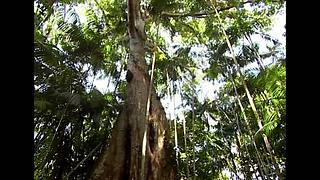
In Brazil, the city of Belem was renowned for its rubber harvest; some inhabitants still perpetuate the practice of harvesting rubber tree sap, practiced in the 19th century by the Indians and exported by large landowners. José dos Santos explains how latex was harvested, then presents the tallest trees in the forest.
In Brazil, in the historic district of Belem, Paolo Chavès, Secretary of State for Culture of the Pará, shows us the vestiges of the Belle Epoque of the city, such as the "Paris N' America", fabric shop and the Governor’s Palace, residence under restoration.
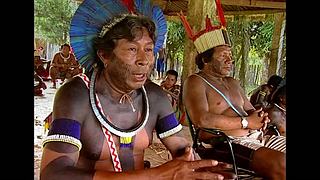
In a village in the region of Bélem in Brazil, meeting with the Indians of the Kayapo people who continue to perpetuate their ancestral traditions and culture that they have not lost in contact with the Whites as explained by the chief of the village Kibe-I Kayapo.
In Brazil on the banks of the estuary of the rivers Tocantins and Para, visit of the market at the auction of Belem, in company of Pedro¿hao, landscape architect, who makes us discover the specialties: rare plants, exotic fruits, spices, cocoa, fish.
The oceanic phenomenon El Nino causes global climatic disturbances that scientists seek to analyse. From New Caledonia, the IRD, the Institut de Recherche pour le Développement, is preparing to place beacons in the Pacific Ocean. The IRD oceanographic vessel will therefore travel thousands of kilometres to place floats richly equipped with technologies by Ifremer, which designed the transmission systems. Explanations by Christophe MAES, oceanographer at the IRD.
Plant protection products are suspected of causing rare forms of cancer in the agricultural world. For the first time, the Mutuelle sociale agricole is launching a survey on this issue. The story features the testimony of a farmer with cancer who is seeking recognition of the link between his disease and pesticide use.
Report on the deforestation of the Amazon rainforest. Small coal producers still deforest their plots in order to survive, but most of the damage is done by large agricultural and livestock companies as well as companies that trade in precious wood species.
Report: overview of regions threatened by drought in France and measures to prevention by the departments. Commentary on alternating images of farms, drained rivers and interviews with Christophe TAULELLE, farmer and François AUNEAU, department manager at Truffaut. [Source: prompter France 2] More preventive measures against drought... It is confirmed that this winter will have been one of the driest in a very long time, despite the snow... After the Deux-Sèvres, new departments have taken and are taking water restriction measures... François-Julien Piednoir, Frédéric FAURE Several European countries are concerned... Portugal has just indicated, for example, that the damage caused by the drought that has been raging since September, already amounts to more than a billion euros... 2004 was the driest year since 1931
The judge for interim measures in Rennes must decide on the communication campaign conducted by the Union des industriels de la protection des plantes (UIPP). The pesticide advertising campaign was launched on February 10 in several weeklies. Environmentalists have summoned the UIPP for false advertising. The commentary alternates with interviews with Philiuppe DESBROSSES, President Objectif Bio 2007, Dr Lilian Le Gofff, Coherence Network, Jean Charles BOCQUET, Director General of the UIPP, François VEILLERETTE, President of the association president MDRGF, Pierre-Yves LE MAZOU, lawyer of the MDRGF association, and Jean Luc SOULIER, defence lawyer.
The use of pesticides, herbicides, insecticides and fungicides raises many questions about their potential health effects for both farmers and consumers. The University of Caen (Calvados) is conducting a major study, while the toxic commission is based for the moment on the work of the laboratories of the manufacturers of the products in question. [Source: prompter France 2] And since we are talking about agriculture... pesticides are dangerous for health... This is the theme of the face-to-face 13H... (JINGLE) Face to face between Francois Veillerette, president of the movement for law and respect for future generations, and author of "pesticides, the trap is closed" (editions Terre vivante)... And Jean Charles Bocquet, director general of the UIPP, in other words the union of industrialists... And it is you, who fund this communication campaign, since February 10, in favor of pesticides... A campaign that your opponents are trying to ban. judges must rule in a few days... Ask your questions by SMS at 5-15-15 or online france2.fr You have to be afraid of pesticides, what are their possible dangers? Elements of response with Alban MIKOCZY and David FOSSARD
What is the Environmental Charter? With this charter, respect for the environment becomes a fundamental right for every citizen. It stipulates that everyone has the right to live in a balanced environment that is conducive to their health. According to Corinne LEPAGE, it is an instrument of political communication and in the light of Community law rather a regression than a step forward. However, the polluter pays principle is not included in it, which Yannick JADOT regrets by mentioning the role of Total that refuses to pay while the company is a source of pollution. According to the Academy of Sciences "the precautionary principle" is what makes polemic and would be a brake on progress. We could ban GMOs as a precaution until we have clear certainty about the consequences of these crops. Dominique BOURG, member of the Committee responsible for drawing up the charter, gives the definition of the precautionary principle "which consists in acting in doubt provided that there are sufficient and serious elements".
Despite the small price gap between gasoline and diesel fuel, which is constantly increasing, the enthusiasm for diesel fuel is not going away. Interviews with motorists and Patrick HAAS, CEO of BP France,
Survey of a biologist from a specialised GM booth and an organic farmer at the Paris Agricultural Show on their interpretation of the precautionary principle enshrined in the recently adopted environmental charter. Alternating comments and interviews (Denise GERENTES, biologist, and Jean-Charles NOEL, farmer) on factual images and archival images of genetically engineered plants.


 The INA Galaxy