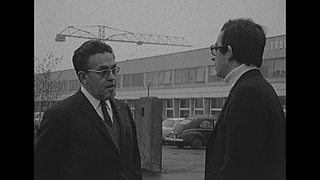
To answer the question of the journalist who takes up a title of paper written by the women of Fessenheim "Fessenheim, life or death of Alsace" and that the journalist finds too alarmist, Françoise BUCHER expresses what she feels, an anxiety linked to the Fessenheim power station and more generally to the network of nuclear power plants in Europe and worldwide.
Inauguration of the new youth and culture centre in Villeurbanne. The new house includes sports halls, games rooms, workshops, an auditorium and a 520-seat performance hall.
The village of Salles-sur-Verdon must be engulfed. Old people and farmers will be the first to suffer and will have to adapt to the situation. A couple of farmers feel there will be no more land. They are not interested in tourism. The village is now divided into two camps: traders and farmers.
Further development of the new district of Bordeaux Lac, the social housing is added to the already built International Fair and to the local rowing club. Auditorium and hotels will then open.
The mayor of Salles-sur-Verdon, Jean GOMBERT, talks about the disappearance of his village inhabited by 166 inhabitants. It is a considerable human tragedy for him. The new village after the dam was launched must be rebuilt on the heights 500 meters from the old village.
The castle of Caen, built from 1060 by William the Conqueror, also called William the Bastard, is the most important monument in the city. Few people know its history, it is witness to all the historical facts that have marked the region since the Middle Ages. Description of the castle walls and the evolution of military architecture in the 12th century.
What is pollution? Children from Annemasse answer this question by thinking about water and air pollution. They explain what they can do at their scale to address this pollution. A smaller one was sensitive to marine pollution and birds that were affected by oil. Another one evokes foxes caught in traps. A little girl thinks we should stop hunters from killing or setting traps for foxes.
An employee of a unpacking station (degassing) explains that at sea, ships throw away everything: "It happens very often, too often... It’s not so much that it would be expensive to do it in a station, but it’s a waste of time..."
A manager of the unpacking station (degassing) in Marseille explains how these stations operate to drain the tanker tanks: "There is one tanker in two, or sometimes two out of three that do not pass the station... They had to dump their polluted waters in the Mediterranean when they should not..."
At the port of Marseilles, a tanker commander speaks about the wild outgassing he recognizes. Tanker captains, once their cargo is unloaded, fill their tanks with seawater to ensure the mopping and cleaning, but most often they discharge this polluted water into the open sea. However, there are "unpacking" stations and a convention signed in 1962 to regulate the dumping of oil at sea.
Interview with Mr. VIEL, Director of the Plant Pharmacy Laboratory of the National Institute for Agricultural Research, who says that pesticides are safe because they are used at low doses. Images of orchard application and laboratory experiments;
François de LA GRANGE talks to Claude CAILLÉ, creator and director of the Palmyra Zoo. During the visit to the park, Claude CAILLÉ presents Palmyre, a tamed cheetah that became the pet of the zoo, which evolves freely in the park. Claude CAILLÉ then evokes his experience as director of zoological park "...what it takes first to be a good zoologist is to love his animals...".
Francis Gag, a man from Nice and author of the book "Le théâtre niçois", has fun seeing the amount of water that the Parisian journalist puts in his pastis: "you drown him there the good man"! He talks to her about the character of the Nice people and explains that "the Southerners are much more secret than we think".
A company manager responsible for public works, subscribed to the services of the Arnage meteorological center, explains why the station’s forecasts are useful and essential for the smooth running of its projects.
In 1970, Roland de LA POYPE presented its new "Marineland" water park, located in Antibes. According to him, his marine zoo will be the first major ocenarium in Europe, with dolphins, orcas, seals. It will also be a place of leisure and discovery for the public and for scientists who have never been able to approach this kind of marine mammal.
Report on the move of the Ecole des Electriciens de la Marine Nationale, which opens its doors to journalists for the occasion in order to present the training curriculum of these artisanal experts of the navy. Report on comment with factual images.
In Poitou-Charentes, scientists are studying the migration of bats. We follow them here in a cave. The team of scientists capture some specimens, observe them and band those that are not yet.
In 1873, Annette Poulard, then young bride, took the lease of the inn "Saint Michel, Tête d'or" at Mont Saint Michel. At that time the tourists came only at low tide, it was difficult to find dishes always ready. That’s why Madame Poulard thought of making omelets. Here is his recipe based on eggs and salted butter, cooking being done on a good oak wood fire. Comment on a photo of Annette Poulard and images of Mont Saint Michel and the preparation of the recipe of the omelette of the mother Poulard.
A landslide took a wing of the sanatorium from the Assy Plateau during the night of 15-16 April 1970 causing the death of more than seventy people, the majority of whom were children. The journalist on the spot explains the situation alternately with images of the rescuers in action.


 The INA Galaxy