Subject devoted to the increase of the white vote in the second round of the presidential elections between 1988 and 2002, followed by the interview of Didier MAUS, professor of constitutional law. He mentions the reasons for the blank vote and explains that the 1962 reform ensures that the president is elected by an absolute majority of the votes cast.
Jean d'ORMESSON speaks on the victory of Nicolas Sarkozy in the presidential elections. He is delighted with this vote result: "I recall that he defended the ideas of the right in a way that frightened his opponents and his friends (...) and it is at the same time, the only one who made the ideas of the National Front retreat".
After the defeat of Ségolène ROYAL against Nicolas SARKOZY in the presidential election, the remarks of Dominique STRAUSS-KAHN, deputy PS of Val-d'Oise, who criticizes the campaign of the left which according to him has not been able to renovate: "The French left has still not made its renovation... In the changing world, the French no longer want solutions that are 20 years old... We must now implement this renewal, it is the condition of hope... And I am available..."
In 2007, during the debate of the second round of the presidential election, Ségolène ROYAL and Nicolas SARKOZY clashed on the nuclear issue. A look back at the few mistakes made regarding the share of nuclear power in France, and the EPR reactor.
Excerpt from the televised debate between the two presidential candidates, Ségolène ROYAL and Nicolas SARKOZY. As they address the issue of schooling for children with disabilities, Ségolène Royal loses her temper against her political opponent to whom she criticises her political immorality and launches a "I am very angry!".
Produced in Lille, Versailles and Toulouse, this report evokes the results of a poll on the electorate of François BAYROU. The latter, the UDF candidate in the presidential election, was defeated in the first round of the election. Alternating factual images, a micro sidewalk, and statistical infographic animations.
In Fessenheim, in the Upper Rhine, the inhabitants and the mayor defend the presence of the nuclear power plant as a source of employment. Their vote in the first round of the 2007 presidential election did not focus on the environmentalist candidate Dominique Voynet. In the second round, their choice could depend on the position of the candidates Ségolène Royal and Nicolas Sarkozy regarding the maintenance of this plant in operation for thirty years. Environmentalists are defending another path to keep jobs. Reactions from two residents of Fessenheim, interviews with Alain Foechterlé, mayor of Fessenheim, and Nicole Roelens, president of the association "Stop Fessenheim".
The day after the first round, suburban voters, especially in Sevran, voted massively for the PS candidate Ségolène Royal. Young people went to vote as well. The pavilions areas are mostly pro-sarkozysts, the popular neighborhoods, voted for Ségolène Royale.
Focus on the problems encountered in some municipalities following the introduction of electronic voting in the first round of the Presidential elections, in particular because of the high turnout of voters. Commentary on images of the alternating vote with an interview with René COUANAU, UMP deputy-mayor of Saint-Malo (Ille-et-Vilaine), and a micropavement of voters in line.
Report devoted to the last day of the campaign of the four main candidates in the presidential election. Nicolas SARKOZY, UMP, is riding in Saintes-Maries-de-la-Mer, Ségolène ROYAL, PS, is in Poitiers, Jean Marie LE PEN, Front National, visiting a Nice market, and François BAYROU, UD, is in Rouen. A commentary on factual images alternates with a reflection by SARKOZY about the Bayrou tractor and the calls to voters of Ségolène Royal and François Bayrou.
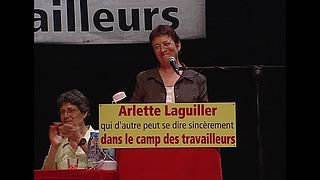
Portrait of Arlette LAGUILLER who has been on the political scene since 1974 and participates in her last electoral campaign for the presidential elections.
In Calais, the National Front won 22% of the vote in the first round of the presidential election. Voters say they want to fight immigration, and a fisherman who has been unemployed for five years is campaigning for that party in the hope that it will finally offer it work.
Reaction of José BOVE, anti-globalization candidate in the presidential election, after an incident in Loudéac between municipal police and a group of young people. An officer was indicted for a gunshot wound to the shoulder of a 17-year-old suspected of wanting to steal a scooter. José BOVE is very worried because "we see a lot of burrs, more and more important". It advocates disarming and even suppressing municipal police. According to him, "these are the new sheriffs in the pay of a local political power. It is completely contrary to the laws of the Republic". " It is absolutely necessary to get out of this logic of militias that are the municipal police".
On the occasion of the start of the official campaign for the presidential election, journalists propose an archival montage offering some television statements from rather wacky or forgotten candidates.
François BAYROU, candidate in the presidential election for the UDF, discusses the vocation and necessity of the school card, which guarantees equal opportunities and explains that in order to fight school failure, Pupils leaving primary school must be able to read before entering college.
Presentation of the major measures concerning national education and education in the programmes of the main candidates in the presidential election, notably Ségolène Royal (PS), François Bayrou (UDF), Nicolas Sarkozy (UMP) and Jean Marie Le Pen (FN). Comments on factual images of relay workshops for schoolchildren in great difficulty and illustration images, alternating with the interview of Marie DURU BELLAT, sociologist.
Portrait of Martine VASSAL, Deputy Departmental Secretary of the UMP des Bouches du Rhône, also General Councillor and Deputy Mayor of Marseille in charge of public sites. She explains her commitment to the right and the meaning of her political struggle. She concedes that being a woman in politics is difficult, but it is a choice. "We must assume," she says.
The founding CEO of Infogrames, Bruno BONNELL, leaves his position at the head of the group. The Board of Directors has appointed Patrick LELEU, former CEO of Noos, in his place. Bruno BONNELL founded Infogrames in 1983, then launched the assault on the American market by buying Atari.


 The INA Galaxy