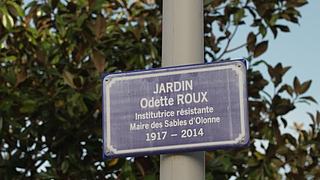
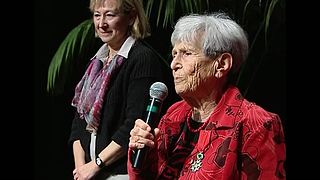
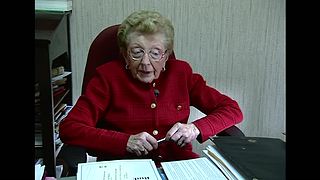
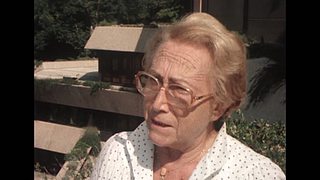
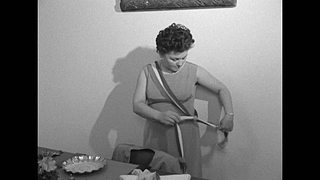
Nearly eighty years after the decree of 21 April 1944 granting French women the right to vote and stand for election, this portrait highlights Odette Roux, a former great resistance fighter who became 27 years old in 1945 mayor of Sables d'Olonne, a pioneering figure of the presence of women in politics. Through the testimonies of his only daughter, Line Roux, and her friend Geneviève Huguet, an early and determined personality is sketched, whose commitment embodies the new openness made to women in public life.
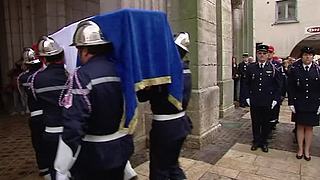
[Source France 3 Regions]: The funeral of Evelyne Jean-Baylet took place this morning in Valence d'Agen. A figure of the Tarn et Garonne and the press, the former patron of La Depeche du Midi passed away at the age of 101. She was also the first woman in France to head a department.
Report on the awarding of the Legion of Honor to Odette Roux (1917?2014), celebrating at 91 an exceptional journey: a great resistance fighter, communist and union activist, she became in 1945 the first woman mayor of a sub-prefecture in Les Sables d'Olonne. At 27 years old, she encourages the reconstruction of the city by municipalizing health and education and making employment for the unemployed a priority. Dedicating its decoration 'to the women of Vendée', it affirms a constant commitment to women’s rights and peace. The testimonies underline its exceptional social policy and a deep humanity.
Portrait and meeting with Jeanne BAUDRAY, 84 years old, mayor of the village Saint Vivien de Médoc in Gironde with its 1,400 inhabitants, who is running for her third term. Interviews with Jean Claude DUPRAT, head of the list "Agir pour réveiller Saint Vivien", by Jean Pierre DUBERNET, head of the list "Saint Vivien l'avenir ensemble" and microtrottoir.
Angélique DODANE, 25, mayor of Pont d'Héry, in the Jura, is one of the youngest mayors in France, she was elected at only 21 years of age. Interview and reactions of residents.
Report in Ille-et-Vilaine which points out the gap between the legal injunction of parity at the municipal level of 2001 and the rural reality, where candidates are lacking and parties "drag their feet". A central figure, Marie-Françoise Jacq (mayor of Louvigné-du-Désert) is confronted with an almost insoluble equation: to recruit six women and dismiss invested men, a symptom of a system that externalizes on the elected officials the responsibility of correcting structural under-representation. The words heard as 'twenty years to change a mentality', the persistent doubt about the interest of public life for women, reveal a political culture that is not conducive to progress.
On the occasion of the examination of the bill on parity at the National Assembly, the report follows in Bouzeron (Saône et Loire) a mayor, Claudette Brunet Lechenault, whose election owes much to the paternal inheritance, sign of an access still filtered. Only woman in the municipal council upon her arrival, they are only three now, the progression remains marginal. Between town hall, family winery and seat on the regional council, the elected representative describes a balance between family life and demanding politics and stumbling over local resistance. It shows a largely theoretical parity in rural areas, hindered by the scarcity of candidates and the immobility of mentalities.
March 8: International Women’s Day. Portrait of an active woman, that of Renée DELATTRE, mayor of Vauhallan (village of 1800 inhabitants in the Essonne). - [Different plans] village. - Madam the mayor walks down the street, enters the town hall. - Interview with Renée DELATTRE (wears the scarf): bring something different because she is a woman; the neighboring mayors are often surprised by his apprehension of the problems. - Interview with the first deputy, André BELAISCH: resents the mayor when she considers the councillors as students. - Interview of the top PS candidate at the next municipal elections, Jean ROY: finds it normal that Mrs. DELATTRE uses her charms since she is a woman; but he does not succumb. - [General view] village.
Pioneer figure of 'women’s politics' (Mayor of Valence d'Agen and general councilor, first woman elected in 1970 as president of a general council, Evelyne Baylet stands out for her realism: on the fallout from Golfech, she announces a "white operation, if not loss making", in line with administrative analyses, and refuses the label of pessimism, claiming the alert. In a context of industrial promises (agri-food, state protocol EDF Region, some jobs created), it calls for vigilance and cohesion to concretely defend the interests of Tarn et Garonne.
Portrait of Brigitte GROS, senator mayor of Meulan for 12 years. Update on the representation of women in municipal councils. Interview of Brigitte GROS alternating with a comment on city council images, infographics and illustrations.
Suzanne PLOUX has just been appointed Secretary of State for National Education. Already a general councillor, deputy and mayor, among others, she is interviewed at the exit of her first council of ministers to talk about her new position.
At the beginning of the 1970s, although women were in the majority in the electorate (15.3 million voters against 13.55 million voters), they remained a very minority in local authorities: one councillor for 41 men and 485 women mayors out of 37,508 municipalities (i.e. 1 for 78). The micro-sidewalk shows an acceptance in principle of electing a woman mayor (affirmation of equality, no objection to the candidacy of the wife), accompanied by a condition of competence), revealing the persistent gap between electoral weight and representation.
Manager of a bar, 42 years old and mother of five children, Andrée Roche has been mayor of Auneuil (Oise) since March 1965; arrived by circumstances more than by ambition, she finally decided to take the plunge after having judged not to be ready a few years earlier. Driven by the desire to advance issues, she imposes herself in a largely male political universe: often the only woman among hundreds of mayors, she claims her ability to stand up to her counterparts, transforming the small humiliations related to her status as a woman into an engine to demonstrate, through her determined action, that a woman is worth a man.
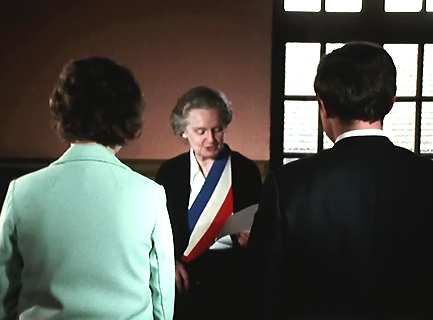
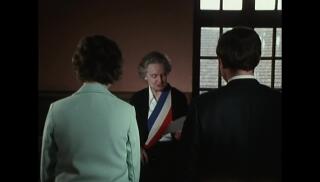
Suzanne PLOUX, Mayor of Chateaulin, General Councillor and Member of Parliament for Finistère had a long political career. To the journalist’s question: "that she is your profession, she answers: "I don’t have one, mother of family, if you think it is a profession". Suzanne Ploux is interviewed behind her desk, we see her at home, pronouncing a civil marriage at the town hall. His interview is interspersed with illustrations of the city of Chateaulin.
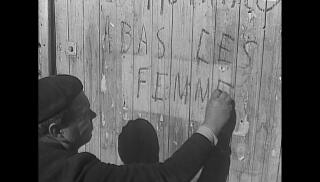
Since 1945, the town council of the village of Echigey in Côte d'Or was entirely female. In the municipal elections of 19 October 1947, men drew up a list which prevailed over women. In this report in pictures in Echigey, residents, municipal councillors and the mayor, Madeleine AINOC, lend themselves to a parody of gender war on the occasion of these elections.


 The INA Galaxy