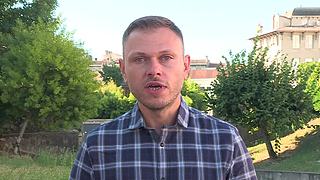
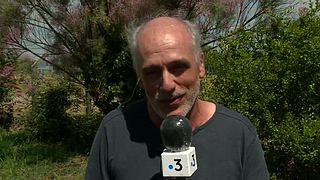
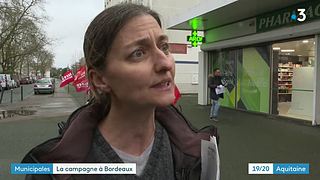
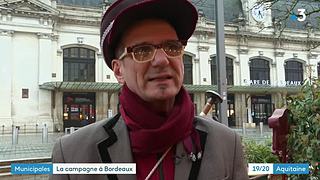
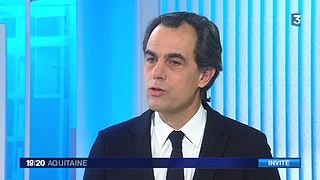
A Bordeaux, au second tour des élections municipales plusieurs candidats s’affrontent : ici les premières apparitions TV du maire sortant Nicolas Florian ainsi que celles du candidat EELV, Pierre Hurmic.
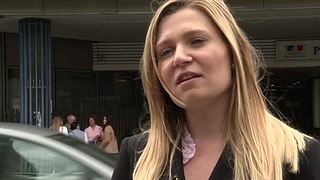
Julie Rechagneux defends a program focused on improving purchasing power, reducing immigration and strengthening the judicial response, believing that insecurity forces residents to adapt their way of life. She claims that these themes are particularly present in several municipalities of the constituency. According to her, the French are tired of a context she considers too lax. The new MEP specifies that she will resign from her European mandate in case of an election to the National Assembly.
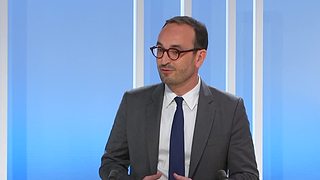
Thomas Cazenave recalls his local commitment since 2020 as a municipal councillor and deputy of Bordeaux, in regular contact with the inhabitants to defend a cleaner, safer and more pleasant city. He acknowledges working immediately at the 2026 municipal elections, considering it necessary to build a new collective momentum. He criticizes the current management, pointing to cleanliness, housing, and travel as areas in difficulty. He thus calls for a real apprenticeship based on a new project for Bordeaux.
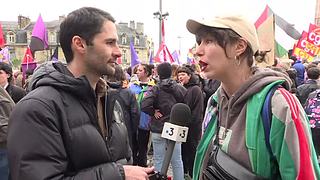
Petra Bernus stresses the importance of mobilizing on 8 March in the face of growing attacks targeting women and gender minorities. She considers the inclusion of abortion in the Constitution as a simple announcement effect, denouncing the lack of real means in the health system. She recalls that feminist advances have always been achieved through the street and collective mobilization. This gathering is part of a demonstration already bringing together several hundred people, marking a strong citizen presence from the beginning of the day.
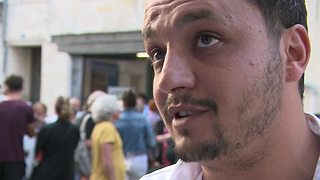
Nordine Raymond stresses that his commitment goes beyond the sole quest for electoral victory, recalling that he had already experienced modest scores. He expresses his satisfaction at having conducted a campaign based on a unity program rather than on a vote against an opponent. Despite the disappointment, he highlights the strong mobilization and diversity of the gathered activists: socialists, communists, ecologists. He claims to want to perpetuate this local union, perceived as promising for the future.
[Source France 3 Regions]: Several times abandoned in the past, is the project for a metro in Bordeaux still relevant? Michael BAUBONNE, the vice president of an association that defends this project is the guest of the "3 questions to" section. According to him, the budget of the entire metro line would be 2 billion euros.
Philippe Poutou, elected from the New Anticapitalist Party, presents himself as an opposition located to the left of the new Bordeaux majority. He intends to voice social anger and push the municipality on transport, housing, ecology, and social emergency measures. While wanting to be a force for proposals, he plans a political standoff, notably with the Socialist Party. It finally focuses on the mobilization of neighborhoods and associative circles to strengthen the balance of power beyond the municipal council.
Fanny Quandale, candidate of the Lutte Ouvrière party, leads a list composed of workers, retirees and unemployed, claiming that those concerned must defend themselves rather than let others speak for them. It rejects any alliance and claims a campaign of ideas, far from an electoral 'hit-parade' and tactical arrangements. For her, the effectiveness of struggles rests first on action in companies, through strikes and demonstrations.
Yves Simone, guide in Bordeaux and independent candidate for mayor, recalls having been a precursor in the promotion of wooden constructions, now wishing to make the majority of new buildings. He defends an urban vision based on minerality, judging excessive the multiplication of trees in the city. According to him, the architecture of Bordeaux must remain visible and dialogue with controlled vegetation. His campaign thus highlights the living environment, urban development and architecture, addressed against the current of the other candidates.
Philippe Dessertine, director of the Institut de Haute Finance and member of the Haut Conseil des Finances publiques, professor of economics, says that Aquitaine has a solid foundation despite the decline in state grants. He highlights the attractiveness of the region and its dynamism, citing aeronautics, laser and more broadly digital as pillars. According to him, it is necessary to invent very quickly a new economic model whose digital could structure the architecture, the region having assets to achieve this. However, he warns against wasting time in a context of reshaping large regions.
Pierre HURMIC was nominated by his party Les Verts, the top candidate in the next municipal elections. Pierre HURMIC, municipal and community councillor since 1995, is running for mayor for the third time. He says he is ready to discuss with the socialist candidate for a possible alliance to come.
RPR candidate Nicolas FLORIAN won 39.3% in the first round of the cantonal elections. He is also second on the list of Patrick PUJOL for the municipal election of Villenave-d'Ornon