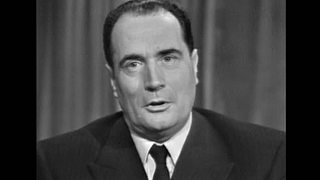
In the 1965 presidential election, François MITTERRAND was elected in the second round and had to bow down to General DE GAULLE, who was elected with 55% of the votes. The comment on a sign announcing the results is followed by a speech by François MITTERRAND thanking the voters on the left.
In an interview with Michel Droit, between the two rounds of the presidential election, General DE GAULLE compares France to a house and pronounces one of his famous "little sentences": "The housewife, she wants to have a vacuum cleaner, a fridge ... and at the same time, she doesn’t want her husband to bamboozle from all sides... The housewife wants progress, but she doesn’t want trouble. Well this is also true for France: we need progress, we don’t need chaos!..."
In 1965, François Mitterrand, presidential candidate questioned about his programme, evokes his opposition to the nuclear policy of Charles De Gaulle, his main opponent. He opposes the race to atomic armament: "We on the left, republicans of progress we refuse it". If he is elected, he will submit to the United Nations a plan not to disseminate nuclear forces and to stop nuclear experiments that pollute and are bad for the health of humanity.
In 1965, General Charles DE GAULLE, in his campaign speech for the presidential election, listed the advantages he found in nuclear energy for France: it provides the country with an inexpensive and modern weapon of dissuation and is necessary for the progress of research.
François MITTERRAND, member of the Socialist Party, is a candidate in the presidential election of 1965 against General de Gaulle. He criticizes sharply his opponent as well as the Fifth Republic.
Alain PEYREFITTE, Minister of Information, interviewed by Jean de BENEDETTI, presents the guidelines adopted by the Board of Directors of the ORTF on the accounting of the presentation times of candidates in the presidential election that will apply from the beginning of the official campaign.
On 21 April 1944, the French Committee for National Liberation decided, after a favourable opinion from the Consultative Assembly, to grant women the right to vote. The French women were therefore able to vote for the first time on October 21, 1945. Interview with Marie Madeleine Dienesch, who was one of the first women elected as deputies to the first National Constituent Assembly in 1945, and the first woman president of a parliamentary commission.
General de Gaulle’s televised address from the Elysée Palace: he announced his candidacy for the Presidency of the Republic for the election of 5 December 1965 after his return to the head of France in 1958. It will be conducted by direct universal suffrage. Excerpts: "Twenty-five years ago, when France was rolling in the abyss, I felt I had to take on the task of leading her until she was liberated, victorious and master of herself. Seven years ago, I thought I had to go back to its head to preserve it from the civil war [...] and build the institutions of the Fifth Republic that the modern world and times demand". "Since then, I believed I could exercise the powers of Head of State [...] in order to restore a complete peace" "Today, I believe I must be ready to continue my task, knowing what effort it is, but convinced that at present it is the best way to serve France"
Excerpt from General de Gaulle’s speech from the Elysée Palace. "The historic election of 05 December 1965 will mark the success or the renunciation of France vis-à-vis itself".. I hope, I believe, I know... Long live the Republic, Long live France"
Excerpt from the televised address given by General de Gaulle from the Elysée Palace announcing his candidacy for the 1965 presidential election which will take place on 5 and 19 December for the first time by direct universal suffrage. In this excerpt, he speaks to the French about the importance and responsibility of this vote. "A great national responsibility will therefore rest with all of you in a month", "partisan tendencies, influences of foreign powers and special interests", "the road that France will follow", "To myself, whom you know well after all that we have done together in war and peace, each of you, each of you, will have the opportunity to prove his esteem and confidence" "The historic election of 05 December 1965 will mark the success or the renunciation of France vis-à-vis itself"..
During a luncheon at the Maison de l'Amérique Latine in Paris, François MITTERRAND, the only candidate of the left for the Presidency of the Republic, said: "I believe in the strength of ideas, I believe in the strength of symbols, I believe in the strength of a popular current, I believe in the people of our country and it is worth, if not more, what can be in history, A man who is finally the only one accountable for his actions and master of his only destiny.
Intervention by François Mitterrand, for the Rassemblement Démocratique (non communist left) on the strong authoritarian overtones of the reform of military service going hand in hand with the very nature of the Fifth Republic.
On the occasion of the presentation of the Maison de la culture de Bourges to General de Gaulle, André Malraux delivers a brief and poignant speech in favour of culture:"When faced with death, there is only that which resists death. In the face of the powers of night, there is only immortality."
Saint-Benoît-la-Chipotte, in the Vosges, has no mayor. The inhabitants explain the reasons for their refusal to be the first magistrate of this small village of 400 souls...
Interview with a young employee of mutual who expresses his lack of interest in politics and his lack of confidence in the actions of political parties.
In the heart of tourist Paris in the 5th and 6th districts, Roger LAPEYRE, president of the Association des droits du piéton, is interviewed about his position in relation to the pedestrian streets and is (without surprise) for...
During the election campaign for the presidential elections, François MITTERRAND, socialist candidate for the presidency of the Republic, is interviewed by Benoite GROULT. François Mitterrand reacts to the poll according to which women intend to vote for General de Gaulle, for him it is a deep need of women security because they have suffered more than men from political instability, they fear becoming so in professional or civic life, they need to be sure of both the present and the future, and perhaps General de Gaulle has given them the impression of being able to give them this minimum security. I believe that the Fifth Republic has tried to make citizens, and especially citizens, accustomed to political problems by avoiding them to think, reflect and decide.


 The INA Galaxy