In the court of Invalides in Paris, François MITTERRAND, Minister of Veterans Affairs and General KOENIG greeted the ashes of those who fell six years ago in Bir Hakeim. Generals KOENIG, of LARMINAT, and Mr MITTERRAND, Minister of Veterans Affairs greeted the remains, then the families of the disappeared, very moved, gathered in front of the coffins.
On the occasion of the first day of May in Paris, the CGT and the Communist Party had convened their troops to march from Nation to Bastille, in the presence of the Secretary General of the French Communist Party Maurice THOREZ, accompanied by Jacques DUCLOS and Marcel CACHIN.
Images, without sound, of the trip by Germaine Poinso Chapuis, Minister for Public Health and Population, to Germany, in Baden-Württemberg: the welcome by a guard of honor, the meeting of children from the institution "Perce Neige" in Bad Dürrheim, the speech from a balcony, the children singing the Marseillaise, the visit of the island Reichenau in the company of General Koenig.
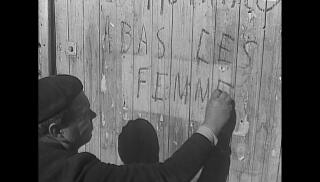
Since 1945, the town council of the village of Echigey in Côte d'Or was entirely female. In the municipal elections of 19 October 1947, men drew up a list which prevailed over women. In this report in pictures in Echigey, residents, municipal councillors and the mayor, Madeleine AINOC, lend themselves to a parody of gender war on the occasion of these elections.
The municipal elections of 19 October 1947 were won by the Gaullist party of the Rassemblement du peuple français (RPF). Report in pictures in Paris on polling day. Georges Bidault (MRP), Léon Blum (SFIO), Maurice Thorez (PCF), Charles De Gaulle (RPF) deposit their ballot in the ballot box. Women vote. Election night at the Ministry of the Interior.
On 11/21/1945, formation of the first ministry DE GAULLE. General de Gaulle is President of the Council and head of the armed forces. Presentation of some ministers.
In Fribourg, the French occupation zone, the Minister of Veterans Affairs François MITTERRAND came to open the Congress of deportees of the Resistance. Comment on images of François MITTERRAND saluting the flag and then giving a speech.
French democracy allows all citizens to aspire to the highest judiciary, that of President of the French Republic. Images of the picturesque or unusual candidates of 1947, including Achille Fournier and Ferdinand Lop.
Commentary on the men’s events of the 52nd French championships at the Yves du Manoir de Colombes Olympic Stadium. Images, in the stands, of Andrée Viénot, Secretary of State for Youth and Sports, who presided over the event.
Results of legislative elections and referendum for the National Constituent Assembly. With an overwhelming majority, the French voted against the return to the institutions of the Third Republic (rejection of the 1875 Constitution) and, for a Constituent Assembly with limited powers, with a smaller majority. On the same day, the National Legislative and Constituent Assembly, with proportional representation, was elected. A tripartite majority consisting of the Communist Party, the Socialist Party and the Popular Republican Movement (MRP), emerged.
At the Bois de Vincennes is held the first Festival of Humanity since the Liberation. It brings together hundreds of thousands of Parisians. Marcel CACHIN, director of the newspaper "L'Humanité", Maurice THOREZ, general secretary of the French Communist Party, Jacques DUCLOS and of the Soviet uniforms.
The municipal elections, the first since the Liberation, gave women, who acquired the right to vote and stand for election on 21 April 1944, the opportunity to vote for the first time in France. Reportage in Paris in the polling stations. Among the electors, we recognize several personalities such as Jeanne Boitel, Marie Dubas, Irène Joliot Curie, Gilberte Brossolette, Maurice Thorez, Francisque Gay, Yvonne De Gaulle, who deposit their ballots in the ballot box. Plans of election posters, polling stations, "some" of the main national dailies on the results.
On the occasion of the trial in Lyon, a portrait of Charles Maurras, a member of the Institut, a master of the political movement L'Action française and the editor of the newspaper of the same name.
Report in Marseilles during the elections of 21 October for the parliamentary elections, the first since the end of the war, and the referendum on the powers of the new Assembly, which will be responsible for drafting the future constitution. Gaston DEFFERRE, head of the SFIO local list, goes to a polling station. Scenes of voting with electors, who participate for the first time in a national vote (silent document).
For the first time since the end of the war, the SFIO is holding an extraordinary congress at the Palais de la Mutualité in Paris, during which the Secretary General of the SFIO Daniel MAYER and Edouard DEPREUX will speak, of the underground executive committee.
Thanks in part to their involvement in the Resistance during the Occupation, the French women won the right to vote and stand for election on April 21, 1944. After the Liberation, women occupied their place in allied troops, had access to elective magistracies, and entered the political sphere. Four women jurors sit on the Court of Justice in Paris, women have become mayor, and the Union des femmes françaises, the result of the Women’s Committees of the Resistance, is holding its first major meeting. In Paris, images of a group of women soldiers, of the four women jurors of the Court of Justice. In a city hall, a woman mayor pronounces her first marriage. Images of the "first big meeting" of the Union des femmes françaises, extracts of the speeches of Claudine MICHAUT, "of the steering committee"; and of Marie BELL, of the French Comedy.
Extract from the speech of Benoît FRACHON, secretary general of the CGT and member of the political bureau during the first meeting of the communist party after the Liberation at Vel d'hiv in Paris. It recalls the 1940 strikes against the enemy.
In the winter Vélodrome filled with crowds, the PCF holds its first meeting since the liberation of Paris. André MARTY, Benoît FRACHON, Marcel CACHIN and Jacques DUCLOS (talking about the "20-year-old captains" and the" 30-year-old colonels") base their speeches on the role of the Party in the resistance.


 The INA Galaxy