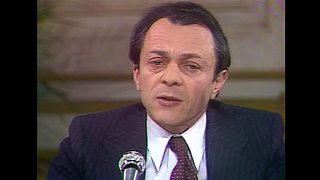
Election night of the 2nd round of the legislative elections of 19 March 1978, live from the Hôtel de Lassay. The outgoing majority UDF-RPR retains power by obtaining 291 seats against 200 won by the opposition. On this occasion, the socialist deputy Michel ROCARD evokes "a new rendezvous missed by the left with history" and affirms that there "is no fatality" if the left fails to govern in France.
Interview with Georges MARCHAIS by Jean-Pierre ELKABBACH. Georges MARCHAIS, annoyed by Jean-Pierre ELKABBACH, tells him that he can go elsewhere if he wishes and he adds "Listen ELKABBACH..." It is extremely unpleasant to discuss with you."
Didactic subject devoted to the relationship between the executive and the National Assembly. The 1958 Constitution allows the President of the Republic to dissolve the National Assembly under certain conditions, except in the case of an interim presidency and the year following a dissolution. Apart from the legislative role of the deputies, the National Assembly has a mission of control of the government which is expressed through two procedures: questions to the government and the putting into play of the political responsibility which is expressed by the motion of censure, on the initiative of members of Parliament, and on the issue of confidence, on the initiative of the Prime Minister. The subject consists only of illustration images taken mostly inside the Palais Bourbon.
Mention by Pierre MENDES FRANCE of General de GAULLE during the War and the Liberation: "He gave the word back to the French people, then he withdrew in 1946. And it happened to me to think more than once in the disorder, the chaos, that represented the Fourth Republic that perhaps De Gaulle one day could be the one around which one would try to gather..." (inserts of the General’s NB archives).
Alexandre ASTRUC, writer and filmmaker, evokes a manifesto of right-wing artists and intellectuals against the ideology of the left, invading, according to him, the world of culture: "The left-wing parties aim to make the artist a propagandist, a robot, serving first an ideal and then a prison... We rise very, very strongly against this conception which, through personal censorship, has transformed literature into something narrow... We want to affirm our absolute hostility to all forms of dictatorship and in particular to the Marxist, socialist and common program dictatorship..."
Images of François MITTERRAND in his house in Latche, feeding his donkeys, accompanied by his dog Titus. He explains his interest in donkeys and talks about his animals.
According to the polls the feeling of insecurity is increasing in France. Interview with Jacques LEAUTE, director of the Institute of Criminology of Paris, this feeling of insecurity developed in France in 1973 and is growing while the number of crimes and crimes is down compared to 1973. This feeling is generated by two cases in particular and their development in the mass media that has repercussions and at the same time there are police roadblocks.
According to the Peyrefitte report on violence in France, the press is responsible for the rising feeling of insecurity in France. This sentiment is stronger in the summer and has been exacerbated by the air piracy case last November and by some polls: the government is too liberal towards offenders. This sentiment benefits security and alarm companies. Jean Marc LECH of the IFOPE explains about the surveys and the difficulty of carrying them out, everything is related to the questions asked and when then to Mr. LEMOINE, protection society.
Gérard Bayer and Jean-Marie Genevaux of Terville City Council detail the types of two-wheeled traffic chosen as part of a redevelopment of the urban network and the financing of this project.
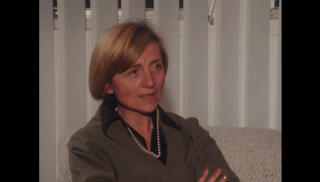
Interview with Nicole PASQUIER on her appointment as Secretary of State at the Ministry of Labor in charge of women’s employment and on her objectives.
During one of his first interventions on television, Alain CARIGNON expresses himself on the development of departmental plan of cycling routes that he presented in Grenoble: "We are in a difficult economy for a long time, we have to look for a different type of growth or go towards very serious failures".
During a campaign clip by the Socialist Party for the legislative elections, Yvette Roudy, PS national secretary for women’s action presents the provisions in favor of women’s rights and the fight against female unemployment set out in the Left’s joint government program: increase in family allowances, an increase in the duration of maternity leave, the right to security and self-determination.
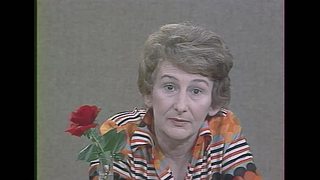
Hélène MISSOFFE, Secretary of State for Health and Social Security, gives her point of view on the particular approach of women in politics. She advocates for joint work between men and women in the making of laws.
Interview with Claude Malhuret, a doctor at Médecins Sans Frontières, about the situation and MSF’s work in Cambodian refugee camps in Vietnam and Thailand. Presence at his side of Xavier Emmanuelli, co-founder of MSF.
In a salon of the City Hall of Paris, Jacques CHIRAC speaks about the problem of canine pollution in Paris. According to him, it is above all a "problem of discipline and means". He therefore recommends entrusting to the contractors prevention missions to the Parisians, dog owners. It also evokes the setting up of small "machines" to clean sidewalks.
Farewell speech, on the "Duguay-Trouin", of Admiral Philippe de GAULLE, during the taking of arms and transfer of power on the occasion of the departure of the Atlantic Squadron.
Interview with Lionel STOLERU, Secretary of State for the Condition of Manual Workers, estimating that in the next 15 years there would be a steady decrease of foreign labour in France due to economic conditions, The Commission’s proposal for a Council Directive on the approximation of the laws of the Member States of the European Union.
The function of senator is detailed in this report following Roger Quilliot, senator of Puy de Dôme, in his daily activities. He recalls that his role is primarily with local elected officials. He thus considers himself capable of introducing common sense, practical sense and humanity into the law, inevitably theoretical and general. Filmed during meetings and during his travels, he expresses a regret, that of not having enough time.


 The INA Galaxy