Before the Council of Europe, Yvette Roudy speaks and delivers a speech on sexism in advertisements and the discrimination and stereotypes they convey about women.
Jean FERNIOT, former editor-in-chief of "L'Express" and editorial writer at RTL, talks about his relationship with politicians during his career as a political journalist in newspapers and news stations: "I had relationships that excluded all political allegiance...I invited them or they invited me... it was a relationship of equal and total independence". He says however: "I never had the slightest illusion about (political) men but I never had any contempt for them either."
Jean Ferniot, former editor-in-chief of "L'Express" and editorial writer at RTL, discusses the form of censorship that journalists exercise on politicians: when a policy involved fellow journalists, all journalists launched the "cemetery procedure". The politician was no longer quoted in the newspapers for a certain period of time. And Philippe TESSON, founder and director of the "Paris Daily", added: "what is the worst disgrace for a politician. He explains that this form of set-aside is now done naturally according to their sympathy rating... He points out that today doing journalism is less pleasant than under the Fourth Republic. The Fifth Republic sanitized and technicalized political life and made the President of the Republic "untouchable".
Philippe TESSON, founder and director of the "Daily de Paris", evokes the complicity that can exist between journalists and politicians. According to him, journalism and politics are both public services. There is also a human factor: the relationship of friendship, trust, emotional relationship sometimes. He said he had kept close relations with left-wing leaders he had known in the past, "without compromising or compromising". Jean FERNIOT, former editor-in-chief of "L'Express" and columnist at RTL, concluded: "We must not believe that journalists are yes-men".
Catherine Nay, a journalist at Europe 1, talks about journalists' rather brief and distanced reports with politicians when they follow them in election campaigns. So there is no reason to compromise. On the other hand, she thinks that we should see very little the President of the Republic: if we go to too many lunches, then we are part of the seraglio... " He represents millions of voters who voted for him, an exorbitant power, we find him a special charm, inevitably". "I made a rule to see him as little as possible... so much the better he does not like me".
Report in Mazamet in the Tarn on the solutions put in place by a watering company in collaboration with several organizations to fight against the pollution of the river Arnette. Interviews with Dominique SIRVEN, head of a delainage company, and Claude SERGE, director of the Mazamet Industrial Research and Analysis Test Laboratory (LECARIM).
On the occasion of the resumption of the autumn parliamentary session, journalist Danièle BREEM analyses the political consequences of the return of former President of the Republic Valéry Giscard d'Estaing to the National Assembly, within the UDF group. Two alternating interviews, by Jean-Claude GAUDIN, President of the UDF group, rejoicing at the reunion between Raymond Barre and the former President of the Republic; of the PS deputy, Alain VIVIEN, "the battle of the leaders, as Jean-Pierre Destrade said, will probably resume (...)" and images of the interior of the National Assembly (corridors and hall).
Parliamentary re-entry: Valéry Giscard d'Estaing becomes a deputy again after having been President of the Republic. The commentary alternates images of the former head of state driving his 505 entering the courtyard of the National Assembly, VGE in the Hall of the Four Columns surrounded by journalists, the hemicycle, deputies applauding him. Series of interviews with Claude LABBE, Chairman of the RPR Group; of General BIGEARD, UDF, "I remain faithful to Giscard d'Estaing (...). I have a lot of admiration for him, that’s for sure."; "I knew him as President of the Republic when I was a member of the opposition. So I know how he ran France. He comes here as a member of Parliament. It leaves me quite cold"; of Guy DUCOLONE, PCF "(...) he has become a member again, it is not my problem, it is his"; by Pierre MEHAIGNERIE, Chairman of the CDS.
In Douaumont, near Verdun, tribute to the war dead of 1914-1918, rendered jointly by François MITTERRAND and Helmut KOHL. After listening to the German anthem, François MITTERRAND and Helmut KOHL hold hands while the military orchestra plays "La Marseillaise".
Journalists followed former President Valéry Giscard D'Estaing during his campaign in Clermont-Ferrand, Royat and Chanonat for the parliamentary elections. Micro-sidewalk with the inhabitants and interview with the former head of state: (...) I had the chance to get out of what is called political politics, that is to say this kind of false debate (...). And now what interests me is the democratic and profound life of France as it can be lived and as I find it".
Laurent FABIUS, Prime Minister, answers a question about his young age that he considers an asset for a government leader born after the war who has experienced changes in society, economics and technology. He evokes his young children.
Summary of the day of Laurent Fabius, the day of his taking office as Prime Minister, following the resignation of Pierre Mauroy, of the transfer of power with the latter at the arrival of his first cartons the Hotel Matignon.
At the headquarters of his former Ministry of Industry in Paris, rue de Grenelle, statement to the press by Laurent FABIUS, appointed Prime Minister after the resignation of the Mauroy government.
Stormy debate in the National Assembly on the bill on the status of the press. Speech of Alain MADELIN, UDF deputy evoking during his speech on the "illegitimacy" of this bill and declaring: "the sovereignty of this assembly is not unlimited" then speech of Prime Minister Pierre MAUROY in the heckling: "it is not the fight for freedom that is so targeted it is the eternal fight of the right against progress, it is the fight against democracy, against the dignity of man and therefore against freedom...the government will not yield..."
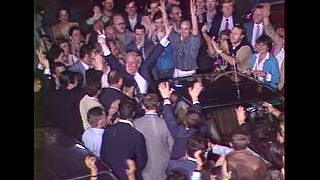
The European election has just ended, the Front National got a good score for its first participation. Gathered at the party headquarters, the activists, in the presence of their president Jean-Marie Le Pen, celebrate this victory. Two activists give their opinion then Jean-Marie Le pen speaks to the press: "...it was enough to hear earlier, the representative of the communist party, to understand that it has just happened a historical event...".
Introduction of the new European Parliament. The Communist Party is losing ground to the arrival in the Green Parliament and the far right. Britain expresses its national dissatisfaction in the European elections, as does Germany.
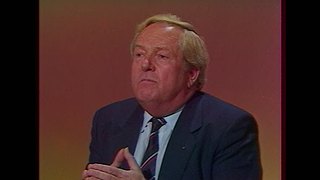
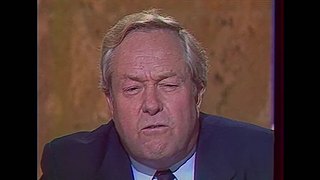
The European election is over. At the time when Jean-Marie Le Pen is interviewed, all the results are not yet known, but his party is on track to establish a good score. On the occasion of this interview, he explains: "(...) it happens that I have been described as the vile, as the beast, as the devil (...) it happens that the French (...) do not think at all, neither as journalists, nor as political observers (...)". "This is only the first stage of a long race that will go until the French reinaissance (...)". He then gives his definition of the people.
Official political expression of the Front National, through its president Jean-Marie Le Pen, on the occasion of the European election. This last reminder of the themes that, according to him, made the success of his party as: "...if the National Front is now a great success, it is because he was the only one to be interested in the real problems of France and Europe: immigration, insecurity...".
In Lille, meeting of Georges MARCHAIS in campaign for the European elections. Extract from the speech of the 1st secretary of the PCF or he says that it is not his speeches but his actions that the left will be judged, then he declares "the grandstand effects, the small sentences, the humour the French have heard a lot about, but what the unemployed are waiting for is to be given work" "What employees, pensions, farmers, families expect is that their standard of living will be maintained and improved and that social justice will be brought to life as the Left has committed itself to it.


 The INA Galaxy