During a debate with the socialist Yvette Roudy, Marie-France GARAUD speaks about the way women exercise power. They are, according to her, more demanding than men but their vulnerability lies in being a mother: "the attitude of women in politics is different from that of men [...]. When a woman engages in political life [...] she does not seek as a man to leave her trace by what she does. The main thing for her is elsewhere [...]. Mrs Indira Gandhi or Mrs Thatcher, who were often said to be harsh and ruthless, were in the exercise of their governmental function of an extreme requirement but that their deep emotional vulnerability was their son".
The problem of a possible cohabitation after the legislative elections is considered from the point of view of constitutional law and in the light of the positions of previous presidents of the Republic. Cohabitation impacts the relationship between the President and the parliamentary majority, particularly in the choice of the Prime Minister. The political scientist René REMOND analyses the reactions of François MITTERRAND and Georges POMPIDOU when they were confronted with this choice. The constitution of the Fifth Republic does not impose any obligation on the head of state, but to prevent the parliament from overthrowing the government immediately, it is desirable that he choose a personality accepted by parliamentarians. While François MITTERRAND said that he could appoint the Prime Minister he wanted, Georges POMPIDOU qualified his remarks by saying that "The President of the Republic takes into account the composition of the Assembly, but is not a slave". Quotes of the two Presidents are transcribed to the image in infographic, in illustration of the explanations in off.
Microtrottoir in Brittany on the regional election of March 16: some confusion seems to reign on the subject of this election and the role of the soon-to-be-elected councillors.
Interview with Michel Gillibert president of the association Mouvement de défense des grands accidentés de la vie. He recalls the large number of people with disabilities in France and the importance of research to help support the management of these people.
The Prime Minister Laurent FABIUS visited the French football team, in training camp in Font-Romeu to prepare the next World Cup in Mexico. Several players of the team and management are invited to express their opinion on the hypothetical ideal position of Laurent FABIUS on a football fields. Jean-François DOMERGUE, Dominique ROCHETEAU, Luis FERNANDEZ, Jean TIGANA, Jean FOURNET FAYARD (president of the French Football Federation) and Michel HIDALGO. Alternately, comment on images of Laurent FABIUS arriving in the hotel, making a pass with a ball and playing foosball with Luis FERNANDEZ, Jean FOURNET FAYARD and José TOURÉ. Finally, group photo after which the Prime Minister confides that when he played football, he played as a right winger.
Bernard PONS, Minister of DOM-TOM, is interviewed after his visit of New Caledonia, Wallis and Futuna and Polynesia. He evokes the crisis in New Caledonia and the officers held prisoner in Auckland in New Zealand.
Microsidewalk made with high school students about their registration on the electoral lists, the importance of voting and politics to them. They don’t all feel concerned.
Following the charge of drug trafficking of an Air France co-pilot, interview of Jean Luc STEIGER, president of the National Union of Airline Pilots about the search applied to the aircrew, of this pilot (Christian BERTET) who was already known for painting trafficking and who was excluded from the union.
Reportage at the Palais de la Mutualité, in Paris, where a meeting of PCF intellectuals was held. The latter were few in number... In the Mutuality Hall, participants explain why they are still communists: Lucien MAREST, head of culture at the PC ("to make society move"), actor Pierre SANTINI ("for putting at the disposal of all the riches that surround us"), the director Raoul SANGLA, on stage ("to hasten the future of spring"). Illustration by different planes of the assistance and speech of Georges MARCHAIS.
Interview with Jean-Marie LE PEN, president of the National Front by Franz-Olivier GIESBERT, who asks him to explain racism and recent remarks on immigration. Jean-Marie LE PEN, defends himself by responding: "Mr. Giesbert in your eyes, as long as I am not painted black, I will not be anti-racist," "It’s Gaulish humor."
Christiane TAUBIRA, Director of the Centre national des arts et métiers de Guyane, presents the training provided by the INTEC (National Institute of Economic and Accounting Techniques) and CNAM, as well as the access modalities. This is his first time on television.
Bruno BONNEL and Christophe SAPET in Villeurbanne talk about the creation of their company Infogrames, and the creation of video games. The report alternates interviews of the two CEOs, and images of the track and fields game "The Stadium Gods", a karate game, and the logo of their company (game "Mandragore"?)
The President of the Republic François Mitterrand defends the choice to have set the new regional elections on the same day as the vote in the general elections, namely on 16 March. Even if there is still confusion in the minds of the voters, pooling the two ballots would, according to him, encourage voters to go to the polls, and therefore limit abstention for the election of regional councillors.
During his visit to France, Mikhail Gorbachev visited the Peugeot-Talbot factory in Poissy and the Lenin Museum where he met Georges Marchais. After a warm exchange between the two men, Georges Marchais speaks of the solid solidarity (despite differences) between the two parties. Mikhail Gorbachev emphasises (vo trad off) that these relations could serve as an example for the other parties.
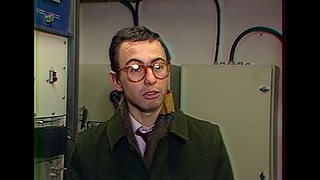
A few months after the disaster in Bhopal (India), which claimed several thousand lives, a local company based in Béziers (Hérault) is authorized by the prefecture to continue its activities of manufacture of the pesticide involved in this Indian catastrophe (methyl isocyanate). Interview with Claude GUEANT, secretary general of the prefecture of Hérault (this is his first televised appearance recorded).
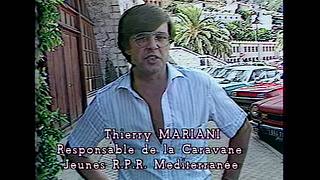
To prepare the electoral campaign for the 1986 legislative elections, a caravan of 7 young RPR activists criss-crosses the Mediterranean coast to meet the voters. Thierry MARIANI is the person in charge of the Mediterranean caravan: "we are going to pick up the voters where they are, today they are on the beach, we are on the beach".


 The INA Galaxy