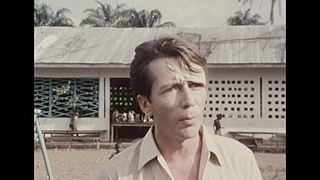
On the occasion of the diabetology days at the Hotel Dieu in Paris in the presence of Doctor Ratsimamanga, ambassador of the Malagasy republic, nearly three hundred specialists took stock of medical advances on this pathology. Pierre Bourget interviews Professor Maurice Dérot, while visiting the Francis Rathery Centre, the first diabetes screening centre in France.
Report on the civil war in Biafra, a secessionist region located in the southeastern part of Nigeria. Dr. Comiti of the World Health Organization (WHO) and the International Union against Tuberculosis, alongside Dr. Labourelle of the Kremlin Bicêtre hospital, on a mission there for the Red Cross, describe a difficult situation to help and care for children, because of the bombings.
Interview a few days after his heart transplant carried out by Prof. Henry and Monties at the Cantini center in Marseille, Emmanuel VITRIA, via an internal television circuit.
On August 22, 1968, two speleologists, Jacques Chabert and Philippe Englender, descend into the abyss of the Olivier, near Andon, in the Alpes Maritimes, to participate in an experiment on sleep led by speleologist Michel Siffre. It is a matter of making one of the men live under a continuous light and obtaining in the other 48-hour days. Michel SIFFRE gives an account of the experience. In the laboratory, a scientist talks by telephone with one of the two guinea pigs, who testifies to his physical state and his daily life. The two men will leave the abyss in January, they will spend Christmas and New Year’s Day under the ground...
At the Broussais hospital in Paris, Father Boulogne, second transplanted from the heart in France, recalls the reasons why he volunteered this operation.
Questioned by Pierre DUMAYET about his book "Dossier de la pilule", the deputy Lucien NEUWIRTH presents his bill, relating to birth control, aiming at authorizing and liberalizing the use of contraception. He insists on the confusion between contraception and abortion. This law should not be confused with the problem of abortion.
Professor CABROL’s team is asked about the failure of the heart transplant of Clovis Roblain, who died a few days after the surgery. Professor Guiraudon and Professor Cabrol explain that this death is a failure but that various lessons can be learned for future transplants.
At the Centre National de Transfusion in Paris, interviews with donors explain the reasons why they gave blood. One explains that he gave for the first time in his workplace, another for his sick friend.
The director of a cancer research centre expresses his views on the prospects for cancer research and is optimistic about future progress in the fight against cancer.
In his office at Groote Schurr Hospital in Cape Town, Dr Chris BARNARD, who performed the first heart transplant in the world, explains that heart transplants are likely to become widespread, and hopes that theseThese become common operations.
In his office at Groote Schurr Hospital in Cape Town, Dr Chris BARNARD (English not translated), who performed the first heart transplant in the world, recounts the circumstances of this historic operation: preparation with his team, the family of the donor.
Press conference excerpt of Dr SHUMWAY: "Our patient has his whole conscience, he is in good shape, he says nothing because of the tracheotomy... We intend to practice other interventions... We will continue the programme under these clinical rather than experimental conditions. '
In Cape Town, South Africa, South African surgeon Christiaan BARNARD performs a heart transplant, assisted by a team of cardiologists and neurologists. Images of the team of medic’s nursing assistants and statement of the chirugien.
Interview with the surgeon Jean Paul CACHERA at the Broussais hospital on the first heart transplant carried out in South Africa, He congratulates the surgeons of Cape Town and tells the progress of the operation. He also raised the problem of the rejection of the transplant.
Interview with Professor Henri WAREMBOURG, Dean of the Faculty of Medicine and Head of the Medical Clinic Department of the Faculty of Medicine of Lille. It declines the building blocks of modern life that are at the origin of the increase in cardiovascular diseases: an overly rich diet and a permanent nervous tension.
During a consultation with a child who has stepped on a nail, a doctor recalls the role and importance of the health book for the medical follow-up of patients and the recall of vaccines.


 The INA Galaxy