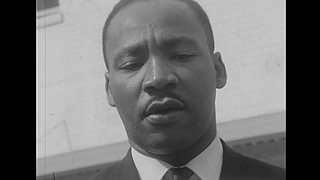
The Great Black March on Washington, led by Pastor Martin Luther KING, on August 28, 1963, gathered 200,000 protesters. This march to demand equal rights between whites and blacks, channeled by federal forces, crosses Washington to arrive at the foot of the Lincoln Memorial with strong banners and signs singing the anthem "We shall overcome!" ("We shall conquer!").
In Moscow, the signing of the partial ban on nuclear testing is a sign of the success of the Soviet Union’s peace policy, approved by Fidel CASTRO. Various plans for a meeting and the signing of the treaty by JF Kennedy’s Secretary of State Dean RUSK, Soviet Foreign Minister Andrei GROMYKO and British Foreign Secretary Alec DOUGLAS-HOME, they shake hands. Plan of USSR Prime Minister Nikita KHROUCHTCHEV addressing the audience.
Commentary by Edouard SABLIER on the partial prohibition treaty for nuclear tests, to which France did not wish to take part. According to him, "The two supergreats now have the absolute weapon, have the means to increase their potential and are at the same time endeavouring to encourage all countries of the world to renounce their own access to atomic power". These remarks are illustrated by images of the signing of the partial prohibition treaty of nuclear tests in Moscow (with US Secretary of State Dean RUSK, British Foreign Minister Alec DOUGLAS-HOME, British Foreign Minister Leonid BREJNEV and Nikita KHROUCHTCHEV) followed by images of ratification by other countries and illustration images.
Interview with Richard NIXON concerning diplomatic relations between France and the United States, in particular on France’s non-accession to the treaty of partial prohibition of nuclear tests recently signed in Moscow. It realizes that France wishes to acquire nuclear force in order to ensure its autonomy but nevertheless considers that it would be desirable for it to adhere to the agreements.
Extract from the press conference of General de GAULLE on 29 July 1963 at the Elysée. He answers questions from journalists about the news of France and the world. Here he comments on the recent Moscow agreements (partial ban on nuclear testing treaty), which he sweeps out of hand by declaring "The Moscow agreement, I say frankly, is of little importance ... If one day the Americans and the Soviets disarm, that is to say if they come to the destruction and prohibition of nuclear means. France will refrain from obtaining them. But it does not seem that we are at the point of getting there."
The United States, Great Britain, and the Soviet Union met in Moscow to sign a treaty restricting nuclear testing. Comment on images of KHROUCHTCHEV welcoming HARRIMAN and Lord HAILSHAM then speaking during a speech.
Averell HARRIMAN, representative of the United States and Quintin Hogg, Baron HAILSHAM, English representative, were greeted in Moscow by Nikita KHROUCHTCHEV for the conference of the three on the cessation of nuclear experiments, for the signing of the partial prohibition treaty on nuclear tests.
A French Jewish couple testifies to his recent life spent in a kibbutz upon his arrival in Israel. The woman regrets this time ("I loved life on the kibbutz, I have the nostalgia, I would have lived there all my life, and I would go back if my husband agreed..."), but the man is much more reserved: "I, I was fed up... I wanted a life of my own, to see my children as I wanted... I had to follow the movement of the kibbutz, eat in the common dining room... All leisure activities were in the grounds of the kibbutz, without the possibility of going out... There were advantages but also disadvantages..."
On the occasion of the first anniversary of Algeria’s independence, Michel PERICARD met with Hocine AIT AHMED (who was one of the leaders of the historic FLN). The latter declares of "Everything goes wrong in Algeria". In favour of political pluralism and democracy, he attributes the silence of the deputies to the fear of the power in place embodied by BEN BELLA. Hocine AIT AHMED reportedly left Algiers the day after the interview granted to "Five columns in the front page".
Subject related to John Fitzgerald KENNEDY’s trip to West Berlin. It is on this occasion that he will speak this phrase that has become famous: "Ich bin ein Berliner"("I am a Berliner").
Interview of a French woman from Algeria in a bookshop on Rue Michelet. She is apostrophied by another Algerian Himoud BRAHIMI, a Muslim who presents himself as a child of the casbah and a man of the theatre. He wants peace in Algeria. She’s afraid of the situation and the attacks. The young Algerian asks him the question: "What makes you want to leave?"
In April 1963, blacks demonstrated in the segregationist city of Birmingham (Alabama), demanding equal rights between blacks and whites. These demonstrations were violently repressed by the police.
As we commemorate the second anniversary of the Bay of Pigs victory at San Antonio de los Banos Air Force Base, the Prime Minister commanding Fidel CASTRO and his brother Raul hand insignia to a group of pilots rising in rank on this day of the revolutionary air force. The commentator echoes the words of Fidel CASTRO’s speech recalling the events of the Bay of Pigs that marked the history of Cuba. In Playa Giron (Baie des Cochons), parade of the battalions of the army of the West and Centre and the militiamen of Battalion 339 of Cienfuegos who participated in the "victorious fight against the enemies of the homeland". Air demonstration, officers, tanks. Resuming the speech of Commander Pedro MIRET by the commentator who recalls that the victory of the Bay of Pigs is the symbol of the fight against imperialism.
On the occasion of the inauguration of a new format of the television news commissioned by the Minister of Information Alain Peyrefitte, Léon Zitrone asks the latter if it is not a "control of the government on the television news". Alain PEYREFITTE justifies his presence on the set and assures that the new formula of the TV news "will mark a progress towards objectivity and depoliticization".
Following testimonies of young Ivorians and French concerning their professional future in Côte d'Ivoire, President HOUPHOUËT BOIGNY evokes through a metaphor, his vision of relations with France.
Testimony of the director of the Abidjan garbage collection company, a Frenchman satisfied with independence. He explains that the purchasing power of Ivorians has increased in the last three years.
The day after independence, Côte d'Ivoire was booming. Its port, the most modern on the west coast of Africa, promotes the circulation of wealth from the country and neighbouring countries. President Felix Houphouët Boigny, founder of the GDR (African Democratic Rally) wishes to make his country "a modern state in cooperation with other African states".
Interview with the director of Côte d'Ivoire’s only agricultural cooperative. He explains that two years after its creation, there are 125 co-operators. They received financial assistance from the government as well as technical assistance.


 The INA Galaxy