Retrospective of the capitulation of the Germans and the signatures of the unconditional capitulation at first in Reims and Berlin two days later in a second time. Archive footage shows the defeat of the Germans. On 8 May 1964, General de Gaulle decorated the tomb of the unknown soldier.
Germaine Tillion testifies to the emotions that passed through him during his deportation. She returns to the feeling of fear: "it is a feeling that reaches you when there is no possible action". It was anger that reigned during those years of imprisonment.
The ethnologist Germaine Tillion testifies to her deportation to the German camp of Ravensbrück. "Night and Fog" is the code name given to prisoners opposing the Third Reich. She explains that she was traumatized for several years when she returned from the camp: "On my return I was disgusted with life...this is the moment where I suffered the most."
Daniel Cordier, an art dealer and historian, was a resistant and a companion of the Liberation in 1944. He recalls his meeting with Jean Moulin in July 1942, and details the organization of the resistance network in Lyon and the link set up with London.
Historian Pierre NORA explains the concept and purpose of the new pocket collection entitled "Collection Archives" of the publisher Julliard: to make available to the average reader the original archival documents and the great unpublished sources used by historians. He takes for example the unpublished Journal written by the anarchist Ravacho -testimony on the misery of the late 19th century- or the Letters of the traffickers to the captain of the ship in charge of the triangular trade.
During a visit to Guyana, General de Gaulle, President of the Republic, delivered a speech in which he did not escape the difficulties of the department and the detachment of France in its regard. He asserts forcefully: "this period is over".
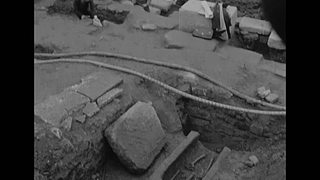
In Limoges, a report on archaeological excavations that uncovered the tomb of Saint Martial of the third century. Many images of discovered graves and skeletons they contained.
Presentation of the new president of the Republic of Togo: Nicolas GRUNITZKY following the assassination of Sylvanus Olympio first president of independent Togo.
Interview of the Togolese ambassador in Paris announcing the visit of the new president of Togo Nicolas Grunitzky and the future relations between France and Togo.
MARQUET interviews Edith RUSSELL, who was a passenger on the Titanic. She tells the adventures of her rescue accompanied by her lucky charm: a little pig.
At his press conference at the Elysée on January 31, 1964, General DE GAULLE announced that France had decided "to place its relations with the People’s Republic of China on a normal, in other words diplomatic level". He recalls that "France was prepared for years to establish regular relations with Beijing" and that "Some economic and cultural exchanges were already practiced".
Prime Minister Georges POMPIDOU makes an official statement from his office of Matignon following the death of President KENNEDY: "Sadness because once again triumphs blind violence... Sadness because a great friendly people is plunged into mourning... Sadness because the free world loses one of its safest guides..."
John Fitzgerald KENNEDY’s coffin arrives at the White House, with his brother Edward, senator, accompanied by his wife. In a living room, the Marines watch over the coffin covered with the American flag (silent subject).
At home, Yves MONTAND, interviewed by Lise ELINA, discusses the reasons for his public political commitments and in particular the consequences for him of his campaign in favour of the Stockholm appeal, a pacifist demonstration against nuclear weapons, but also very ideologically oriented to the left.
Report on the cities around Brasilia by the men who came to build the capital of Brazil. These provisional towns were to disappear when Brasilia would have been able to house their inhabitants. This moment happened but the inhabitants of these hovels refused to leave and won. This "free city" will not disappear. In the same way in Brasilia the old habits have returned and reintroduced disorder...
Reporting in Brasilia, the official capital of Brazil, where civil servants mainly work. The city, which has not yet been completed, is organized into housing groups.
Report dedicated to the Isidor and Ida Strauss Public Primary School, located in the East district of Harlem. It is a kind of test school where Puerto Rican, white and black students receive a good education and rub shoulders without difficulty. The school principal, interviewed in French, says that the question of skin color never arises between black and white children.
Pierre DESGRAUPES, in the screening room, surrounded by Pierre DUMAYET and Pierre LAZAREFF, declares that he censored certain subjects about the Algerian War in "Five columns in the front page" because the images seemed to them to have a too great "shock force" or impact.


 The INA Galaxy