The president of the hotel association of the Arcachon Basin noted a decrease in tourist attendance at the beginning of the 1968 summer season: "There are still places [...] because reservations, especially from foreigners, have been cancelled" following the events of May 68. However, he hopes that tourists will find their way back to the beaches and take advantage of the special rates offered by the region’s hotel industry.
London, Lancaster House. Signing of the Treaty on the Non-Proliferation of Nuclear Weapons in the presence of the British Foreign Minister, Michael STEWART, in the centre, as well as the Russian Ambassador to England, Mikhail SMIRNOVSKY, on the left, and the American ambassador in England, David K. E. BRUCE, on the right.
From 1 July to 15 August 1968, the "gifts to tourists" operation in Gironde was organized by the Trade Union of Initiative. Mr GERARD (?) explains the principle of this operation: tourists will receive a voucher giving them the right to bottles of Bordeaux wine offered by the city. This gift aims to revive the summer tourist season in the region following the events of May 68.
On the French Riviera, the summer tourist season begins with difficulty. The president of the hotel trade union deplores the catastrophic situation in the hotel industry since the strikes last May. According to him, hotels have a filling rate of just 15 to 20%. He hopes the customers will come back but remains for the moment very pessimistic.
Report on the demonstration of May 6 at the Latin Quarter in Paris. Student demonstration following the closure of the universities of Nanterre and Sorbonne on 3 May (silent document).
The population was asked about General de Gaulle’s speech on the events of May 1968 and the holding of a referendum. A sense of disappointment prevails: it is felt that the general expressed himself too late and too softly, without providing answers to the problems.
Occupation of the Sorbonne in Paris and the Odeon theatre: debates in the courtyard, meals in the corridors, discussions in the amphitheatres, debates on creation and freedom of expression multiply.
On Monday, May 6, 1968, Daniel COHN-BENDIT with other students went to sing the International at the convocation to the University Discipline Council. Daniel COHN-BENDIT holds a short improvised speech in front of the entrance of the Sorbonne.
Statement by Daniel COHN-BENDIT in the courtyard of the Sorbonne: "I think this is the first time we see this, that is to say that here, we occupy the Sorbonne!"
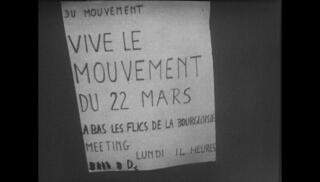
Interview with Daniel COHN-BENDIT, leader of the March 22 Movement, who defines this movement and believes that it is not intended to remain an academic: "It is clear that the March 22 Movement does not want to stay in university, it wants to expand, and try to make a junction in the struggle with the workers or peasants..."
Report of the night known as "the barricades", colour images of the damage to the Latin Quarter: remains of barricades, overturned cars, charred streets, broken windows, ... (silent document).
Interviewed by Jacques POUX, Maurice GRIMAUD, Prefect of Paris Police, took stock from the police prefecture on the day of 3 May when the demonstrators and the police clashed in the Latin Quarter after the announcement of the closure of the faculties of Nanterre and the Sorbonne.
Alain PEYREFITTE, Minister of Education, is interviewed by Yves MOUROUSI. He returns to the intervention of the police forces inside the Sorbonne: "The forces of law and order entered only because the forces of disorder had entered..."
The Panama Canal, an ambitious project by the French entrepreneur Ferdinand de Lesseps that ends in scandal. After the secession of the Colombian province, the Americans took over. Inaugurated in 1914 in the middle of a world war, it resulted from an unfair treaty, ceding to the United States, for life, control of a 13 km area for a very low rent.


 The INA Galaxy