The activist Frédéric Oriach was arrested on the street in Paris while giving an interview to journalists. He was wanted by the police for the Paris bombings and his relationship with Direct Action.
Charles ANDRIEU, former trade union secretary of the chemical industries CGT of the Alpes Maritimes, explains that before 1936 we worked all year. He recounts how paid holidays were born, thanks to the action of the unions: they had at the time 10 working days.
On the occasion of the 44th anniversary of the Hiv Vel Scoop, Annette LERIS, a social worker, assisted women and children. They did not realize the seriousness of the situation, because it was the French police who took them. His testimony is illustrated with photos
Ceremony in Paris, near the Bir-Hakeim bridge, in the presence of Jacques CHIRAC, mayor of Paris, to commemorate the 44th anniversary of the Hiv Velvet Scoop.
Attack in PARIS, at the headquarters of the Brigade for the repression of banditry (BRB ), quay of Gesvres, causing one death, the divisional inspector Basdevant, and many wounded. Commentary on factual images of the rubble and damage caused by the bomb in the premises of the BRB alternating with the interview of witnesses and the reaction of Jacques CHIRAC, on the scene.
Marcel TRILLAT questions Charles PASQUA about his involvement in the Service d'Action Civique, several times implicated in criminal cases. Charles PASQUA first explains his attachment to General de Gaulle "we had a fidelity that confined a little to religion [...] and if we had been asked to be killed for him, we would have done it". He then evokes the recruitment of the SAC within popular circles with "people who are totally committed". With respect to criminal matters, he argues that it is impossible to prove the guilt of a member of the organization.
On 7 May, a fire broke out in a subway station in East Berlin. The West German press reveals that this was not just an accident, a dozen East German citizens would have confiscated an empty trainset to gain the Western network. The way being blocked, the Vopos (guardians of the Wall) reportedly intervened, and as a result of exchanges of gunshots, there would be no survivors today. Comment on illustration images.
At the Hotel Drouot, in Paris, auction of the poster depicting the speech of the historic call of 18 June 1940 of General de Gaulle. Brief in the pictures.
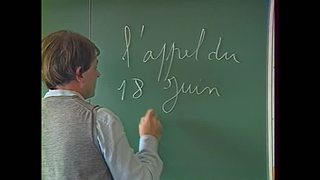
At the request of the Minister of National Education, René MONORY, the text of the call of June 18 of General DE GAULLE is being studied in high schools and colleges. Comment on factual images.
The writer Breyten BREYTENBACH analyses South African politics and criticizes government measures. He talks about the responsibility of the rulers over the current situation of the country and the repression of the power in place.
Driven by Jean-Marie TJIBAOU, a delegation of the FLNKS came to Paris to meet the President of the Republic François MITTERRAND. The comment on images of Jean-Marie TJIBAOU arriving at the Élysée and posing with François MITTERRAND is followed by an excerpt from the press conference of the kanak leader. He states that François MITTERRAND seems ready to get involved in the project of Edgard PISANI, providing for the referendum on self-determination.
Following the discovery of the Titanic, many technological innovations were made. The Robin is a small robot designed to inspect wrecks. It will be connected to the submarine the Nautile and will allow access to places where the submarine cannot enter the wreck of the Titanic.
The historian André KASPI summarizes the history of Palestine in the first half of the 20th century. The division of the Middle East was made between the belligerents, and more particularly between France and England, even before the end of the First World War. It is Great Britain that has the mandate over Palestine after the defeat of the Ottoman Empire. In the Balfour Declaration of November 1917, the British granted Jews "a national home" in Palestine, without specifying what this term covers. This commitment of the United Kingdom is confirmed by the League of Nations. The English strictly limited Jewish immigration to Palestine in 1939, at a time when the extermination of Jews was beginning in Europe. Starting in 1945, the United Nations allowed mass immigration of Jews to Palestine and began to evoke a plan of sharing between the Jewish community and the Arab community.
The historian André KASPI returns on the origin of a Jewish state in Palestine. The Zionist movement began in 1895 when Theodor Herzl wrote "The Jewish State". Having seen the deterioration of the condition of Jews in Western countries, the Austrian journalist believes that they need a state to protect them. At the end of the 19th century, this position was only shared by a minority of Jews, but the Zionist movement began to organize.
SOS Racisme organizes an anti-Apartheid day in Nantes with conferences and shows to fight Apartheid in South Africa. Jean Pierre RICHARD, national president of the anti apartheid movement is interviewed.
An Afrikaner farmer from Transvaal who employs 160 blacks on his tobacco plantations, Willy VAN LANDESBERG, speaks about the Apartheid regime. He explains that he works with "primitive" people and says he is very angry with Ronald REAGAN and the UN who allow themselves to tell him what he should do with them. For him, these laws allow each ethnic group to "live its religion and traditions separately".
Report on the history of the establishment of the Guiana Space Center in Kourou in French Guiana and the launch of various rockets, probes, balloons and satellites since 1968. Discussion of investments for future launches, notably Ariane rockets.
At Croisic, a former military man, Bernard Sourisseau, is accused of having acted for years on behalf of the KGB. He seems to have informed the Soviet Union for years about the manoeuvres of the French submarines. Interview with Marcel Le COSSEC, fisherman, saying he was very surprised.
Philippe Caloni interviews Abbé Pierre, Henri Grouès, French Catholic priest of the Order of Friars Minor Capuchin. He returns to his activity of resistance during the Second World War, when he made cross the border to persecuted and his actions in the maquis.


 The INA Galaxy