Interview of the director Frédéric ROSSIF about his film "La fête sauvage" which he calls "a wild opera with animals" and which he gives the main themes: love, dream and death.
Laurent TERZIEFF talks about the actor’s relationship with the audience in the theatre and the importance of having fun for oneself, as a child, in the cinema.
The writer and academician Joseph KESSEL expresses himself on speed: Is it important for man to go fast? Today, it is often important to go fast, but he notes that one traveled just as much but in fewer and better numbers when there were only boats or planes of smaller size, human size.
Small self-portrait of Claude SAUTET, who in a few minutes tries to define who he is, at least to give some leads on what makes his current concern. Filmed at home in the Gobelins district of Paris where he has lived for more than twenty years, he says (in voice-over) that he does not like talking about himself or what he does, that he prefers to listen to others. He looks back at the change in this popular neighbourhood that he loves and sees the change because of rising rents. A great music lover, he puts on a record of classical music and lights a cigarette.
Interview with Marie Madeleine PEYRONNET, governess of Alexandra DAVID-NEEL who was the first woman to return to Tibet. His housekeeper talks about his archives and his house, views of his house and travel memories.
Jean FERRAT answers questions from Jacques CHANCEL. He says he is "sympathetic to communism", and confides in living his activism through song and municipal activities. However, he is not against the idea of joining the Communist Party one day. He also claims to be tolerant, especially for the poor, by quoting one of his songs and calling for free expression for all, especially in the artistic fields.
Françoise DOLTO explains how important the role of the mother is for the well-being of the future adult child. The first nurse, whether she is the real mother or an adopted mother, is the mediator for the whole society. She is a mother in the full sense of the word when she loves the father of her child and when she loves her child not as a doll, as an extension of herself, but as a future person to whom she speaks.
Tunisian President Habib BOURGUIBA, who has been in power for nearly 20 years, and who was re-elected the previous year with a clean score of 99.98% of the vote, calls the political opposition in his country "childish" and "small microbes without any kind of importance".
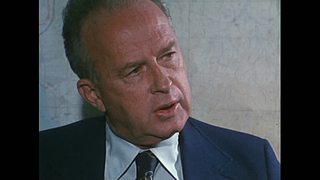
Interview with Yitzhak RABIN, Prime Minister of Israel. He evokes the threat of Islamization that weighs on Lebanon and the lack of reactions of the leaders of the Christian world. Faced with this attitude, he reaffirmed Israel’s desire to be a strong Jewish state.
Alice SAPRITCH tries the song, she records a record entitled "Alice Sapritch à nu". Report in the studio where the actress records "Les hommes sont des poupées", "C'est le charme" and "Alice Twist" and tries a vocalise. Interview with Alice SAPRITCH and her producer Hubert BAILLY about the difficulty of learning to sing.
Georges BRASSENS and Maxime LE FORESTIER evoke the first singers accompanying each other on guitar. Georges BRASSENS quotes Tino Rossi as one of the precursors in the matter which causes the general hilarity on the set. Maxime LE FORESTIER speaks of guitarist Barthélémy Rosso as one of his models.
Michel BOUQUET evokes his mother, in love with the theatre that took him to the French and to the Opera Comique, releases probably at the origin of a vocation. He then talks about his meeting with Maurice Escande.
Interviewed at home, cartoonist Claire BRETECHER evokes her aggressive image, her anguishing feeling of being in fashion in a fleeting way. " I feel like a gadget," she says.
At his home in Saint-Savin de Blaye (Gironde), Michel HIDALGO talks about how he intends to take up the position of coach of the French team that has just been awarded to him. A man of dialogue, he is putting forward a collective project. We see him training and cycling.


 The INA Galaxy