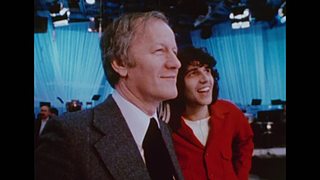
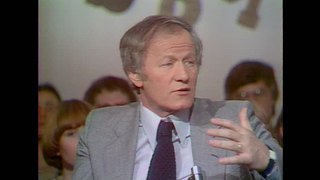
Interview of Michel AUDIARD explaining that he stopped drinking alcohol because he had noticed that he was rambling. Antoine BLONDIN, who is present on the set, explains that he continues to talk about his past as an alcoholic.
On the occasion of his presence at the Cannes Film Festival for his role in the film "Freedom road", Mohamed ALI (vo trad off) gives his definition of humor, "it’s me!" , explains that he can be mean sometimes, then to the question "are you as good an actor on the screen as on a ring", he says he is better on the screen and imitates Dracula.
Interviewed by Michel DRUCKER, Louis MALLE tells the story of his film "La Petite" which was inspired by the life of the American photographer Ernest J. Bellocq and by a historical book about New Orleans and the Storyville district. He is surrounded by two actors in the film, the very young Brooke Shields and Keith Carradine.
Interviewed by Louis BERIOT, Michel HIDALGO, coach of the French team, speaks about the discussion that took place within the French team on playing the next World Cup in Argentina, a country led by a military dictatorship. He says there was a discussion, but no debate, and that the French team has already played in countries with political regimes "that do not correspond to ours."
Interviewed by Bernard PIVOT about his book "La nuit, le jour et tous les autres nuits", Michel AUDIARD talks about his old beliefs, cemeteries, death and forgetfulness. He also spoke of the difficulty of writing.
Interviewed by Bernard PIVOT about his book "La nuit, le jour et tous les autres nuits", Michel AUDIARD evokes the death of his son who is the only reason he wrote this novel.
Interview of RENAUD during a report in a vacant lot and a bistro in which he goes with DOMINIQUE Lanvin, his partner and future mother of his daughter. RENAUD thinks it is appreciated by young urban people because it tells stories and situations they know and it speaks the same language as them. The bistro is his "second home"; according to him it is a privileged place of communication for young people, "where everything happens (...) the place where you remake the world and where you dream"
Interviewed near his home, in Carmel, California, Clint EASTWOOD tells his first role in the film "Revenge of the Creature", where he plays the role of a laboratory technician.
Jacques Chancel retraces his career and explains what attracted him to journalism. His long stay in Asia helped him to shape his approach and interest in men more than systems. Just as there are newspapers, according to him there are 'televisions'. For him, it is about offering a television that is both interesting and unexpected for the viewer.
On stage, during a debate on child prostitution, the writer Gabriel MATZNEFF, in the presence of a commissioner in the Juvenile Brigade, relativizes the problem by making the distinction between tariffed relations and "sincere love" between a child and an adult... " What is wrong is love without love, caresses without tenderness... But with love, there can be something very beautiful between a 15-year-old girl and an older man."
On the occasion of the release of his book "L'évangile au risque de la psychanalyse", Françoise DOLTO is asked by Bernard PIVOT about his relationship with the Christian faith. She says she is astonished by the atheists who have the merit, according to her, of having certainties. Françoise DOLTO describes how her recent reading of the Gospel reminded her how Christ embodies a "path of desire" close to the object studied in psychoanalysis.
Interview of singer Alain SOUCHON after his time at the Elysée Montmartre in Paris: he evokes the beginnings of his career and his song "J'ai dix ans".
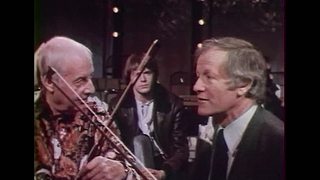
Behind the scenes of the "Grand échiquier", Jacques CHANCEL takes care of the final preparations for his show with his guest, the violinist, Stéphane GRAPPELLI.
Excerpt from the speech at the meeting forum in Le Havre (Seine-Maritime) by Gisèle HALIMI, lawyer, president of "Choisir", which evokes the goals of the creation of this feminist movement.
The journalist and television man Jacques Chancel explains to Bernard Pivot the intention behind his book "Le temps d'un regard", a collection of highlights and impressions left by his encounters and experiences. The book will remain as the first volume of a series that the author will later describe as a diary, started at the age of 14.


 The INA Galaxy