The Dalai Lama, Tenzin GYATSO, recalls the sentence of President Mao: "Power is at the end of the rifle". I think it’s a narrow view of history, he says, because the real power is in the heart, in the soul of people, in their determination... Images of the religious ceremony of the offerings.
Asked about the possibility of returning to Tibet, DALAÏ LAMA expressed its reservations about the real intentions of the Chinese authorities regarding the occupation of his country, and the Tibetan exiles.
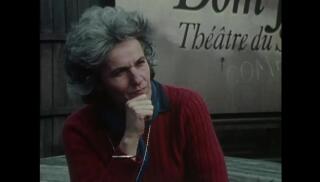
Before his first visit to a large Parisian hall (Le Théatre de la ville), singer RENAUD presents himself during an interview at the bar counter. He expresses his identity and his origins, speaks of his academic failure with humour ("I continued my studies running around the court and I did not catch up with them"), of his first jobs to pay the credits of his first motorcycles and, "bring home the paycheck so we don’t empty it". He wrote his first songs in 1968.
Simone VEIL refutes the comparison between genocide in the camps during the Second World War and the prisoner camps that exist today in other totalitarian countries.
Interview with Vittorio Gassman’s wife, Diletta, who evokes their couple and the difficult character of her husband. He’s not boring, but "he’s very mean sometimes". Image of Diletta cooking and the couple talking.
Vittorio GASSMAN evokes the profession of actor. " At the base of the actor, there is a mad desire to be loved, to be recognized, to be for a brief moment... the center of the world. Without egocentrism there is no actor."
Vittorio GASSMAN evokes the film of Dino Risi "The Fanfaron" (Il sorpasso), which he describes as a "very sincere portrait of euphoric Italy of the 60s", with "a prediction that this euphoria was not intended to last long".
Pierre SCHAEFFER, pioneer of concrete music and electroacoustic expression, makes an experiment with a bell in each hand to make hear the resonance of objects in order to integrate them into musical works.
Pierre SCHAEFFER, pioneer of concrete music and electroacoustic expression, exposes his research on new sound materials and the functioning of "composing machines". It shows how the machine can amplify and release the sound energy of a small bell or match.
Pierre SCHAEFFER, pioneer of concrete music and electroacoustic expression, exposes his research on sound perception by making a demonstration at the piano.
Louis de FUNES en gendarme, speaks of his mother, interviewed by Michel DRUCKER, on stage, in public: "It was Raimu but even stronger", of a Spanish temperament of fire, with huge anger, of perfect bad faith, liar. This is where he drew his inspiration. Anecdote with a Spanish factor. Presence of Michel GALABRU.
Meeting in a tea room, Éric ROHMER, Fabrice LUCHINI and the actresses of the film "Perceval le Gallois", including Arielle DOMBASLE and Béatrice ROMAND, talk about the film. Fabrice LUCHINI explains that it is not necessary to reveal everything to make a scene attractive. Éric ROHMER defines his film "Perceval le Gallois".
Interview of Éric ROHMER in a tea room, surrounded by Fabrice LUCHINI and the actresses of the film "Perceval le Gallois", including Arielle DOMBASLE, Béatrice ROMAND and Pascale OGIER. He explains the choice of the actors of the film. He was looking for physics corresponding to the criteria of beauty of the Middle Ages. Fabrice LUCHINI jokes about the gestures of medieval miniatures. Éric ROHMER criticizes the gestures of historical films.
Michel DRUCKER asks Sylvie VARTAN if living with Johnny is easy. She answers that living as a couple is not an easy thing. Michel DRUCKER says that he is a man who has a "Heart of Gold". A feeling shared by Sylvie VARTAN and Gérard DEPARDIEU.
Referring to the song written for Julien Clerc "L'assassin assassiné", Jean Loup DABADIE evokes the difficult freedom of expression in the artistic milieu.


 The INA Galaxy