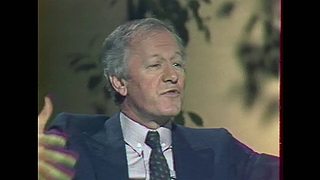
Elisabeth BADINTER talks about her historical research and questions the silence that exists about mother-daughter relationships in the 17th and 18th century.
Asked by France ROCHE, Claude BERRI explains that "cinema suffers from lack of ambition" and hopes that his film will allow to emerge more "financially complicated" films, which do not see the light of day for fear of taking too many risks.
First part of Johnny HALLYDAY’s show at the Paris Pavilion at the Portes de Pantin in November 1979. Johnny HALLYDAY, in a futuristic combination, sings "My Face" accompanied by his musicians.
Report on Daniel BALAVOINE at his high school in Pau, at his friend’s doctor and bowling alley. The images of BALAVOINE alternate with the interviews of his sports teacher, a school friend and his father.
Evelyne SULLEROT questions Milan KUNDERA on the "lack of confidence in her own culture in Western Europe". Milan KUNDERA prefers to speak of "decadence" and "lack of vitality".
Anny DUPEREY and Bernard GIRAUDEAU repeat a dance step for their musical "Attention fragile". Interview of the couple about the difficulty of showing the show, their complicity and their mutual demands. Interview interspersed with three short excerpts from the rehearsal of their musical: they sing as a duo and perform a few steps of dance.
On the occasion of the publication of her latest book, "Le temps Chanel", Edmonde CHARLES-ROUX explains to Bernard PIVOT why this is the second time she has written about Gabrielle Chanel. She evokes this unusual personality and tells why she was nicknamed Coco.
Questioned by Jacqueline Alexandre, Jacques Chancel explains his intention behind his cultural programs that give to discover artists and personalities to the viewers, without worrying about the notoriety of the guests. He does not see himself as a presenter but as a journalist who wishes to share what he loves above all.
Bertrand BLIER, about the film Buffet froid: a film on fear, where the characters are afraid of everything: loneliness, doors that creak, their own shadow... and which end up triggering a succession of "colds". We laugh around Jean CARMET, who defends himself from interpreting the most cowardly character.
On the set of Michel DRUCKER, Bertrand BLIER, together with his father, Bernard BLIER, evokes his childhood memories. " There was no talk of cinema at all," he confided. Then he evoked the film "Quai des orfèvres" in which his father most impressed him.
The images of the Prague trial, during which Vaclav HAVEL and his friends were condemned, will never exist. Thus, with the participation of the association AIDA, the troupe of the theatre of the sun, directed by Ariane MNOUCHKINE, staged the reconstitution of the first Prague trial at the Cartoucherie de Vincennes, under the title "Pour Havel". Different extracts from the play. Interview with Patrice CHEREAU who explains what he saw in Prague and how the reconstitution could be possible
An interview with Micheline PRESLE about Jacques DAVILA’s film, "Some news" to which she says she is particularly attached, he had designed it for her from the outset. She tells the plot of the film, which she considers as a "women’s film".
Woody ALLEN answers several questions about his personality (his lack of diploma, special talent, his taste for music) and talks about his latest film, "Manhattan", which he believes is more a "comedy drama as a comedy with dramatic elements".
Regarding the gifts given to Valéry GISCARD D'ESTAING during his presidential term (including "the diamonds" of Bokassa), the President of the Republic states that everything was donated to charity. He concludes with this short sentence: "Let the low things die of their own poison".


 The INA Galaxy