Report on Lech WALESA, leader of the Solidarity union, before the parliamentary elections on 4 June. Addressed by journalists outside his home, he refuses to be interviewed. The report continues during one of his meetings in a small town 40 km from Gdansk.
Bertrand BLIER expresses himself on the theme of television in front of cinema. He feels little concerned by this problem, although solidarity. According to him, all creation must fend for itself, and do not think that we live in a time when the creators are cursed.
Faced with Frédéric MITTERRAND, Farah PAHLAVI points out the shortcomings of the Islamic republic in place since 1979: summarily executed, mischief of the war against Iraq, increase of the unemployment rate and poverty, exiles, explosion of demographics, rise of terrorism. She deplores the obscurantism of this regime.
Asked by Frédéric MITTERRAND, Farah PAHLAVI describes oil as a double-edged resource that allowed Iran to start its development race but, at the same time, attracted lusts.
Comment on pictures of Lech Walesa on his arrival in Strasbourg. The leader of the Solidarity union is to receive the European Human Rights Award at the Council of Europe. In an interview Lech Walesa explains that his country has become more democratic and that he now wants to join Europe.
Faced with Frédéric MITTERRAND, Farah PAHALAVI explains that if the criticism was so harsh towards her husband the Shah of Iran, it was because he had made his country a powerful state. She confesses with great emotion that she has always loved him, especially because he allowed the independence of his country.
Marthe Mercradier receives, on behalf of the troupe, the Molière for the best comedy show for La Présidente, which the actress, Roland Giraud and Jean-Pierre Darras dedicate to Jean-Michel Rouzière.
Report on the shooting of Bertrand BLIER’s movie "Trop belle pour toi", with Gérard DEPARDIEU, Carole BOUQUET and Josiane BALASKO. Repetition of the scene "How can one abandon a beautiful woman like that?" in a friendly atmosphere, and dialogue between the actors and the director. Off comment by Gérard DEPARDIEU on the relationship between filmmakers and actors.
Elisabeth Badinter evokes the importance of the writings of Louise d'Epinay, woman of French letters of the 18th century, friend of Jean Jacques Rousseau, Grimm and Voltaire, and in particular of her book "Les contre confessions ou Histoire de Madame de Montbrillant", kind of "Nouvelle Héloïse" written from the point of view of a woman, describing and testifying to the modernity of the life of"a woman of her social class with reflections on the education of girls, the organization of balls, from a sociological, philosophical and historical point of view.
Twentieth anniversary of the departure of the presidency of the Republic of Charles de GAULLE after the failure of the referendum of 27 April 1969. Comment on archive images.
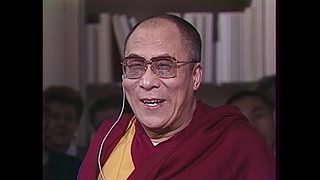
To the question of Bernard PIVOT on the laughter and the perpetual smile that he wears despite the difficult situation that is his, the DALAI LAMA responds with an Indian saying.
The President of the Constitutional Council evokes the Chinese occupation of Tibet to highlight the remarkable non-violent resistance of the Tibetan people. For him it is an exemplary approach that will bear fruit. Then he talks about the situation in Tibet with the support of Amnesty International’s report to denounce mass arrests and torture and repression.
To Bernard PIVOT’s question about the possible reincarnation of the Dalai Lama in a little girl, the 14th DALAÏ LAMA explains that it is possible, and that this has already happened for other lamas.
Bernard PIVOT questions DALAÏ LAMA on the media he has known since his exile. He develops his message of tolerance and understanding towards all civilizations to explain his openness to the world.
Interviewed by Bernard PIVOT, DALAÏ LAMA explains his enthronement at the age of 5 and the enthusiasm he felt for the idea of going up to the capital Lhasa.
DALAI LAMA, the Tibetan spiritual leader, is on a private visit to Paris. He did not comment on the situation in China, his major concern being the Chinese occupation of Tibet. Excerpt from his press conference, in which he talks about his influence and his inner peace.


 The INA Galaxy