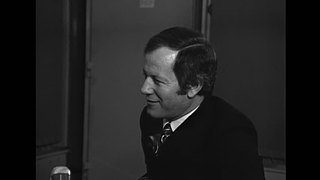
Jean SEBERG, talks about the film "Kill", directed by her husband Romain Gary, whose main topic is the harms of drugs. She recalls how dear this theme is to her husband, who has witnessed tragedies directly related to drugs in her surroundings. She goes on to describe in a very dark way the drug problem in the United States, which also affects children.
Interview with Jacques TATI where he explains that in his films, his goal is not to criticize modern architecture but to talk about how it is used: "the important thing is to defend the individual". " I don’t see why we should demolish a very beautiful city to build a city that may be much more practical but will have lost all its charm";
In this interview conducted in New York in December 1971 by Jean-François VALLEE and translated by Patrice BLANC FRANCARD, John LENNON evokes the Beatles. He ends up declaring in French "Les Beatles sont morts".
Roland BARTHES, professor at the Ecole Pratique des Hautes Etudes, defines himself as a linguist and amateur sociologist. He evokes his new activities: drawing and painting.
Michel POLNAREFF talks about his sexuality and claims that he is not homosexual. Interview interspersed by a very (very) brief excerpt from the song "Je suis un homme". The singer says that one day he will be tired and that he will probably lose his calm before the accusations of homosexuality: "I am very, very nervous... When I am called a faggot... One day, for sure, it will go away..."
In their restaurant, the TROISGROS brothers welcome Japanese apprentice cooks. Acette occasion Pierre TROISGROS talks about the influence of French cuisine in the land of the rising sun.
Régine confesses to liking clothes. She talks about her childish embarrassment of having been dressed with those of others and in repercussions only makes donations of new clothes.
Speaking to Jacques Locquin, Jacques Chancel looks back at his beginnings while he was a reporter in Asia for Paris Match and RTF He mentions his journalistic fibre and his preference for radio.
Delphine SEYRIG, actress, expresses her admiration for women’s rights movements. She thinks that in the movies, it’s time for women to talk about themselves and not for men to talk about them.
Following the announcement of the bill on filiation, Etienne MOUGEOTTE leads a debate in the form of a trial. Françoise DOLTO on the set speaks in front of Maître COURNOT who thinks that the vote of this law risks causing trouble for legitimate children. The psychoanalyst defends the rights of the adulterous child who, like every child, needs the recognition of both parents.
On the occasion of his return to the theatre in the play "Oscar", Louis DE FUNES evokes his gift for comedy, his ability to observe and recall scenes of daily life for a comic effect on stage.
The camera follows singer Marcel Amont flying a plane over the Castellet in the Var. Passionate about aviation, he confides "I am convinced of the benefits of aviation".
Interviewed by Pierre WIEHN, Marcel AMONT defends himself of being a committed singer, then explains that having a communist father and a practising Christian mother, gave him the habit of tolerance. " But there are people I will never work for,' he stresses.
During the inauguration of an exhibition dedicated to PICASSO at the Louvre, President Georges POMPIDOU gives his vision on the Spanish artist that he compares to a volcano, and defines it as a "perpetual creator".
Interview of Michel AUDIARD by Guy BEART about the streets of Paris and the authors of the street. Michel AUDIARD explains that he only knows the 14th district, his original district. He quotes some of the writers he likes to describe Paris: Victor Hugo, Honoré de Balzac, Céline, Louis Aragon, Georges Simenon, and René Fallet.


 The INA Galaxy