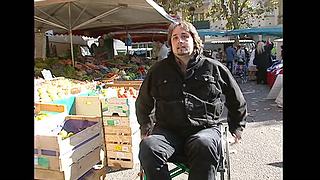
Meeting in Marseilles with Marie-Jeanne ROBINEAU (Syndicat national Psychologues), psychologist for 20 years, who evokes the lack of psychologists in society, and their lack of recognition and usefulness, whereas many evils could be treated by speech and listening instead of taking various medicines, provided that they have an official status which protects the patient from the dangers and excesses of swindlers of the profession... Comment on factual images and interview of the interested party.
Experts gathered in Toulouse to appeal to local maternity and elected officials to treat stillborn children with greater dignity. Indeed, parents who lose a child a few months pregnant, need to talk about this loss as a real death.
The campaign of vaccination against meningitis continues in a part of the Puy de Dôme and concerns only the age range from two months to twenty years. While some pediatricians question the usefulness of vaccinating toddlers, the authorities do not express any doubt. Reassuring for some and worrying for others the vaccination against meningitis C raises many questions about the possible negative consequences of such vaccination. Interview of Laurence LEMONIER (nurse) with her baby in the pediatrician. She believes it is not innocuous to vaccinate a baby and that caution is required to avoid unnecessary vaccination. Interview with Dr Geneviève CHEREAU, a pediatrician who will not carry out this vaccination because of the immaturity of the immune system of children before the age of 4. She questions a possible link between the development of allergies and autoimmune diseases and intense vaccination. It also points to the presence of aluminum hydroxide in the composition of vaccines as a potential risk. He is concerned about the cumulative doses, especially since the Ministry of Health’s Institute of Health has conducted an epidemiological investigation which identifies this adjuvant as responsible for a disabling muscle disease. Interview with Professor André LABBE, head of the pediatric department of the CHU de Clermont-Ferrand: many vaccines do not contain any, therefore, there is no cumulative risk and the quantities are too small to cause short- or long-term consequences. The French health safety agency considers the tolerance to this vaccine satisfactory. Serious adverse events represent one in 22,000 cases
Report. News of the first graft of both hands. Denis CHATELIER was operated on just two years ago. In front of the press today he said he had regained an almost normal sensibility. Commentary on images of the press conference by Denis CHATELIER alternating with interviews with Professor Jean Michel DUBERNARD (Edouard Herriot Lyon hospital) and Denis CHATELIER.
In 2002 general practitioners wanted their fees to be increased. Negotiations between the doctors' unions and the CNAM were to be tough. Some doctors threatened to become disillusioned and freely fix the amount of the consultations. Meeting with general practitioner Vincent Laustriat, who for the first time devised to go on strike. In his office, Dr.Laustriat receives a patient in consultation. Interviewed he explains: "...since I exercise I never have a longer duration without increase without revaluation, so it is legitimate that it is revaluated..."
From now on, the morning after pill will be delivered free to minors in pharmacies. It is an emergency treatment, to be taken within 48 hours, for young women who have had unprotected sex and who fear to be pregnant
An update on the influenza epidemic in France. Commentary on factual images and interviews Doctor Marcel DADOIT (general practitioner), his medical secretary, and Cécile VILLEPRAND (pharmacist).
A report written by economists of the World Health Organization (WHO) has been submitted to the Minister of Health, Bernard Kouchner, with innovative conclusions concerning developing countries: it is not economic progress that will allow the development of a health policy, but a health policy that will allow economic progress. Images of hospitals, patients, condom distribution in Africa, one of the countries most affected by the major types of most widespread diseases, infectious diseases, infants, malnutrition and smoking, alternate with infographics and interviews from the Director-General of WHO, Dr. Gro Harlem BRUNTLAN and Jeffrey D. SACHS. The Director-General of WHO explains that to help these countries develop economically, the additional investment cost in health per person would be minimal compared to the wealth produced. Jeffrey D. SACHS, an economist from Harvard Cambridge University, adds that when disease weighs on a society, the political and economic system collapses, leading to violence, war, and even terrorism.
A report devoted to the daily life of a disabled child in the midst of his family. The commentary on factual images alternates with interviews with her parents. [Source: Prompter France 2] Question: What do stakeholders think?... Here is the example of a family where the eldest, aged 16, has Down syndrome.... For them, the Perruche decision is simply dangerous... Report, Laetitia LEGENDRE and Maya EL-HUSNI
On the eve of the World AIDS Day, an overview of the disease in France. Interviews with Professor Willy ROZELBAUM, and Thierry LESELLIER, Head of Communication Sida Info Service, about the relaxation of prevention and an increase of disease in precarious populations.
Diabetes affects more than three million French people and an additional 800,000 undiagnosed diabetics. Every week, a specialized department at Salpêtrière Hospital welcomes dozens of patients to teach them about preventive actions. Overview of measuring devices. Testimony of Colette HERVIOU, diabetics. Interviews with Dr Claude SACHON, diabetologist, and Professor André GRIMALDI, from La Pitié-Salpêtrière.
Meeting in Nice (Alpes-Maritimes) with Christophe Mazza, a paraplegic person, who talks about the low coverage of disability costs, particularly the cost of a wheelchair and the adaptation of a motor vehicle.
Report devoted to a first medical: remote operation between New York and Strasbourg thanks to a robot. Testimony of the patient who was operated on with the gallbladder and interview of Professor Jacques MARESCAUX, surgeon at the CHU de Strasbourg. Alternating testimonies and factual images of the operation. Interview with Professor Jacques MARESCAUX, surgeon at the CHU de Strasbourg.
A Strasbourg surgeon went to New York to remotely operate a 68-year-old patient hospitalized in Strasbourg. Comment on images of the operation alternating with the interview of Jacques MARESCAUX, surgeon at the CHU de Strasbourg.
Presentation of neurological sequelae caused by a stroke. Interview with Professor Mathieu ZUBER, from the Department of Neurology at the Sainte-Anne Hospital in Paris.
A retrospective on the discovery of AIDS since the first cases reported on 5 June 1981 in the United States, just twenty years ago. Overview of the epidemic. Commentary on archival, illustration and infographic images alternating with an interview with Dr Gilles PIALOUX, Department of Infectious and Tropical Diseases, Rothschild Hospital, and a micro-sidewalk of young people.
On the occasion of World No Tobacco Day, a report on the dangers of passive smoking, which has caused many victims. Illustration images around this dangerously deadly incivility and interviews with Robert LE CAM, president of the association "Rights of non-smokers", Jocelyne SOUISSI, mother of a young asthmatic and Professor Alain GRIMFELD, paediatrician pulmonologist at the asthma center of the Trousseau hospital.
The Observatoire Régional de la Santé is conducting a study in the Bouches du Rhône to understand the epidemic of Q fever around Etang de Berre. Didier RAOULT, professor at the Faculty of Medicine of Marseilles and reference centre for France and Europe, is interviewed on this epidemic which can go unnoticed in humans but which can also generate fever, hepatitis or meningitis and have serious consequences in people at risk, such as pregnant women or heart patients.
François works as a midwife at the maternity ward of the Croix-Rousse hospital. Five men worked in this profession in Lyon, 80 in France for every 15,000 women. At the beginning of his career, he struggled to find a position in the hospital, as many department heads were suspicious of men giving birth. He thinks that the fact that the profession has long been exclusively female has served the profession. Occupational inequalities between men and women, both in pay and in the distribution of responsibilities, tend to change, but very slowly. The problem of the status of midwives, whatever their gender, remains the main demand of striking practitioners.


 The INA Galaxy