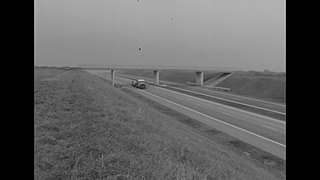
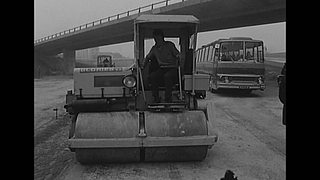
Survey on the economic underbelly of the French motorway network, with the State using private companies for construction and operation, with in particular the appearance of tolls in the 1970s. In 2006, the government of the day decided to sell its remaining shares in the highway companies to private companies. Gain of the operation: 15 billion euros and exchange of the disposal of infrastructure. Archive images and excerpt from a television news of July 18, 2005. Interview in Tinqueux (Marne) by Jean-Stéphane Méra, trade union representative UNSA SANEF, who talks about the significant reductions in the number of employees in the motorway company in recent years.
Continuation of the survey on the economic underbelly of the operation of the French motorway network. In ten years, tolls have risen twice as fast as inflation, for example on the Paris-Strasbourg section. This situation prompted some public authorities, notably the Autorité de la concurrence, to look into this matter. Example in the Ardennes of a free motorway under construction, the A34 connecting Brussels to Charleville-Mézières, supported by the public authorities because not profitable enough for private investors at the moment. A parliamentary report on the subject is expected before next summer. Interviews of Marc Jeansou, 40 Million motorists, which highlights the profitability of private motorway companies; Olivier Faure, Member of Parliament for Seine-et-Marne, who wants more transparency in the tariffs and calls for tenders applied as well as a return on investment for the State; and Bruno Levasseur, Director of Roads and Infrastructures of the Ardennes General Council.
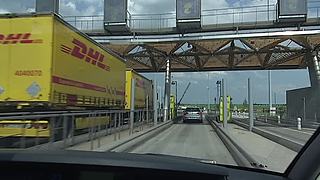
On the A1 motorway, on the eve of the great cross-country drive of holidaymakers on August 15, several businesses intervene to ensure the safety of motorists. Léa RAHBAN is a radio host on Radio 107.7, which broadcasts information about traffic conditions from Senlis. Philippe AUCLAIR, SANEF patrol boat, constantly monitors the state of the roads to limit the risk of accidents. And at the Chamant toll booth, the largest in France, agents are always ready to assist users to ensure traffic flow.
The privatization of French motorways, which is expected to bring in more than €10 billion, raises a political debate. Interviews and reactions of Annick LEPETIT, spokesman of the PS, François BAYROU, president of the UDF, and Luc CHATEL, spokesman of the UMP.
The privatization of the Autoroutes de France begins next Monday. Candidates will submit their bids to the Ministry of Finance, but only institutional investors can apply. This privatization will allow the State to recover at least 10 billion euros earmarked for deleveraging. Commentary alternating with the interview of François CHAULET, analyst at "Montsegur Finance".
The government is giving up its shares in the highways. The announcement had already been made, but the procedure is starting this morning. It will be tendered. A privatization that could bring 11 billion euros.
This day is officially launched the privatization procedure of the 3 main motorway companies. The State thus offers itself a cash inflow estimated at 11 billion euros. But there are questions to be asked, and in particular, for users, the question of the consequences of tolls already considered to be far too high. Commentary on factual images, micro-sidewalk of motorists and interviews Thierry BRETON, Minister of Economy and Finance, and Michel SAVY, professor at the Ecole Nationale des Ponts et Chaussées.
While the public authorities are beginning to reconsider the policy of the "all highway", the question arises of how to finance these expensive infrastructures. Example with a project of section of the A51 motorway planned to connect Grenoble to Sisteron, with the explanation of the financing of this type of project. Interviews with Gérard Leras, farmer and spokesman of the Greens (Isère), Bernard Ménasseyre, President of the 7th Chamber of the Court of Auditors, and Patrick Gandil, of the Directorate of Roads at the Ministry of Equipment.
This morning, demonstrators distributed leaflets at the tolls of Saint-Isidore, Villeneuve-Loubet, Cagnes-sur-Mer and Antibes (Alpes Maritimes) demanding the free A8 motorway granted for forty years to the company ESCOTA instead of the initial thirty years. Testimonies of motorists and interviews with Christian Razeau, association Quartiers de Nice, and Hubert Maillant, general manager of the company ESCOTA.
The rest area of Assevillers, on the A1 in the Somme, includes several restaurants. Serge MONCEAU, area manager, gives the attendance figures, employee headcount and talks about the diversity of clients. One of them explains that he sometimes sets up his business appointments in the restaurant on the side of the highway.
Saint-Arnoult-en-Yvelines has become one of the largest tolls in Europe. In ten years the traffic has doubled. After several months of work, the inauguration of the new commissioning, with a new architecture, a widening of the lanes and more cabins. Interview with Patrick ROGER, Cofiroute toll management manager, who hopes to absorb nearly 7,500 vehicles per hour.
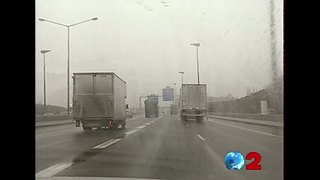
The A1 motorway is the busiest and most dangerous in France. A motorist advises to drive slower to avoid accidents. Heavy vehicle traffic is particularly implicated; some truck drivers interviewed are aware of the risks, especially in foggy weather. Captain COIRIER, from the CRS of the A1, recalled the safety instructions.
The regional council of Nord-Pas-de-Calais is innovating in terms of road safety. On the A1 motorway, "Drive with music" cassettes are offered to drivers crossing the toll of Fresnes-lès-Montauban in the Pas-de-Calais. Michel DELEBARRE, Minister of Transport, explains the objective of this operation: to urge motorists and truck drivers to drive carefully.
Five state-controlled mixed economy companies manage most of the French motorway network and are obliged to reinvest any profits in the construction of new infrastructure. Unlike the five private companies that manage the rest of the network. Interview with Henri Cyna, CEO of Cofiroute.
Survey on motorways, from the place of the State and the Ministry of Transport to the role of concessionary enterprises. The cost of building and operating these infrastructures is mentioned, with reference to the law passed in 1955 and the 1970 law establishing motorway tolls. Interview with Mr. Germain, Director General of the SAPRR, who explains the major construction sites (earthworks, pavements...).
Survey on motorways, with the place occupied by the State and by the Ministry of Transport, as well as by concessionary companies. Interviews with Henri Cyna, Managing Director of Cofiroute, who refers the responsibility for tolls to the governments that have defined the French motorway model; It also stresses the budget that it would represent for the State if it managed these infrastructures directly. Mr. Germain, Director General of the SAPRR, explains the role and importance of the toll that will allow the motorway companies mainly to repay the financial and banking debt to the investors and, for the rest, to finance the operation of the road network.
Albin CHALANDON, Minister of Equipment and Housing, signs the concession allowing a private group to build new motorways. These new lanes are supposed to be toll only for 35 years, until the private company has repaid itself.
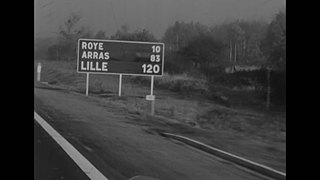
The A1 motorway is open to traffic from today between Paris and Lille. Mr. LEILI, from the Société des autoroutes du Nord de la France, retraces the main stages of its construction started in 1964, lists the departments crossed, the works of art built and the main difficulties that had to be overcome.
A few days before the inauguration of the Autoroute du Nord, which will link Paris to Lille, Pierre DECOSTER, president of the Chamber of Commerce and Industry of Lille, Roubaix, Tourcoing, talks about the economic benefits brought by this new axis of communication for the whole region.
Personalities, technicians and journalists came to visit the construction site of the A1 motorway, or autoroute du Nord, which will connect Paris to Lille in 1967. Work is underway in the Plaine Saint Denis, near Paris, the Seine and Oise, the Oise and the Somme where machines are busy building concrete pavements and engineering structures such as the Roberval viaduct and the bridge over the Oise.


 The INA Galaxy