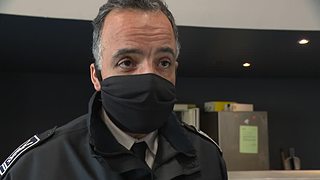
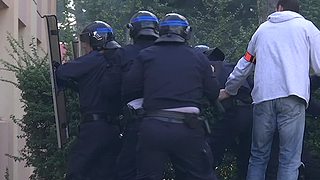
On the occasion of the opening of the "Beauvau de la sécurité", a major national debate aimed at re-establishing a bond of trust between the police and the French population, report in Amiens, in the Somme, to meet young people distrustful ofto law enforcement and people who are frustrated by drug trafficking. The commentary on factual images, illustrations and archives alternates with interviews with some young people in a sensitive neighborhood of Amiens, two parents of students and David PREUD'HOMME, divisional commissioner DDSP - Somme.
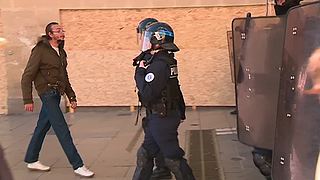
During a demonstration of the Yellow Vests in Montpellier, the demonstrators found themselves blocked in a police trap orchestrated by the CRS. Comment on factual images alternating with the testimony of protesters and Bruno Bartocetti, Regional Secretary SGP Police FO recalling the unauthorized nature of the demonstration.
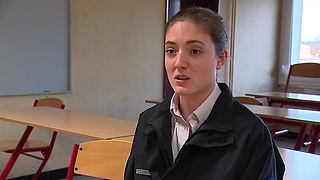
A report on the growing number of young people who want to join the national police force. Anaïs, 20, realized her dream: in September, she joined the Sens police school in Yonne. For her, becoming a peacekeeper was a vocation and an evidence. Thomas, a former soldier, is 27 years old. As with other young recruits, the January and November attacks strengthened his motivation to become a police officer. Alternating factual images, and interviews with Anaïs and Thomas, students of the Sens police school, and Jacques RICHARD, director of the Sens police school. [Source: France 3 prompter] As a result of the attacks of November 13, President Hollande announced, as you remember, the recruitment of 5,000 additional POLICE and GENDARMES in 2016... And since the applications are multiplying in the Police and the Gendarmerie... Illustration with this report by Sylvain LEQUESNE and Jean-Christophe DUCLOS who met two young recruits
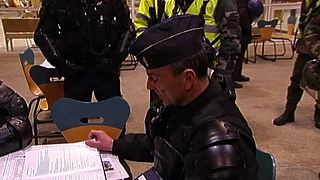
After the death of environmental activist Rémi Fraisse, killed by an offensive grenade on the construction site of the Sivens dam, this report follows the training of mobile police at the barracks of Saint Astier, in the heart of Périgord. At the National Training Center of the gendarmerie forces, they follow a two-week course to learn how to manage crowds using regulatory equipment and the use of summons: hand tear gas grenades and flash grenade launchers. A comment on factual images alternates with the interviews of Pierre de Quatrebarges, squadron commander, mobile gendarmerie.
At the National School of Police Officers in Nimes, presentation of training exercises for law enforcement in cases of urban violence in the context of the controversy over police violence after the death of Remy Fraisse in Sivens. Commentary on factual images alternating with the testimony of a police student about unforeseen events and necessary adaptability.
In Rennes, meeting with Jeff, 16 years in the police, former Brigadier Chief at Police Secours, on his job, his vocation since childhood, his missions and working conditions, the relations of his team in the fields with the population during patrols.
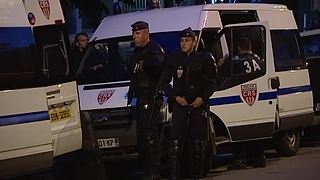
Report. The evil of law enforcement is growing. The quota policy imposed by the hierarchy is weighing more and more on officials who feel that they are no longer fulfilling their mission of prevention. Comment on factual images, of the note of the minister on the quotas requested alternately with the anonymous testimonies of several police officials and the interview of Hubert WEIGEL, central director of the Republican Companies of Security and Paul LE GUENNIC, Union policeman, he thinks that it is not only the CRS, in the police stations everyone has the pressure, the entire national police is in effervescence. . The CRS say they are under pressure, between a decrease in the number of employees and the policy of the figure imposed by their hierarchy. Steve, former CRS, denounces the policy of the number of PV imposed by the hierarchy. Franck, CRS, makes the same observation, he denounces the fact that we ask the CRS more and more interpellations. The central director of the CRS refuses any notion of quotas:
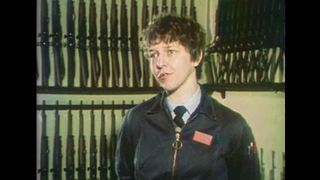
At the school of the national police, meeting with a police student in training, Liliane, former secretary who chose to retrain in this profession by vocation and to no longer be locked in an office, have physical activities, by the attraction of armament and fire and a certain discipline. His goal is to test some bitumen.
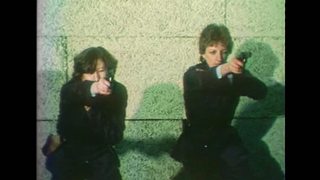
Interview with a student of the national police school on the conditions of the use of his service weapon: to defend the life of someone or his own life. , the response to be proportionate to the attack and another student on what the female police officers brought to the police stations in terms of cleanliness and dress of their colleagues. Comment on images of a course of shooting firearms alternating with the testimonies of women, students of the national police school and a police officer on the contribution of women in police stations.
Testimonies of several young women in training at the school of the national police: for one, it is a childhood dream in order to be in contact with people in difficulty to help them and to make disappear the violence in the streets, for another, a woman will understand certain things better than some men, and in the case of rape, a woman will confide more easily in another woman than a man. For one of their colleagues, recruiting women into the police force could cause problems for everyone.
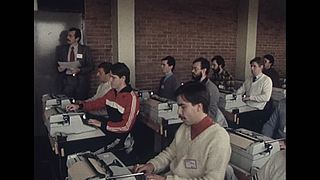
A look back at the training of police inspectors at the Cannes Ecluse police school in the Paris region. The 16-month course alternates theoretical and practical courses for recruitment from the baccalaureate. Testimony of a young woman, former bookseller, Francine HUREL, in vocational retraining in this profession by chance like half of the students and a student inspector on the reasons for their engagement in the police alternating and interview of a police inspector Gérard LENZ regretting the lack of prior interview with a psychologist primarily recruitment because of the lack of motivation of certained recruits and their visions and illusions about the profession very close to the profession of social worker.
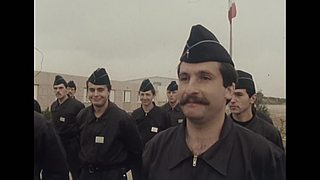
In Fos sur mer, discover the CRS training center where 300 students learn how to neutralize terrorists during practical classes. For some it is a question of vocational retraining after a period of unemployment, for others it is a real vocation to practise this trade to help people to live better in society. Testimony of a former maintenance mechanic and a CRS student in training by vocation.
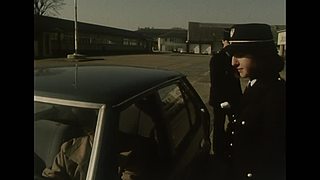
On the occasion of the recruitment of 6000 police officers, investigate their training sites. In Vincennes, discovery of the police enforcement center training peacekeepers from the BEPC with five months in school and four months of practical training in a police station: the courses alternate between practical sequences and criminal law courses. Practice session on traffic violations. Testimony of an apprentice peacekeeper, former carpenter Pascal LESGARDS on his motivations. Interview with Gérard BARDIAU, independent police union regretting the "too fast" training time of the citizen as a policeman with all his responsibilities.
Roger BORNICHE explains what are the different types of police officers: the police officer with English-style schedules, the "cop" or researcher, snooper or questioner working 24 hours a day with the objective of getting rid of the society of highwaymen, the CRS casequé for the general public and the gendarme.
Roger BORNICHE looks back on his career in the police, a profession he practised to escape the STO in 1944- and his debut in Orléans in the Safety Brigade during the Second World War during the German occupation: his first function: keep a communist prisoner tortured at night by the German police and then a Jew arrested for trying to cross the demarcation line. He will resign and then return to this profession for job security and retirement.


 The INA Galaxy