Report. File devoted to a measure envisaged by the Government: the suppression of a public holiday. In order to finance the care of elderly people, the active could work for free one more day per year. This proposal, which is added to the Solidarity Day established in 2004, divides the French. A commentary on factual images, archival images and infographics alternates with interviews by Stéphane CARCILLO, economist at the OECD, as well as those of passers-by conducted during a vox. [Source: France 2 prompter] The news in France. Will we need to work more to finance the dependency? This is one of the announcements that Emmanuel Macron should make on Thursday, during his televised intervention. The executive would notably consider abolishing a public holiday. Is France one of the countries that has a lot? How much would it bring? Response with Paul-Luc MONNIER and Chloé CORMERY
Report in the form of true-false devoted to the economic influence of public holidays in France and the consequences of their possible suppression. Comment on illustration images and infographics. [Source: France 2 prompter] This is the economy figure of the day. 2 billion euros, that’s what public holidays will cost the French economy this year. 2 billion more than last year... So, why not eliminate some? That’s what some suggest... before discussing it in detail... First, look, we wanted to know what the French were saying about it... For or against the removal of public holidays...? Opinions differ... SOUNDS... So, do we need fewer public holidays to support the economy? And how much would such a measure bring? Questions, answers with Josselin DEBRAUX
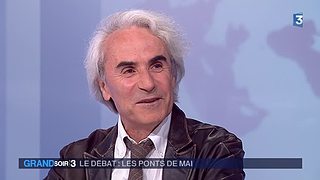
André Rauch, historian specialist in leisure, is invited in Le Grand Soir, for a debate on the bridges of May and the company. The presenter Louis Laforge asks him "what do all these days that... are all part of the French heritage correspond to". According to the historian, there are three origins: worker like May 1st, religious like the Ascension and commemorative like May 8th since 1953.
Report on the return of the Pentecost holiday. The day of solidarity worked, decided by the Raffarin government after the heatwave of 2003 is not removed, but its date is decided by each company. This return to the Monday of Whitsun is intended to put an end to many practical problems such as childcare on that day, schools being closed and parents at work. Interview with Xavier BERTRAND, Minister of Labour, on this decision, motivated by the calendar of public holidays in May. Comment on factual images and archive images.
Report on the controversy surrounding the suppression of a public holiday, Whit Monday, to fund a fund for the benefit of elderly people. If the Church is rather in favor of it, the merchants, for example, see no interest in it. The interview of Father Stanislas LALANNE alternates with a comment on infographic images and archives.
During the meeting organised by Jean-Pierre RAFFARIN for a plan in favour of the elderly, an idea was launched: to abolish a holiday. The extra social contributions would feed an old age fund. Commentary on factual images, illustration images and infographics interspersed with interviews of Robert CHAMBEIRON, national association of veterans of the Resistance, Robert CREANGE, National Federation of deportees and internees resistant and patriots, and a sidewalk.
Valéry GISCARD D'ESTAING addresses the issue of 8 May 1945 as a public holiday. General de Gaulle did not want to make it a holiday. This day became a holiday in 1981. He wanted this day to become a day that would highlight European reconciliation. In this he was presumably, as he points out, ahead of his time.


 The INA Galaxy