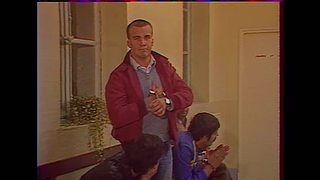
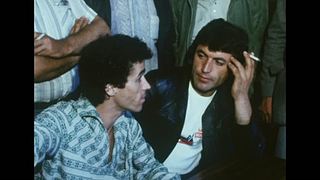
In Revin, in the Ardennes, a raccoon against young Beurs was organized in the district of Orzy. One of the victims is testifying. Residents interviewed confirm that unemployment and idleness go hand in hand with racism in this abandoned working-class neighbourhood.
Subject devoted to the murder of Habib Ghemzi by future recruits of the foreign legion in the train Bordeaux-Ventimiglia. Recall of the dark case on images of the arrival of the murderers at the courthouse of Toulouse, statement by Jean-Claude BRIGNOLLES, prosecutor of the Republic of Montauban who expresses his shame and extract from a statement by Max GALLO, spokesman for the Mauroy government: "the government wishes to express its indignation and fight against all forms of racism, a cancer that robs the democratic foundations of society; It is the responsibility of this political party to promote awareness of all these dangers".
Two racist attacks in Bourganeuf against Turkish workers: a house and a home where immigrants employed as forestry agents in the region were targeted by high-powered shotgun fire aimed at killing to intimidate.
Testimony of Mohamed MESSAOUDI, victim of a ratonnade. He tells how he was assaulted one evening at his parents' house, in Bondy, in Seine saint Denis, by young people shouting "To death the Arabs".
On the occasion of the 20th anniversary of the demonstration of October 17, 1961 in Paris, testimony of an Algerian mason rescued after being thrown into the Seine with four other companions. Then interview with the deputy Eugène Claudius Petit, who denounced before the Chamber of Deputies on October 30, 1961, "the hideous beast of racism". He also criticized the racist policy of curfew put in place at the time by the prefect Maurice Papon and compared it to the policy of the Occupation. Archival photographs and images of the graves of Algerians victims of police repression punctuate the remarks.
Director Yves BOISSET talks about his film "Dupont Lajoie" which stages an ordinary racism. He explains that the Algerian actor, whose character is killed in fiction, was himself a victim of racist violence in the real world.
Reminder of the racist violence that occurred in August and September 1973, related to the murder of traminot Emile Gerlache by an Algerian, Salah Bougrine. Seven migrant workers were murdered during this period, including a 16-year-old man, Ladj Lounès. Immigrant workers go on strike on 3 and 4 September 1973, in Marseille and Toulon. The racist incidents resulted in the suspension of Algerian emigration on 19 September 1973 by the Algerian president Houari Boumédiène.
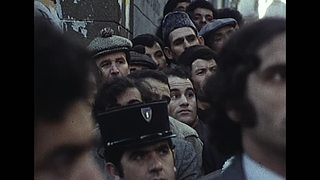
Several dozen people gathered near the Algerian consulate, which was attacked the day before by the ultra-right group Club Charles-Martel. Gathered around two special envoys of the Algerian president Houari Boumédiène and their ambassador, the demonstrators are deeply moved. Some of them decide to go and demonstrate in front of the Prefecture but they are prevented from doing so. Mr. BEJAOUI, ambassador of Algeria, is interviewed; Mr. BENMAKLOUF, responsible for the Amicale des Algériens assures that those who committed the attack are "racist criminals who act with impunity (...)" and that it is necessary to "avoid any provocation".
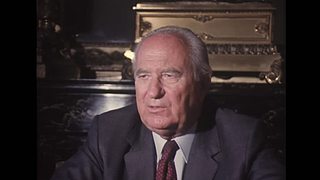
State of immigration in Marseille where, in some districts, the number of immigrants exceeds the "threshold of tolerance" (more than 10% foreigners). Gaston DEFFERRE is interviewed about the racial crisis which occurred in Marseille during the months of August and September 1973 and about the policy to be conducted regarding immigration. The racial problem and the abusive use of foreign labour by employers. "This is a striking case that illustrates the mindset of extremists. The problem that the population of Marseille is experiencing when there is too great a concentration of foreigners because of government policy must be raised. Choices must be made to avoid the racial conflict that threatens us".


 The INA Galaxy