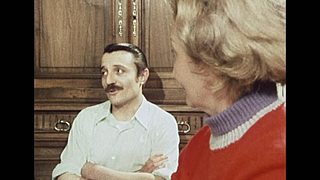
Roubaix, a large family made up of six children. Testimony of the parents in the presence of one of the girls about the pill. The father is fiercely opposed to the idea that his daughters adopt this means of contraception outside marriage.
Interviews with several people about their opinions on contraception. A husband declares himself against the pill out of fear that his wife will cheat on him. A young girl is for; a young boy says: "I am against the pill because I think that husband and wife should be able to restrain themselves if necessary. And for the young girls who are not married, they too must restrict themselves until they are married." A family planning doctor deplores the fact that few women in her region use contraception.
The nurses and hospital agents of the Tronche demonstrate against the "hospital-factory". They believe that the public hospital lacks staff and that working conditions are deficient.
Professor NETTER describes the operation of the male pill, which is based on exactly the same principle as the female pill: a surplus of hormones, which in the case of man would reduce spermagenesis. He deplores the fact that this method is not yet used, explaining that it is mainly a matter of male pride.
A man in his 30s says he’s in favor of a vasectomy. He explains that his fourth child was not programmed. He added, "I don’t see why my wife alone should have to assume these responsibilities".
Excerpt from a report showing Sophie in the exercise of her profession as a surgeon, the only woman to hold this position at the Saint-Louis hospital in Paris. During the excerpt, a fellow surgeon answers the question: "What do you think of female surgeons?" and in turn, Sophie talks about the attitude of her male colleagues towards her. Prejudices have a hard time.
On infographics and illustration images, journalist Guy SARTHOULET explains how homeopathy works and how medicines are manufactured. The interview with Doctor Pierre Barbier, which evokes what can be treated with homeopathy, completes this presentation.
The BCG vaccine against tuberculosis was invented by Calmette and Guérin half a century ago. The strain then used by Calmette is still the one used at the Institut Pasteur, where we follow the steps of the manufacturing of the current vaccine.
Explanation by the head of the polio department at the Institut Pasteur in Paris of the different stages of the (victorious) fight against this disease: "This real hell that was the polio department of sick children... At one time we could only try to repair the damage and maintain life... And then, as in good novels, the vaccine arrived..."
For this program dedicated to menopause, the presenter, Jacques GARAT, explains that no viewer asked has agreed to come and talk about it on stage, revealing the "taboo" or embarrassment women have to speak about this subject in public... The only two women present, for this subject yet eminently feminine, are the presenter and a gynecologist, Jacqueline REY, who with her colleague Gilbert TORDJMAN evoke this embarrassment...
Each year, a new flu vaccine is created. At the Institut Pasteur, twenty operations were necessary for the manufacture of the last born. This was followed by the first tests on mice and guinea pigs, and then on volunteer humans.
On the plateau of "Vivre au présent" devoted to winter diseases, a doctor answers a letter from a viewer concerning the virtues of cod liver oil. This one aquiesce by explaining that the vitamin D contained in this oil is useful in winter because of the lack of sun at this time of the year. It also advises vitamin D in other forms.
Following the departure of the village doctor, the inhabitants of Châtelus, and in particular the elderly, deplore the fact that they have to travel 15 to 20 km to go to the doctor and obtain medicines.


 The INA Galaxy