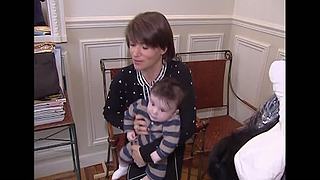
In an interview with Catherine Ceylac, neuropsychiatrist Boris Cyrulnik, whose latest book "Autobiography of a scarecrow" has just been published, talks about the effects of the omnipresence of technology in our western societies on the psychic development of children. Alone with machines, they lack social interactions and risk evolving in a "world without others", which is, he recalls, "the definition of narcissistic perversion".
Boris Cyrulnik, neuropsychiatrist, who has just published "Autobiography of a scarecrow", is questioned by Catherine Ceylac about his arrest by the Gestapo, when he was a child, during the Second World War. He talks about the repression of Jewish children and how he managed to escape, in Bordeaux, to escape death.
Boris Cyrulnik, neuropsychiatrist, explains to Catherine Ceylac, on the occasion of the release of his book "Autobiography of a scarecrow", why, for a long time, he could not talk about what happened to him, as a child, during the Second World War. Confronted with disbelief or "sadistic gluttony", he says he was forced to remain silent for 40 years.
A few days before the 20th edition of the Téléthon, the controversy between the Association française contre les myopathies (AFM) and the Catholic Church has risen a notch. The Church questions the use of the funds raised for research on embryonic stem cells and the screening of sick embryos during in vitro fertilization, which she considers contrary to Christian ethics. This opposition worries the Telethon officials, who fear the repercussions on donations. Commentary on illustration images (laboratory, cells under the microscope) alternating with the interviews of Michel DUBOST, bishop of Evry-Corbeil-Essonnes, and René FRYDMAN, gynecology-obstetric service reproductive medicine, Hôpital Béclère.
To treat her cellulite, journalist Laurence Postic tested the "palper-rouler" technique at the "Mince et relax" institute in Rennes. Patrick Joye, masseur, shows and explains the principle of this technique: squeeze the fat tissues and roll them between the thumb and fingers in order to deeply de-filter, oxygenate and drain by restarting the local microcirculation.
Interviewed, two women who lost all their hair, say what they felt at that time. One of them explains: "...it’s very difficult to stay, to still feel like a woman, to be worth something, when all her hair has fallen off".
Interviewed, Emmanuel Delaporte, dermatologist at the CHRU in Lille, explains what alopecia is and how it translates in women. He discusses two types of alopecia, androgenetics and telogenic effluvium.
In France, stroke affects 150,000 people every year, with one stroke every 4 minutes. Explanations of risk factors and testimony of Jacques BOUSSUGUES, retired 68 years old, recently a victim of a stroke. Then an interview with Dr PHILIPPA LAVALLEE, a neurologist at Bichat Hospital, who describes possible emergency treatments.
Due to the resurgence of pertussis, the update on the recall of vaccination against this infectious and bacterial disease. The comment on images of a mother with her infant in consultation alternates with interviews with the pediatrician about the pertussis vaccine and the mode of transmission of the disease; of the mother "I am for vaccinations as a rule". Sequence on the vaccination of the baby.
Report on the 14th edition of the Sidaction at the CHU of Caen, in which a point of information and donations could be established to raise awareness as much as possible and to collect extremely valuable funds in the search for a cure against this disease so difficult to bear on a daily basis. Commentary report with factual images and interview of Max Bouilloud, member of Sid'acueil, and Renaud Verdon, head of the department of infectious diseases at CHU de Caen.
It is now possible to have a child without the risk of transmitting the virus, when one of the parents is HIV positive. Meeting with a couple whose man is HIV positive and the father of a healthy little girl. Comments on laboratory images alternating with interviews with the couple, Dr Florence LONGUET, the Infectious Diseases Department of the hospital group Bichat Claude Bernard and Dr Nathalie ROUGIER, reproductive biologist in the hospital group Bichat Claude Bernard.
In his Parisian office, Doctor Philippe Blanchemaison, phlebologist, gives explanations on two advanced techniques of cellulite treatment: focused ultrasound and laser.
Chantal SEBIRE, 52, suffering from an incurable and degenerative disease, says she wants to end life and suffering. Her three children express their feelings about her wish to die at home, with her family. His general practitioner Emmanuel DEBOST understands his request but cannot go against the law.
Jean-Jacques GARAUD, Director of Development at Roche Laboratories, explains on a company site why certain cancer treatment drugs can be expensive. According to him they are the results of numerous tests and lengthy research before finding an adequate formula.
Report on the controversy that accompanies the installation of condom dispensers in high schools. Supporters and opponents judge the necessity of this installation, and its consequences on the development of adolescents. Interviews with Lucette SALGAROLO, principal of the Lycée Noordover (Nord), Jean Marc NESME, deputy UMP of the Saône et Loire, Doctor Agnès DUCROS, school doctor SNMSU, and testimonies of high school students.
Would thermal cures be more effective than antidepressants to treat anxiety disorders and depression? A study of two groups of patients seems to prove this. Patients who received 3 weeks of massages, hot tubs and jet showers were far more likely to have regained a serene sleep than patients in the group on medication. But one does not prevent the other. Testimonies of two curists at the thermal baths of Saujon in Charente-Maritime who alternate with results of investigation on the chances of healing and the interview of Doctor Olivier DUBOIS, psychiatrist in the establishment.
Would thermal cures be more effective than antidepressants to treat anxiety disorders and depression? A study of two groups of patients seems to prove this. Patients who received 3 weeks of massages, hot tubs and jet showers were far more likely to have regained a serene sleep than patients in the group on medication. But one does not prevent the other. Testimonies of two curists at the thermal baths of Saujon in Charente-Maritime who alternate with results of investigation on the chances of healing and the interview of Doctor Olivier DUBOIS, psychiatrist in the establishment.
Meeting with Pierre LEHMANN, 79, with COPD, or chronic obstructive pulmonary disease, a disease often manifested by chronic bronchitis. Pierre is treated by a physiotherapist thanks to sports sessions. The most common cause of COPD is tobacco, and indeed, Pierre smoked for 50 years... This disease affects 2.5 million people in France. Commentary on factual images, testimony of Pierre, and interview with Catherine JOURDA, his physiotherapist.
A report on AIDS, the number of new cases of which is declining in France except for homosexuals. Effort is particularly focused on screening with the forthcoming use of a faster test. Commentary on graphic images and infographic interrupted by an interview with Professor Gilles BRUCKER, Director of the Institute for Health Watch.


 The INA Galaxy