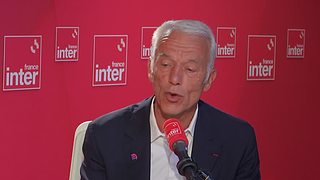
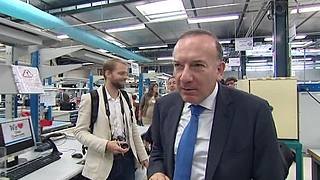
Interview with Patrick MARTIN, president of the MEDEF, who reacts to the current political situation while the appointment of a new Prime Minister is expected. He claims that the bosses are worried: "The economy, in general, does not like indecision and even less threats."
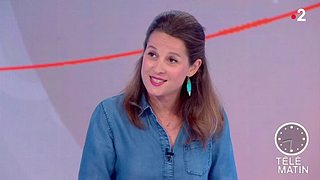
Maud DESCAMPS recalls that the MEDEF, formerly CNPF created in 1945, changed its name in 1998 under Ernest-Antoine Seillière. For some, the MEDEF is mainly a training and consulting organization for employers, in competition with the French Association of private companies, which brings together the large companies of the CAC 40.
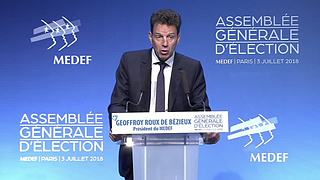
Portrait of Geoffroy ROUX DE BEZIEUX, new president of the MEDEF after Pierre Gattaz. Former employee of L'Oréal, he founded The Phone House at the end of the 1990s and made a fortune by reselling it. He will now have to lead the negotiations on unemployment insurance and pensions. An excerpt from 'It’s up to you to judge' shows him debating with Martine Aubry. For the expert Stéphanie MATTEUDI, he will have to establish a real dialogue with the unions.
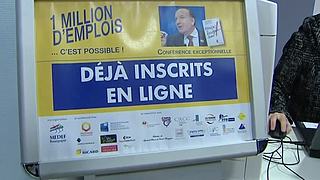
Pierre GATTAZ was in Dijon to present the "1 million jobs" operation, which is supposed to create a million jobs in five years, already, according to him, exceeded even before it had been achieved. In front of 650 people at the Palais des Congrès, the boss of MEDEF insisted: we must prioritize the economy over politics and remove the brakes on companies and investors.
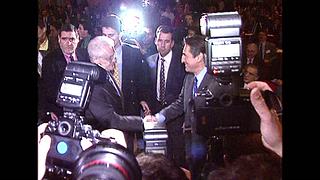
Pierre Gattaz succède à Laurence Parisot à la tête du MEDEF après avoir rallié ses deux principaux concurrents, Geoffroy Roux de Bézieux et Patrick Bernasconi. A la tête de Radiall, entreprise de 2 500 salariés créée par son père Yvon Gattaz, il respecte les règles syndicales. Réactions de Geoffroy Roux de Bézieux et des salariés de Radiall.
Le reportage inclut des images d'archives de Yvon Gattaz, président du CNPF de 1981 à 1986.
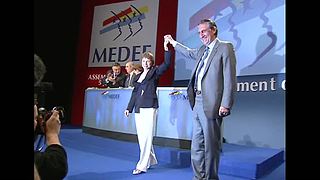
In La Défense, Laurence PARISOT, president of the Ifop, is elected as head of MEDEF, succeeding Ernest-Antoine Seillière. Coming from the service sector, which represents six out of ten jobs, it marks the end of industry’s domination in the employers' organization. It wants to be consensual while displaying its liberalism: "Freedom of thought stops where labor law begins." Reaction of Serge DASSAULT, member of the MEDEF.
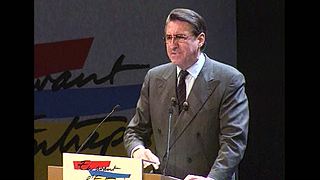
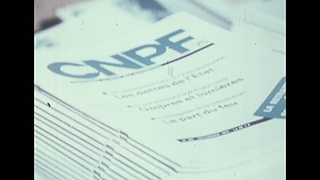
The CNPF becomes MEDEF, a symbolic name change intended to modernize the image of employers. Ernest-Antoine SEILLIERE, president of the MEDEF, stresses that the term "employers" is perceived as outdated: "We are France which produces, which employs, which invests and which innovates",
At the Forum de l'Expansion, Prime Minister Lionel Jospin met with business leaders, including Ernest-Antoine SEILLIERE, president of the CNPF. During a press conference focused on the 35-hour period, Seillière strongly criticized the reform, deeming it "rushed, costly and archaic", and announced that he would consult his base if the law was adopted.
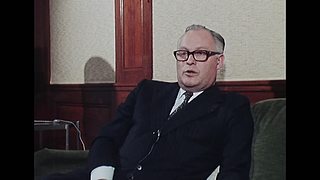
In this interview, Philippe CLEMENT, Vice-President of the CNPF and responsible for finance, explains that the funding of the CNPF comes from professional federations, which are themselves financed by trade unions and companies. The UIMM, the federation of metallurgy, represents 20% of the funding for French employers. The companies' contribution is calculated on their turnover.
Michel FROIS, general director of information at the CNPF, explains the interests of the 'Allô CNPF' operation: the importance of having a means of direct expression with the public, and the usefulness of an immediate link between the CNPF, the various employers' organizations and business leaders.
Return to the history of the CNPF and its evolution. From 1946 to 1966, Georges Villiers chaired the CNPF. In 1966, Paul Huvelin and François Ceyrac modernized his image and developed the contractual policy. In May 68, the CNPF asserts itself as a social partner. Today, he defends the economy and liberal society, with uncontested representativeness.
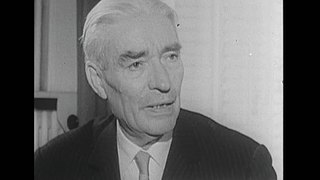
Since 1946, Georges VILLIERS has been leading the French employers. Tuesday, this business leader was re-elected for the 19th time as president of the CNPF. Interviewed in his office after the election, he explains working as a team, considering himself as a 'catalyst', and stresses the importance of numerous meetings and committees.


 The INA Galaxy