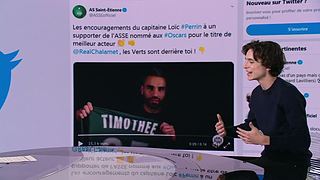
Interview with Timothée Chalamet about his French roots: father from Chambon sur Lignon, summers spent at his French grandmother’s house, between two worlds: the village of Auvergne and New York. He talks about football camps in Carpentras and basketball in Dijon, his attachment to AS Saint Étienne (touched by a message from the club during his Oscar nomination) and says he practiced French with La Grande Vadrouille and La Boum. His French would come back to him with a longer stay, and he would like to film with French directors, giving a nod to François Ozon.
The États généraux de l'économie sociale et solidaire are being held this weekend at the Palais Brongniart, a former stock exchange building in Paris, on the initiative of Claude ALPHANDERY, President of the National Council for Integration through Economic Activity (CNIAE). This gathering brings together economists, sociologists and philosophers, whose ambition is to promote the development of an economy closer to men. Alongside Alphandéry, two intellectuals and former resistance fighters like him, Stéphane HESSEL and Edgar MORIN.
On the occasion of an exhibition of the contemporary artist Richard Serra under the glass roof of the Grand Palais in Paris, as part of Monumena 2008, Richard Serra explains how he conceives his work at the intersection between architecture and sculpture in the perspective of "make architecture alive" in the form of a walk in the case of the Grand Palais and would like France to keep its work "Clara Clara" in the Jardin des Tuileries. The author had caused controversy by installing her sculpture "Clara Clara" in the gardens of the Tuileries where she makes her comeback. Interview with Richard Serra and Stéphanie Coupé, cultural mediator alternating with images of the sculptures.
For 47 years, the Théâtre de La Huchette in Paris has been offering the public the same plays by Eugène Ionesco: "La Cantatrice chauve" and "La Leçon". More than a million spectators and 137 actors succeeded each other on stage. Report on the occasion of the 14571st performance, while the actors are now owners of the theater. With interviews with the actress Odette BARROIS ("La bonne"), a spectator, and Nicolas BATAILLE, the director.
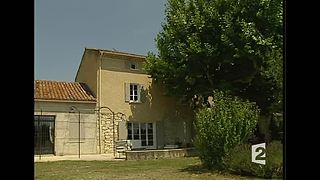
After spending two years in prison, Edwige ALESSANDRI, suspected of the murder of her husband, has just been released by the Court of Appeal of Vaucluse for lack of evidence. She decided to hire the private investigator Jean-François ABGRALL to conduct new investigations. On 17 July 2000, at his home in Pernes les Fontaines, Richard Alessandri, owner of a supermarket, was killed in his sleep with a firearm. Edwige ALESSANDRI tells that the detonation woke her up and that she heard the murderer’s voice. The journalist recalls that 20 investigators entered the house and soiled the crime scene before the arrival of the technicians. After considering the trail of wrongdoers, the investigators arrest Edwige Alessandri and his two sons.
On the occasion of an exhibition, as part of the FIAC, interview in American English with the contemporary American sculptor Richard Serra on the scandal he causes unintentionally with his works of art composed of steel plates and how his works are received in the United States.
Discovery of the transformation in Bordeaux, in the Chartrons district, of the Lainé warehouse, former real warehouse of colonial goods built in 1824, in the Musée d'art contemporain de Bordeaux by the architects Denis Valode and Jean Pistre. Richard Serra exhibits some of his works, he explains in an interview how he conceives his works according to the place of exhibition.
Marc Bessou talks with Jacques Balutin about his recognition of his voice as an actor and his work as a voice actor thanks to the notoriety of the series Starsky et Hutch.
Invited on stage actor Jacques Balutin evokes the work of dubbing, the respect of the mandatory text by the actors doublers, his work with Francis Lax, double of David Soul, to sometimes add text in the series "Starsky and Hutch" when the two actors are from behind or during car shots.
Francis HUSTER who adapted and directed "The plague" by Albert Camus emphasizes the modernity of this story: "it is a text that speaks of AIDS, hostages, political betrayals, human mistakes, loneliness of people... It is the purest, simplest and most dangerous text that can be played on a theater stage..."
In the salons of the Ritz Hotel, after a statement by Jack HEMINGWAY, Pierre SALINGER announces the winner of the Ritz Hemingway Prize: the writer Marguerite DURAS, for her book "L'amant". This one speaks of his admiration for Ernest HEMINGWAY and his pride to have received this prize: "a real prize, obtained freely, the Goncourt they were obliged to give it to me ...".
"La Cantatrice chauve" and "La Leçon" are two plays by Eugène Ionesco performed at the Théâtre de la Huchette in Paris since 1957. Close-up on the 7863rd performance, with the cashier talking about spectators who come back often (a priest, a young man who has been single and has since become a father), and an interview with the actress Jeanne ALLARD, who has been playing the same role since 1965.
In Calonne-Ricouart, a dump catches fire and explodes. Six victims, 47 houses destroyed and three hectares of land covered in ash. Silent subject consisting of images of damage.
Historically the term "red telephone" corresponds to a direct line of communication established in 1963 between the United States and the Soviet Union following the Cuban missile crisis in 1962. As part of a debate on the nuclear balance in the world and the atomic threat, Pierre Salinger, journalist and former collaborator of US President J. F. Kennedy, brings a nuance to this definition. The "red phone" that exists between the White House and the Kremlin is not a telephone but a teletype line that sends messages. The other "red phone" is an alert system between the US high command, the various operational bases and the US president, the latter being the only decision-maker, especially in matters of nuclear threat.
In a debate on the nuclear balance in the world and the atomic threat, Serge Zykov, Soviet journalist and permanent correspondent of "Izvestia" in Paris, gives his definition of the red phone: "In our country, the red telephone is the one that connects the White House to the Kremlin"... "when we established a telephone between the Palace of the Elysée and the Kremlin, in our country it was called the green telephone"... " Red is fire.... while green is the colour of hope."
Explanation of the GATT (General Agreement on Tariffs and Trade) negotiations in Tokyo, within the framework of the Nixon Round, followed by Valéry Giscard d'Estaing’s statement on customs duties and external trade policy: "As far as external trade policy is concerned, there is therefore no contradiction between the achievement of this economic and monetary union and our participation in multilateral negotiations."
In the Azores, Georges Pompidou and Richard Nixon discussed economic and monetary issues. France insisted that it would not give up without a quid pro quo regarding trade between the United States and Europe, including the 10% surtax on imports, and requested that these discussions be linked to a global agreement on currency parities, including the devaluation of the dollar.
Rue de la Huchette in Paris, Louis MALLE recounts some memories of the Théâtre de la Huchette and the plays of Ionesco, which he regularly came to see at 18 in the neighborhood, and in particular "La Cantatrice Chauve". Nicolas BATAILLE introduced him to Ionesco himself, a playwright hardly known at the time.


 The INA Galaxy