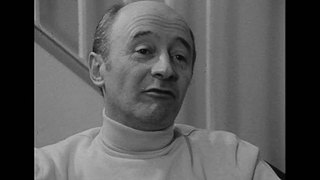
Controversy surrounding the reissue by Gallimard of three anti-Semitic pamphlets written by CELINE, namely "L'Ecole des cadavres" (1937), "Bagatelles pour un massacre" (1937) and "Les Beaux Draps" (1941). Interviews with philosopher Raphaël ENTHOVEN and Serge KLARSFELD, president of "Sons and daughters of Jewish deportees from France", and archive images of the writer.
The manuscript of "Voyage au bout de la nuit", by Louis Ferdinand CELINE, was acquired by the Bibliothèque nationale de France at an auction. François GIBAULT, biographer, and Thierry BODIN, expert, discover the original text, revealing the work of the writer.
The original manuscript of Louis-Ferdinand CELINE’s masterpiece, "Voyage au bout de la nuit", was found at the home of an English collector. It will be auctioned off. Commentary on factual and archival images and interviews with Pierre BERES, bookseller and expert, François GIBAULT, Céline’s biographer, and Henri GODARD, Céline’s manager at Editions La Pléiade.
On the set of Bernard PIVOT, Henri GODARD, specialist of the work of CELINE, published in the "Cahiers Céline", the 3rd which is in fact the medical thesis of the writer, in 1924, devoted to "Semmelweis and other medical writings". H. GODARD explains the reasons why Céline was passionate about SEMMELWEIS, the Hungarian medical hygienist to whom the writer identified: "The personality of Semmelweis had a real fascination for Céline, as a benefactor of humanity, not recognized, and a victim of general hostility... Céline himself said in a letter that he would have liked to be Semmelweis... It was a form of ideal for him, in which he projected himself..."
In Houilles, in the Yvelines, an exhibition was devoted to Louis-Ferdinand CELINE, which obviously provoked various reactions. Explanations of the organizers: "Generally, the people who come are people for Céline, the others do not bother... The negative reactions are mostly on the phone...", "Compared to his past as a "collaborator", I answer them that he is also a writer... I am 22 years old, but I find Céline very current, there are very present concerns... I think we will rediscover him..."
Interviewed, Michel Audiard and Lucette Destouches speak about the writer Céline. Michel Audiard evokes the character of Céline: "We must recognize that Céline is unbearable...". Lucette Destouches, Céline’s widow, looks back at the threats against Céline.
Michel POLAC questions in his home the man of press and television Pierre LAZAREFF who talks about the book, read at 24 years old, according to him the most upsetting of his life, "Voyage au bout de la nuit" by Louis-Ferdinand CELINE which he evokes with emotion: "An author like Céline, what he could do in life, I don’t care, too much genius for me to take care of it... I forget the rest..."
In her residence in Meudon, where she lived with her late husband, Lucette DESTOUCHES, widow of CELINE, in front of Claude AGOSTINI, recalls the writer: "He saw things so clearly, if precisely, it was wonderful, every moment was a discovery of the truth... He was only looking for what was right in himself, that’s all... Now that he’s gone, I’m lost..."
About Bardamu, the main character of his novel "Voyage au bout de la nuit", Louis-Ferdinand CELINE, in Meudon, at home, answers the questions of Louis PAUWELS, about his voluntary commitment during the First World War (at 18 years old), by lyricism. He remembers his state of mind at that time and admits to having been afraid of death because then he still had reasons to live, which is no longer the case when he speaks.
Interview with Louis-Ferdinand CELINE, at his home in Meudon, in his office which was also his consulting firm. In response to Louis PAUWELS, he spoke of love, death, and his reactions to his own death.
On the set of Pierre DUMAYET, Louis-Ferdinand CELINE evokes the violence: "I do not see myself violent at all... I have lived in violence, but I myself am not... And the very annoying books I was able to write were precisely against violence, because I felt a war coming and denounced the reasons for the war and the aftermath... History has proven me right... not men, but facts..."
Interviewed by Pierre DUMAYET, Louis-Ferdinand CELINE evokes the success of "Voyage au bout de la nuit". Once this novel appeared, he thought that he would return to his medicine and that he would then simply have financial tranquility, especially in relation to his apartment: "It was for my tranquility that I wrote this novel... And then to my great surprise, and it still lasts, I am still surprised by its repercussions..."


 The INA Galaxy