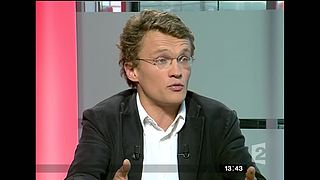
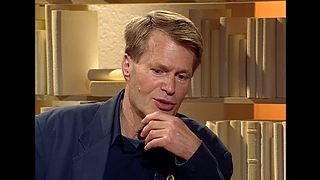
Catherine CEYLAC receives Sylvain TESSON, a travelling writer, on the occasion of the publication of her book "S'abandonner à vivre". Interviewed about the origin of his desire to travel, he explains: "If you ask this question to travelers you will often be disappointed, because basically the traveller does not really have an answer to this question, we feel the call of the forest, the call of the road...".
Christophe Hondelatte receives the travelling writer Sylvain Tesson, to talk about his book "L'Axe du loup". This story traces the trip that Sylvain Tesson made in 2003, on the tracks of escapees from the gulag between Siberia and the Bay of Bengal. He evokes here the difficulty of such an undertaking: "...me, I wanted to live this journey, in effort and suffering (...) it was necessary that (for) myself things were a little difficult, for me to understand what was in the head of someone who escapes".
Bernard Pivot receives the writer Jean-Marie Gustave Le Clézio to talk about his book "Hasard". Here the writer evokes his difficulty of living in the city. Interviewed on the rough places in which he lived as Mexico or among the Indians of Panama, he explains: "...when you’re in the forest you can’t move around with a lot of things, I would move around with writing and living for a few weeks, I wouldn’t go beyond a few weeks, so you have to reduce your baggage".
Bernard Pivot receives the writer Jean-Marie Gustave Le Clézio to talk about his book "Hasard". The writer recalls his first trip as a child, when he left with his mother to meet his father in Nigeria. It was on the boat the "Nigerstrom" that he began to write: "...it is true that a boat cabin is a good place to write, any boat, but preferably a cargo ship...cargo ships that carry goods, occasional passengers and then some passengers who are there to make the long journey, Here we are in a world that is secretive of literature...".
Laure Adler receives the writer Jean-François Deniau to talk about her book "L'Atlantique est mon désert". Following a major surgical operation, he decided to sail solo across the Atlantic. He evokes here the sea that he compares to the desert and speaks of the stars seen at night: "...there is a landscape that I find superb that is 360 degrees of horizon, with the sea that changes at every moment, as in the desert...".
Laure Adler receives the writer Jean-François Deniau to talk about her book "L'Atlantique est mon désert". Following a major surgical operation, he decided to sail solo across the Atlantic. He evokes here a stormy episode of his crossing: "...I do not know any sailors who have not said to each other at a time, but what have I done to God to be there, it is not possible, because the heavy weather at sea is terrible!"
Laure Adler receives the travelling writer Nicolas Bouvier. He talks about his passion for travel. Responding to the request to show us one of his trips, he evokes one he made nearly 40 years ago: "The crossing of the deserts of eastern Iran, there are almost 40 of this, by tracks that were still little frequented and where the dangers did not come from men but from the absence of men...".
Bernard Rapp receives Patrice Franceschi to talk about his book "Au Congo jusqu'au cou". This book relates his first expedition carried out 15 years earlier, in Africa, to meet the Pygmies. He evokes, overwhelmed by the emotion, an eventful and dangerous episode of this expedition: "... suddenly, because of the swamps, nothing, more animals, then it is famine, famine settles...and we have nothing more to eat, just to think about it!"
Bernard Rapp receives Ella Maillard, a Swiss traveller and writer, to talk about her book "La Vagabonde des mers". It first evokes a cruise carried out on the Mediterranean in 1925. Ella Maillart then explains the importance of geographical maps: "...I believe that geographical maps are important in the love of travel...". Further on, she adds: "...after all, I was born on earth, the earth belongs to me why not go and see how it goes". They explain his love of travel and the sea in these terms: "The sea was for me the freedom of an authentic life...travel is to find an authentic life far from our artificial cities".
Bernard Rapp receives Patrice Franceschi to talk about his book "Au Congo jusqu'au cou". He evokes the day when he decided to leave the medical student path in which he was engaged, for that of adventure and travel. From that day, he says: "... one day, one very precise day, this January 24, I said well no, there is a revolution to be made which is that of completely deciding his way...". He then explains his choice to go to Africa to meet the Pygmies.
Bernard Pivot receives Paul-Emile Victor to talk about his book "La Mansarde". Paul-Emile Victor discusses the influence of reading on his desire for adventure. He quotes some titles and authors such as "Malaysia" by Henri Fauconnier, Prix Goncourt 1930. He then explains the meaning of the title of his book "La Mansarde": "...when I was about fourteen years old, I lived in Lons le Saunier and my parents put at my disposal a mansard under the roofs...which was my refuge...the departure of my geographical route...".
Bernard Pivot receives Paul-Emile Victor to talk about his book "La Mansarde, Vents du Nord, vents du Sud". On this occasion, Paul-Emile Victor returns to what he calls "the real start", the decision that allowed him to go on an expedition. He does not consider the day when he left the family factory or the one when he embarked in 1934 on the boat "The Why Not?" as his true departure. He says: "...it’s the day I decided to leave and it’s a decision, that’s the hardest thing in a lifetime, it’s that decision"
Etienne Bernard and Michèle Demai receive the high mountain guide, writer and explorer Roger Frison-Roche. He is interviewed about the 1935 Alpine expedition in the Sahara, in which he participated. The objective was the discovery of the Hoggar massif. He explains his arrival and his discovery of the Sahara: "First, it was a very slow and wonderful penetration...really it was extraordinary this epic...it took seven days to get to Tamanrasset...".


 The INA Galaxy