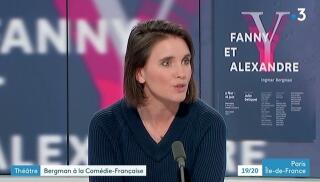
Director Julie Deliquet talks about her staging and adaptation for the Comédie Française of a work by Swedish director and playwright Ingmar Bergman, "Fanny and Alexander," with the following mise en abîme in the first part the happy story of a family of actors during a Christmas meal, falling victim to the misfortune of the mother’s remarriage with a fundamentalist and perverse bishop.
Sophie Marceau, currently plays in Lorient in the play "Une Histoire d'âme", adapted from a script written in 1972 by the director and playwright Ingmar Bergman. She plays the role of Viktoria, a young woman who has always dreamed of being an actress. Suffering from schizophrenia, she delivers a jumble of intimate reflections, frustrations, and fantasies. It is with this monologue by Ingmar Bergman that the actress Sophie Marceau returns to the stage, after 18 years of absence. Excerpts from the play and an interview with Sophie Marceau on this introspective journey that inevitably takes him back to himself. For the director, Bénédicte Acolas, who is signing her first play here, this Bergmanian heroine could not have been performed by anyone other than Sophie Marceau.
Guest on stage, filmmaker and film lover Frédéric Mitterrand, reacts to the death of Swedish director Ingmar Bergman and looks back at his work’s impact on the history of Swedish cinema, his family origins, the impact of religion on his films as the son of a Lutheran pastor and recommends to a neophyte viewer the films "Smiles of a Summer Night" or "Autumn Sonata" with Ingrid Bergman and Liv Ullmann.
In Villeurbanne, at Studio 24, the director Roger Planchon, presents with the actors of the play "S'agite et se pavane" which he proposes and stages in world premiere in French with Bulle Ogier, Jackie Berroyer, Judith Henry and Françoise Brion. Interview with Jackie Berroyer about the play and with Roger Planchon about Ingmar Bergman and his reflection on cinema, the play telling the story of two patients in a psychiatric asylum imagining a film show speaking around Schubert and Princess Mitzi. Excerpts from the play.
In Paris, at the Théatre de la Madeleine, actors Nicole Garcia and André Dussollier take part in the final rehearsals of Ingmar Bergman’s play "Scènes de la vie conjugale" (Scenes from married life), which retraces a couple’s divorce through very intimate and realistic scenes. in a staging by Stephan 116gg and Rita Russek. Images of rehearsals and interview with the actors Nicole Garcia and André Dussolier and Anne Bourgeois, assistant director.
Actress Liv Ullmann talks about her collaboration with filmmaker Ingmar Bergman, for whom she starred in a dozen films. She returns to her very particular way of directing the actors, which encouraged all the actors, from the oldest to the most fleeting, to give their best.In the end, she herself retains her ability to accept her creative fantasy and sometimes makes use of her experience with Bergman and other overly authoritarian directors.
Actor Max von Sydow looks back on his many collaborations with the Swedish director and film maker Ingmar Bergman, both in cinema and theatre, for which he created a "true Swedish Bergmann world". The actor is also internationally known for his role in "The Exorcist" by William Friedkin.
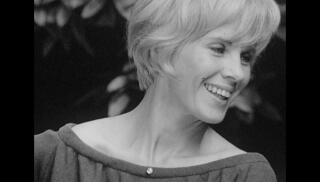
Léon Zitrone speaks in his hotel in Paris with the Swedish actress Bibi Andersson, revealed and known for her films shot with director Ingmar Bergmann: "Le septième sceau" or "Les fraises sauvages". To the question of her label as an intellectual actress, she returns to the responsibility that it represents to be a "perfect" actress and to the difficulty of leaving Bergman’s universe; yet this is the film "The Seventh Seal" which opened the doors to an international career outside Sweden.
Swedish directors Kjell Grede and Vilgot Sjoman discuss the influence of director Ingmar Bergman in Swedish cinema and reception, sometimes negative of his films with his Swedish classmates due to the violence and exacerbated feelings expressed by his characters in a traditionally secret and puritanical Swedish society.
Interviewed by Jean Collet, the director Jacques Doniol Valcroze evokes the influence of summer nights among couples in the films of the Swedish director Ingmar Bergman, currently refugees in his fortress on the island Faro like the heroine of his film "Monica".
Interviewed by Jean Collet, the director Jacques Doniol Valcroze evokes his relationship with the Swedish filmmaker and stage director Ingmar Bergman through the prism of one of his favorite actresses, Bibi Andersson, whom he himself had cast in 1967 in his Franco-Swedish film "Rape" -shot in Stockholm while Bergman was preparing his future film "L'heure des loups" - and returns to the fascination that the latter exerted on his actresses whom he had often trained himself, he was also nicknamed "the king" because of his grip on Swedish cinema in the 1960s.
Ingrid Bergman talks about her reunion with filmmaker Ingmar Bergman at the Cannes Film Festival, ten years after their first meeting. Factual images of the two personalities at the festival.
Swedish actress Bibi Andersson, assisted by a translator, looks back on her collaboration with director Ingmar Bergman, with whom she has just shot the film "Persona", one of her most striking roles on the theme of "the identity of man and the possible rapprochement between the sexes".
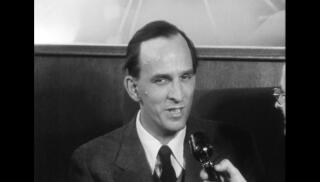
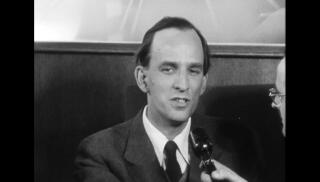
In the noisy setting of a bar at Le Bourget airport in Paris, the Swedish director, playwright and film-maker Ingmar Bergman, director of the Malmo theatre, mainly known for his stage productions, answers questions from the journalist André Parinaud in French. He evokes his favorite French directors (Marcel Carné, Julien Duvivier), the plays of French authors that he has already staged like those of Molière or Jean Anouilh, confesses that he would like to stage French authors such as Eugène Ionesco or Albert Camus and looks back on his Swedish masters, the great theatre directors Olof Molander and Victor Sjostrom.
On the occasion of his visit to Paris to present the play "Les Gens du Varmland" by Fredrik Dahlgren, the Swedish director, playwright and film-maker Ingmar Bergman, director of the Malmo theatre, known mainly for his theatre productions, answers questions in French to the journalist André Parinaud. When asked about the differences between theater and cinema, he confesses that theater is his profession but cinema is his passion.


 The INA Galaxy