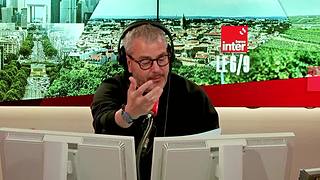
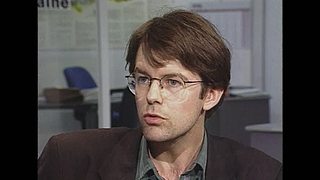
Ali Badou reçoit l'écrivain Yannick Haenel, auteur du livre "La solitude Caravage". Il revient sur les rêves érotiques engendrés par sa découverte adolescent d'une partie du tableau de Caravage, le visage de Judith, du tableau de Caravage "Judith et et Holopherne, et de sa déception en découvrant plus tard que son héroïne était une tueuse.
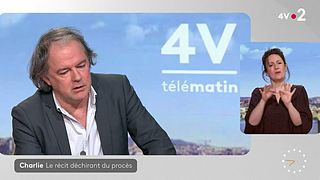
The writer Yannick Haenel, who became a columnist for the newspaper "Charlie Hebdo", fifteen days after the attack of January 7, 2015, looks back ten years later on the atmosphere in the newspaper after the attack, the freedom he is granted to write his columns on artistic life and on the strength of Coco’s testimony during the trial of the Charlie Hebdo attack.
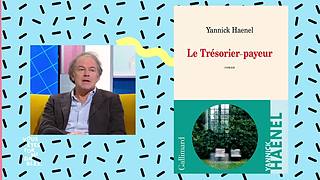
Virginie Demange receives the writer Yannick Haenel on the occasion of the release of his latest novel "Le trésorier payeur", he discusses the genesis of this novel, the visit to an exhibition "expenses" on the writer Georges Bataille in the former ocals of the Banque de France in Béthune and the discovery of the house of the former paymaster of the Bank and the tunnel between his home and the bank.
Quelques jours après avoir reçu le prix Médicis pour son roman "Tiens ferme ta couronne", Yannick Haenel est de passage à Rennes.au Théâtre National de Bretagne, à l'occasion de l'adaptation pour le théâtre par Arthur Nauzyciel de son livre "Jan Kerki". L'écrivain connaît bien la ville de Rennes où il a vécu et étudié à la fin des années 80. Une ville associée au rock. Dans un entretien accordé à Guy Papin, l'écrivain revient sur le Prix Médicis et l'histoire de son livre narrant les tribulations d'un écrivain quinquagénaire, auteur d'un scénario fleuve sur Herman Melville qu'il souhaite voir adapté pour le cinéma par Michael Cimino.
The writer Yannick Haenel, author of an eponymous book on the Polish resistance fighter Jan Karki and his fight to defend the cause and warn about the fate of European Jews during the Second World War imagines in a romanticized way the meeting between Jan Karski and US President Franklin Delano Roosevelt and denounces "the violence of the sofas" and the beginning of a "political accommodation" on the part of the Allies prefiguring the post-World War II period.
In an interview with Olivier Barrot, the writer Yannick Haenel looks back on the three parts of his book "Jan Karki" which evokes the life of this Polish resistance fighter who alerted and tried, in vain, from 1942 onwards, the Allies on the fate and extermination by the Nazis of European Jews. The first part of the novel is devoted to the testimony of Jan Karski in Claude Lanzmann’s film "La Shoah", about his discovery during two visits to the living conditions of Jews in the Warsaw ghetto in 1942, the second part is a summary of his war memoirs and the third part consists in a fictional evocation of Jan Karski’s feelings and evokes his failure and depression. "God died in Auschwtiz"
Christian Rolland receives the writer and teacher Yannick Haenel for his new novel "Les petits soldats"; born in Rennes, the author (a professor of literature) talks about his military adolescence at the Prytanée de la Flèche; he followed in the footsteps of his father, a career soldier who then wished to embrace this career, but the discipline and teaching conditions in this military high school disgusted him completely: he even "learned to disobey," to hate wearing a uniform and having his head shaved, "the spirit of body," to develop through books his critical thinking and a "do everything to develop his solitude" allowing him to protect himself from the virilist discourse of the ranks and this mental prison.
Yannick Haenel presents his book "The little soldiers" - of autobiographical inspiration - which tells the story of his period of studies at the Prytanée Militaire de La Flèche during his adolescence between 1982 and 1985, the changes in boys' bodies, its influence, the frustration and the arrival of girls in this military school.


 The INA Galaxy