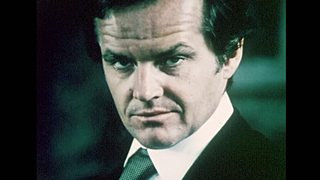
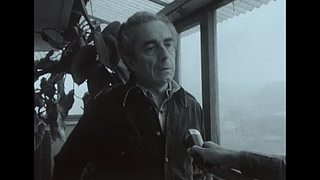
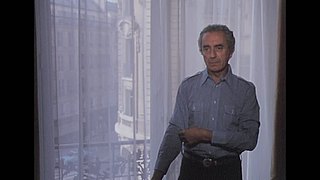
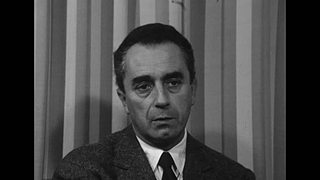
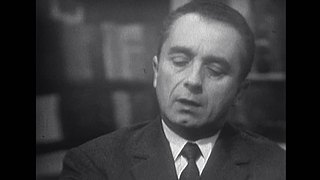
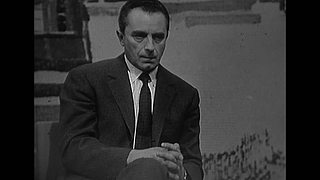
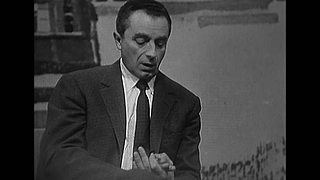
Jack NICHOLSON talks about his collaboration with the Italian director and screenwriter Michelangelo Antonioni. He likes to work with him because he considers the actor as "a mobile space" and works each scene "as if it were a documentary... on what is really happening that day".
Italian director Michelangelo Antonioni talks about his latest film "Profession: reporter". He does not want to make an autobiography, unlike Federico Fellini. He prefers to project his moods of the moment, his encounters, his readings.
Italian director Michelangelo Antonioni talks about the role of actors. According to him, the actor should not seek to understand the film in his unity. He explains that some people can be stupid but extraordinary in their game. Laughing, he confesses to know some but refuses to give names! He believes however that the actor is not an object but "a force of nature, it must be controlled, it must be dominated".
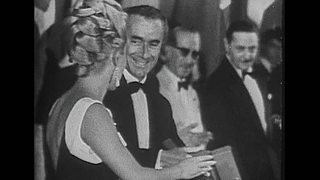
Jean-Claude BRIALY, accompanied by Virna Lisi presents the winners of the 20th Cannes Film Festival and announces the attribution of the Palme d'or to Michelangelo Antonioni for his film "Blow up".
Interview with Italian director Michelangelo ANTONIONI whose film "Blow up" is in competition at the Cannes Film Festival. In this interview, he discusses the conditions of the film’s production.
Italian director Michelangelo Antonioni is interviewed about his film "The Red Desert" and the use of color. According to him, color allows us to suggest aspects and serve the content of the film even if this color does not exist in reality.
On the occasion of his visit to Paris for the dubbing of his last film "La Notte", Michelangelo ANTONIONI talks about his studies and his early interest in art. He remembers his first documentary, made with friends in a "madhouse".
Italian director Michelangelo Antonioni looks back on the construction and rhythm of his film "L'Aboustcore". He explains his desire to do as much "real" as possible, far from the usual cinematographic techniques.
Italian director Michelangelo Antonioni looks back on his work from 1943 to 1950. He talks about his experience as a documentary filmmaker and his first short films. It was at this time that he began to take an interest in men and move away from the themes addressed in Italy in documentaries.
Italian director Michelangelo Antonioni looks back on his work during the fascism in Italy. The production of documentaries allowed him to avoid making films for the regime. He returns to the difficulties concerning the production of the documentaries "Les Gens du Po" and "N.U." during this period.


 The INA Galaxy