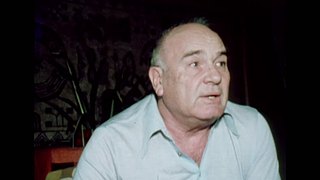
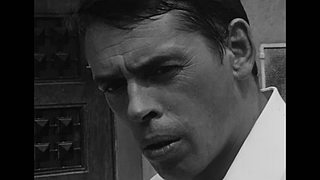
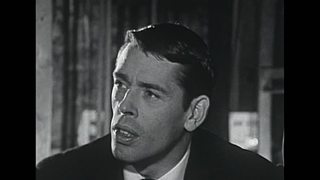
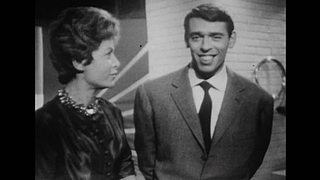
Nearly 2 months after his death, a friend of the singer Jacques BREL, himself installed in the Marquesas for almost 10 years. It evokes the daily life of the singer, in this archipelago at the end of the world, who, according to him, was looking for, sick, "a retreat, a place to die," surrounded by a population that did not consider him a star but as Mr. Everyman: "He was warm, he was interested in people, he loved people, he liked to be of service..." Then he tells an anecdote about an artist’s project to overcome the extreme isolation of the population: parachuting mail with his plane or creating a cinema...
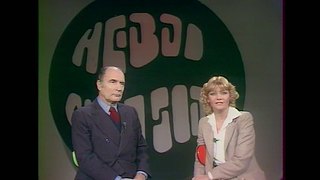
While the last disc of Jacques BREL, "Les Marquises", has just been released, François MITTERRAND, First Secretary of the Socialist Party, who listened to it that morning, analyzes the work and explains that Jacques BREL is above all a writer, a poet, who knew how to make his language evolve, his words, throughout his life and his career as an artist.
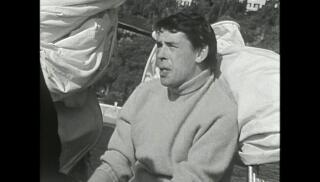
On his boat off Menton (Alpes-Maritimes), Jacques BREL talks with Michel POLAC about "Don Quichotte": "There is everything in Don Quichotte... There is an incredible tenderness, I love tenderness, it is the value to which I give the most importance." He adds that he appreciates this man a little dreamy who does not accept the same reality as the others...
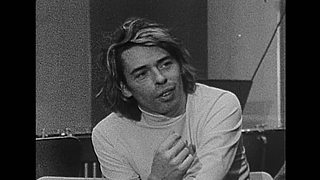
In the middle of rehearsals for his play "L'Homme de la Mancha" at the Théâtre des Champs-Elysées in Paris, Jacques BREL explains in his dressing room how Miguel de CERVANTES is the source of his attraction to the character of Don Quixote and the editing of the musical that followed. He explains that music hall is a totally solitary art and that there, in the theater, he finds teamwork, which does him a lot of good. Finally, he returns to his decision to stop the scene and the singing tricks: "For reasons of honesty rather than fatigue... When you manage to have a certain technique, a certain ease, a certain power, you have the temptation to cheat and you end up succumbing to this temptation... And I was at that moment when I might start to cheat..." His words are illustrated by images of rehearsals of the play.
The singer Jacques BREL talks about his first film, "Les Risques du métier" by André CAYATTE. He explains that he doesn’t yet know if he will have as much freedom in the cinema as in the song, and analyzes the fact of moving from the song to the cinema more as a natural desire to discover new things, "to expand," of sensation, than as a question of ambition or ego (of "pickles").
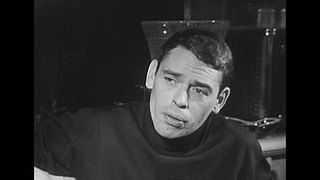
In a café in Lyon, the singer Jacques BREL talks about his taste for solitude and his character, feeling rather "funny", but if his songs sometimes carry within them a certain despair, it is according to him that there are not many reasons to be fully happy every day in society. He adds that as an artist, he feels he has no message to convey, simply observing what he sees and telling stories, like the storytellers of yesteryear passing through small villages.
Interview of Jacques BREL by Denise GLASER. He evokes the anger he bears in him, the indignation he feels to see the world as it is. He explains that you don’t get old.
Interview with Jacques BREL about his farewell to the stage. He is not fed up with the stage and wants to continue writing, but he wants to discover other things.
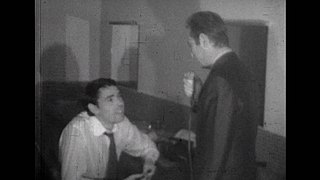
Interview of Jacques BREL by Guy LUX on his farewell to the stage. He will continue to make songs, to make records, he may make a television but more singing tours, more stage, and he thinks he is too proud to reconsider his decision. Then he takes up the polish on his shoes, interrupted to answer Guy LUX’s questions.
Jacques BREL, passing through Nancy for a concert, explains in an interview the reasons why he does not return on stage for the encore: "It’s calculated, it’s false... I consider that it’s a bit of a lack of dignity towards the public... The audience deserves to be treated like an adult and you don’t play with the audience with a "fais le beau, t'auras un sucre"... We tell a story in 15 or 20 songs, and when it’s over, it’s over..."
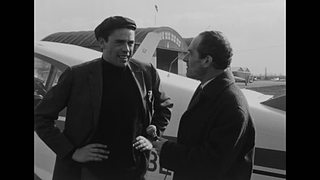
Awaited by the journalist on the tarmac of Bron airport, near Lyon, the singer Jacques BREL, who arrived in a private plane that he pilots himself, explains that aviation is for him a recent passion, and that he does not wish to travel in this way as part of his artistic activity so as not to mix profession and leisure.
Interviewed by Jacqueline JOUBERT, Jacques BREL talks about the love of song and words: "I like to sing but I especially like writing songs... We manage to write songs that when we sing... We manage to know the weight or the value of words by singing every day..." When Jacqueline JOUBERT asks him if it happens to him while singing to be bothered by a word, he replies that yes, often, but that it is too late to change it, to correct it, because "it’s like men the songs..."


 The INA Galaxy