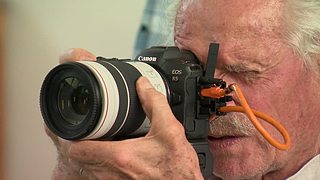
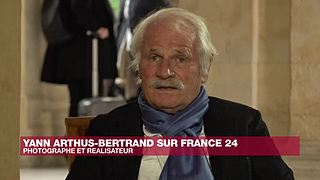
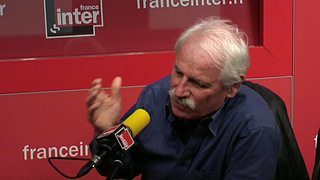
Reportage in Martigues where the photographer Yann Arthus-Bertrand set up his travelling studio. He wanted to build an archive base that would draw the portrait of a united France. Interview with the photographer who takes on the utopia of his project and images from a photo shoot.
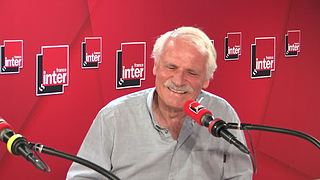
In the microphone of Amélie Perrier on the occasion of his exhibition "Legacy", the photographer and documentarian Yann Arthus-Bertrand returns to the history of his first photos of lions taken in Kenya at the beginning of the 1980s.
The photographer Yann Arthus-Bertrand says his admiration for the environmental activist Greta Thunberg but specifies: "we must not leave it on children’s shoulders to change the world".
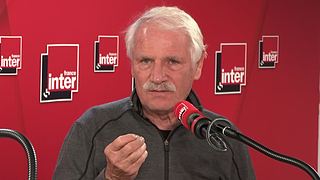
Guest of Eric Delvaux, the photographer and documentary filmmaker Yann Arthus-Bertrand deplores the religion of growth, the hypocrisy of policies, the overconsumption of fossil fuels entirely responsible for climate change. According to him, the ecological revolution will be neither political nor scientific nor economic. He advocates an inner revolution for everyone.
In the studio with Augustin Trapenard on the occasion of the release of his film "Human", photographer Yann Arthus-Bertrand recounts his journey until the realization of this film, his wish was that "the beauty of people resonates with the beauty of the world".
Rushes of the film «Home». The San Andreas fault lies at the junction of the tectonic plates of the Pacific and America, it passes through the cities of San Francisco and Los Angeles. An overflight of a dry stream bed covered with vegetation, amidst an arid landscape.
Rushes of the film «Home». Powell Lake is an artificial lake on the Colorado River formed by the construction of the Glen Canyon Dam. In recent years, the region has been suffering from a severe drought and the lake is at its lowest level since it was launched in 1980. An overview of the shores of the lake and the meanders of the Colorado River and surrounding canyons.
Rushes of the film «Home». A glimpse of the "dry tears of the Aral Sea", the salty sands of the Aralkum Desert and the shipwrecks gnawed by the rust of abandoned fishing boats since the withdrawal of waters.
Rushes of the film «Home». Palm oil is one of the most consumed oils in the world. An ingredient in traditional African, South American and Asian cuisine, it is also used in the food and cosmetics industry. It can also be turned into biofuel. In fact, its demand is increasing sharply. But this success has a cost, and in Indonesia, which is one of the main producers, the Borneo forests are disappearing in favour of this crop. An overview of an oil palm growing area; if some landscapes are planted with palm trees, others are completely desert (palm trees not yet planted or already torn off?) and crossed by parallel rounded lines, forming arabesques, on which the palms are normally aligned.
Rushes of the film «Home». Ijen is an Indonesian volcano located on the island of Java. It comes in the form of several craters including the Kawah Ijen and the Merapi Ijen. The Kawah Ijen has the peculiarity of holding on its top a lake reputed as the most acidic on the planet. Next to the lake is a sulphate from which sulphur is extracted. An overview of the Kawah Ijen volcano in a more or less cloudy sky.
Rushes of the film «Home». Sanlucar La Mayor seems to be the ideal place for the installation of solar power plants with its large spaces and its almost permanent sunshine. In the middle of fieldss, flying over a solar thermal power plant near Seville.
Rushes of the film «Home». An overview of a coal-fired power plant, the only power generation system developed in South Africa, despite its abundance of greenhouse gas emissions.


 The INA Galaxy