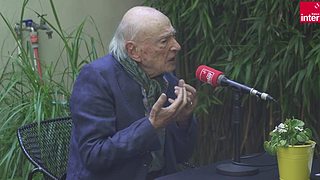
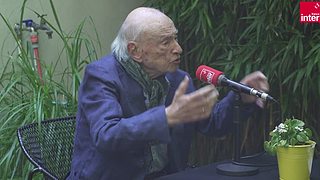
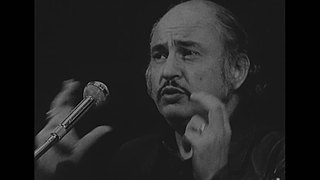
The sociologist Edgar Morin explains his idea of "sleepwalking" which means that almost nothing has been done since the Meadows report to deal with the ecological tragedy.
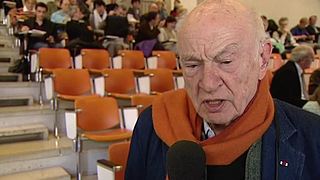
On the occasion of the launch of the first itinerant university on the theme of sustainable development, sociologist Edgar Morin explains the goals of this project. The goal is to open up possible paths by defining what must grow and what must decline.
Edgar MORIN explains that there are oases in life, moments of poetry during which one feels happy, transfigured, living more intensely in the game, in the relationship with others or in a football match. In our civilization they try to "proscribe" us. Civil society tries to defend itself. There is a human aspiration to harmony between humans and between humans and nature
Edgar MORIN evokes the "Yéyé" generation, an expression he used in an article in Le Monde in 1963 because of the yeah sung by the young people of the 1960s
Edgar MORIN explains the importance of his trip to California. He asked himself about the hippie movement and was surprised. He was invited to the Salk Institute of Biological Research and asked to reflect. They wanted someone who wasn’t a biologist but who was in the humanities. This was the time when biology showed that it could have formidable powers, especially in genetic manipulation.
Politics brought to Edgar MORIN the idea of communion with the human race. Many people thought, not just the Communists, that with the 20th century, we would enter a better world. We were talking about democracy, an advanced industrial society. That was the discourse of the 1960s. All hope is linked to despair.
The idea of homeland land is important because we are all earthlings and all major problems are planetary like ecology, drugs, war. The human species through its diversity has a unity. While blind economic processes unfold in globalization the only response is to realize that the land is the common homeland
Edgar MORIN believes that it is important for society to ask questions about science. The development of the physical and nuclear sciences, the development of biology and especially genetics pose problems for society. All sciences are social, affect and transform society.
Edgar MORIN, interviewed by Jean-Louis SERVAN-SHREIBER, believes that complex thinking can be implemented by everyone. A strategy must be put in place to achieve this. The strategy is the work on uncertainty and complexity
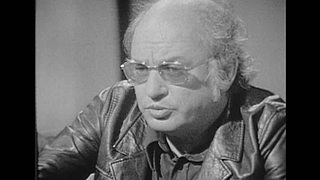
Edgar MORIN, interviewed by Gérard GUEGAN, sees himself as a researcher. He has been at the CNRS since 1950. The word scientific is doubtful but the word he likes is a seeker even if he does not know very well what he is looking for. He seeks not to be mistaken and to understand
In a conference, the sociologist Edgar Morin explains that he observes a reduction of the ecological problem into a series of pollutions to be treated, and whose technology offers only partial remedies: "a puzzle of small problems which each have their own solution".
How did the rumor of Orleans come about? Edgar MORIN deciphers this rumor that there has been a white trade for 7 or 8 years in several cities including Paris and provincial cities. As soon as the story takes place in a small town there is a force that fixes the accusation on the Jewish merchant.
Edgar Morin compares the actors James Dean and Jean Paul Belmondo: James Dean played in films where he was a teenager in revolt, and James Dean authenticated the roles of his films in his own death. Jean Paul Belmondo is only a film called "À bout de souffle" where he embodies something that may be the theme of a hero from adolescence.


 The INA Galaxy