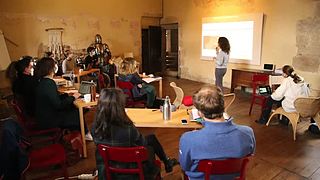
The philosopher Cynthia FLEURY organizes medical humanities seminars with students, researchers and PhD students from the chair of philosophy at the hospital commandery of Lavaufranche in the Creuse.
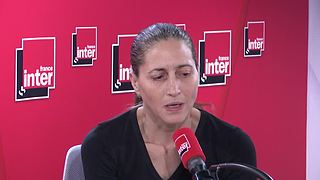
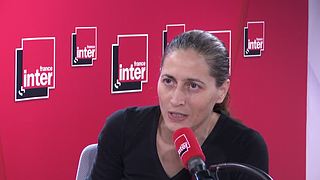
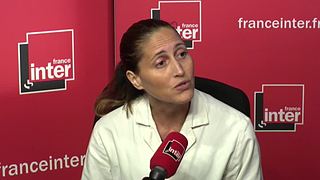
Cynthia FLEURY, holder of the Humanities and Health chair at the Conservatoire national des arts et métiers, is invited to talk about the crisis in the care sector that has been shaking France for several months, on the side of caregivers as well as those who are cared. To the question of what a society that abandons its medical care policy gives up, she replies that it neglects the 'capacity' of a society, knowing that care is from the capacity and not from the assistance. She says: "Care is what allows a whole society to stand. It is fundamentally the matrix of emancipation, autonomy, democracy. If the predominant idea that claims that economic rationalism is the most effective in organizing society, it seems clear to him that an accounting perception of health is incompatible with the act of caring. This vision is totally deleterious in the sector of medicine, not taking into account the notion of time in the management of a patient compromises the relationship with the patient and does not allow to face the complexity of diseases and treatments.
The first challenge of the chair of philosophy created within the hospital group in Paris is to make the hospital an open place. If care and knowledge are the same matrix, it is necessary to provide access to shared and interdisciplinary knowledge in order to allow for their understanding. The chair offers free seminars and courses open to all. It collaborates with the patient university, founded by Professor Catherine TOURETTE TURGIS, France being the only country in the world to graduate its expert patients. The ambition of this hospital-academic device is to imagine concrete solutions to problems and to transmit and disseminate knowledge and the state of research.
The philosopher Cynthia FLEURY, co-author of the essay "Le souci de la nature", dissects man’s relationship with nature and its implications. Starting from the following precept: nature is one of the pillars of the social contract, she and her co-authors have studied the extinction of experience direct to children’s nature and its consequences on future political and societal choices. It was Western societies that made the break with nature, seeking to dominate and exploit it. Cynthia FLEURY reiterates that ecological solidarity constitutes the human being. She cites the example of the microbiome and the resurgence of diseases linked to environmental causes, but also the origin of most global conflicts.
The chair of philosophy at the Hôtel Dieu, a Parisian hospital center, has undertaken several missions that Cynthia FLEURY, philosopher, psychoanalyst and member of the scientific council explains. It is a question of developing the practice of hospital medicine and making it more humane, of thinking about it in all its dimensions. It is also about fighting for the reintroduction of 'humanities' in the initial training of doctors, to fight against condescension and inequality between caregiver and patient, to consider the patient as a subject, to obtain their consent and to agree to share medical knowledge. The new generation of doctors is sensitive to these subjects.
Cynthia FLEURY, philosopher, explains that "care is everything that works the social capital that makes the wealth of a society", while giving concrete examples of what it induces in human relationships within the same society.


 The INA Galaxy