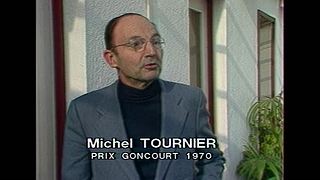
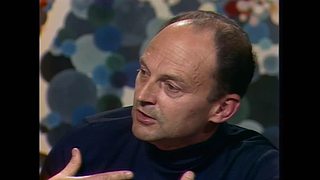
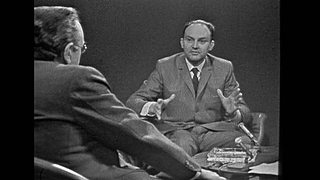
On the set of Apostrophes, the writer Guy Hocquenghem confides his admiration for Michel Tournier’s novels but deplores the dry style of the recent book by the latter "Le vol du vampire", which he compares to "Critique de la raison pure" by Emmanuel Kant. As a philosopher himself, Tournier takes this as a compliment, he who considers that the greatest literary critics are philosophers.
The writer Michel Tournier explains the history of the award related to the Prix Goncourt, a modest check of 50 francs according to its contemporary value. For a current author, however, the contribution of the prize is of significant financial interest in terms of sales volume and resulting copyright.
While Bernard Clavel deplores the fact that the Goncourt prize is systematically awarded to a book published by Gallimard, Grasset or Le Seuil, Michel Tournier, writer and juror of Goncourt, recognizes that affinities influence the distinctions but that it is above all a mechanical effect related to the number of works published by this trio of publishers.
The writer Michel Tournier explains according to him what is the contribution of Germanic culture to French culture. It evokes a love-hate marriage, as well as the Germanic influence in the writing of Jean-Paul Sartre. Also, he believes that the German Jew is the cornerstone of Western civilization.
The writer Michel Tournier explains that his writing is influenced by a frustration: the deprivation of physical contact during childhood with other people and especially his mother. Going to the end of this idea, he believes that men may regret being unable to experience motherhood and its specificities; he adds about sexuality, that the male orgasm is certainly worth nothing in comparison with the one a woman can experience.
Questioned about his works by Pierre Sipriot, Michel Tournier explains how according to him the education of children has gradually shifted from a form of initiation to a form of information, which by replacing moral and practical learning, is wrong to generate gaps in the psyche of beings. The gradual physical distancing between a child and his mother, then the 'physical desert' between early childhood and adolescence would be a cause.
The writer Michel Tournier presents us in his attic which acts as a photo studio, an old camera of which he describes the complexity. Passionate about photography that he practices as an amateur, he explains why this is essential for him in his life and work.
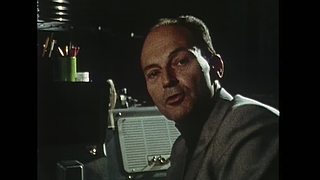
Surrounded by the heads of French radio stations, writer Michel Tournier gives his impression about the impact of the information broadcast by the radio: he gives this medium a certain power, of manipulation, as evidenced by the fact, for example, that in times of conflict, radio stations are among the first strategic catches of an assailant.
Asked about his novel "Le Roi des Aulnes", featuring an ogre, the writer Michel Tournier explains his philosophical approach and the importance of myth for everyone, as a founding element of personalities and desires. He summarizes his thought thus: "we are all mythological beings".
The writer Michel Tournier explains to Alain Jérôme and readers of his novel 'Le Roi des Aulnes' one of the reasons that motivated his writing. Disgusted by the Germany he knew during his childhood, the author wanted to exorcise a form of personal and family trauma related to the rise of Nazism, war, and collaboration. The writing of this book, which revolves around a mythical character (an ogre), must allow him to move on to something else.
In conversation with Pierre Dumayet about the novel 'Friday or the Pacific Limbo', writer Michel Tournier explains the features of 'his' Robinson, a character stranded on a deserted island who, paradoxically, given the context in which he finds himself, expresses certain behavioral characteristics specific to modern life. His life on the island echoes ever current issues such as racism, physical appearance or even sexuality as a social construct.


 The INA Galaxy