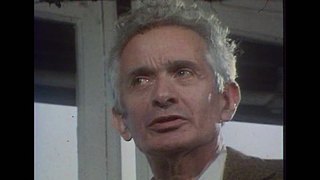
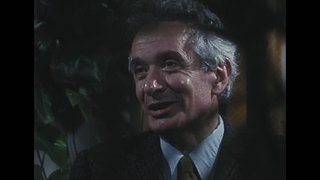
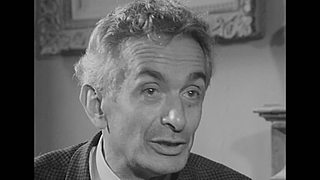
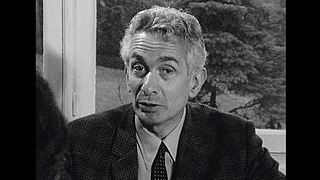
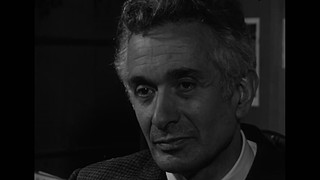
Meeting in Poitiers with the writer René Barjavel, author of anticipation and science fiction, who turned to fantastic historical novels in the Celtic tradition with 'Les dames à la licorne' and 'L'enchanteur' - story of Merlin - and embarks on a new literary genre, the detective novel at the instigation of Simone Gallimard, with her latest book 'The Skin of Caesar', a police investigation after the murder in the Nimes arenas of the actor playing the role of Julius Caesar.
The writer René Barjavel looks back on his studies at the college of Cusset, near Vichy, in 1925, his social life and the specificity of this college, the first to be mixed and to accept girls and boys then, his beginnings in journalism, at 18 years old, in Moulins, at the Progrès de l'Allier and evokes on this occasion having invented 'the monster of Vichy' like the monster of Loch ness in 1929.
In this program by Anne Sinclair, the writer René Barjavel answers Jean-Louis Ezine’s question about his fear of the present. He retorts that it is the curiosity about the future of the human species that drives him, and refers to his novel 'Ravage'.
The writer and journalist René Barjavel, questioned about the places of his childhood, in Tarendol, in the Drôme and in his office in Paris, evokes his desire to write as simply as possible, he would like the reader to forget that he has a book in his hands and that his story goes into his head without him noticing, he wrote his first novel 'Ravage' in 1942, the story of the collapse of a civilization due to lack of energy. He is surprised that the teenagers who read his novel, 30 years after its publication, think it has just been written.
Claude Dufresne speaks at his home with the writer René Barjavel who talks about his life and his daily writing routine, his rejection of realism and his need to put dreams and love in this daily life, by Jean Tarendol, hero of his book 'Tarendol', one of his fictional characters who resembles him the most, -"the one he thought he could be with his qualities of intransigency and tenderness"- and his conception of women, "the essential of creation" for him.
Interview in Paris with the writer and journalist René Barjavel about Parisian life, which he compares to an old peasant town just like him, but not made for that, its streets are engorged and its lungs are filled with toxic gas; the city was originally a community of neighborhoods. Regarding Sarcelles and its grand ensembles, the man was forgotten, considered, for him, only as "an element of statistics"
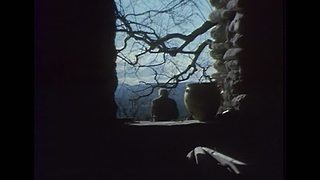
In the Drôme, in the village of Tarendol, back to the places of his childhood, the writer René Barjavel sitting in front of his grandfather’s barn admires the landscape and the surrounding countryside and evokes the little joys of his daily life, both the smells of the countryside and the smells of exhaust fumes, his uprooting spread over three generations, his grandparents farmers, his parents, commercial bakers and him living in Paris after starting as a journalist.
In this show devoted to women’s fashion and its creators, René Barjavel, writer and journalist in the Journal du Dimanche, complains about certain contemporary fashion designers who, in his opinion, erase forms of femininity in their work. Pierre Bergé, general manager of Yves Saint Laurent, and Pierre Balmain, couturier, and Sophie Litvak, former model and fashion editor, respond.
Interview with the writer René Barjavel about his play "Madame Jonas in the whale", a play evoking life in the arch, an underground atomic shelter of a small group of survivors selected by Mr. Gé alternately with excerpts from the play performed by François Maistre, Jacques Jouanneau, Maria Pacôme, Richard Darbois and Valentine Prats in a production by Jacques Charon at the Théâtre des Bouffes Parisiens.
On the occasion of the release of his book "Les chemins de Katmandou", a city he visited and very renowned among Western youth, the writer René Barjaval decries the current society, "a society of destruction" rather than a consumer society. For him, today’s man separates man from the universe, from nature and its sources, "we kill all reasons to live": trees, birds, men, which explains the youth revolt movement of May 68.
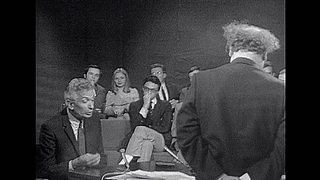
Thirteen days before the first steps on the moon, Jacques-Ollivier Chattard presents a show on the theme of space conquest hosted by Pierre Desgraupes with notably the science fiction writer, René Barjavel, for whom, the conquest of space is inevitable, according to the principle that "life must spread" and is an example of a new space law because the moon will belong to everyone and not to the first nation who sets foot on it, which was done for the South Pole.
The writer René Barjavel tells the story of his new novel "La Nuit des temps" relating the discovery at the South Pole by archaeologists of the ruins of an ancient utopian civilization and a golden sphere containing a sleeping couple. After reflection, the woman was 'resurrected' first and tells her story and that of the man found.
The writer René Barjavel wrote for television a futuristic series 'Space Commando' taking place in the 3000s, filmed and reconstituted in the studios of Bavaria in extraordinary futurist settings and inspired by tests carried out by NASA. The series features a hero Cliff Allister McLane, an old-fashioned hero like Roland, defender of Western civilization against alien enemies from deep space.
Interview with René Barjavel, screenwriter for the big screen of "Don Camillo", which begins on television with the series "Space Commando": "very simple adventure" taking the viewer "into a fantastic world". For him, everyone already read Science fiction with the novels of Jules Verne, it is moreover, a literary genre including all literary genres: the comic strip, the popular novel, the fantastic or metaphysical novel
The writer René Barjavel explains how he wrote the dialogues of the dubbed version in French of Visconti’s film "Le Guépard". On this occasion, he expresses his admiration for the director and the actors of this film, which had the distinction of being shot in the mother tongue of each actor.
Invited by Pierre Desgraupes, on the occasion of the reissue of one of his first novels, in the context of the Cold War, René Barjavel evokes the theme of this novel of anticipation "Le diable l'emporte" : the geopolitical repercussions of sending a rocket to the moon where a nation has laid a flag -thus claiming territory-, a third then a fourth world war erupts and a major banker then decides to build an underground shelter, an ark, to save humanity.
Guest by Pierre Desgraupes, the writer René Barjavel explains why he cannot write ordinary "literature" based on what makes individuals act "in the heart full of mud": two traditional springs, love or the law of perpetualization of hope and interest, to be stronger and smarter at the expense of others (which explains why he can only write science fiction novels.)
Pierre Desgraupes receives René Barjavel on the occasion of the release of his new novel 'Le voyageur imprudent' addressing a classic theme in science fiction, time travel. His character, Pierre Saint Menoux, an associate of Mathematics, leaves in a rather recent past looking for evidence of his interventions and goes on the other hand very far into the future until the year 100,000 to discover the future of man in the thousandth century. An actor interpreting the character of the novel answers Pierre Dumayet’s questions about what the future holds for man.
The Académie Goncourt refused to award its prize, and a jury of fanciers decided to replace the defaulting academicians. The comedians, dressed in redingotes, each read a different book. We recognize: Georgius, Béby, Lilo, Jean Mara, Jacques Dutal, Julien Courtine, Max Revel, Durocq, Yves Deniaud, Jean Rigaux. The Prix des dix is awarded to René Barjavel for his two novels 'Ravage' and 'Le voyageur imprudent'. The photographers operate.


 The INA Galaxy