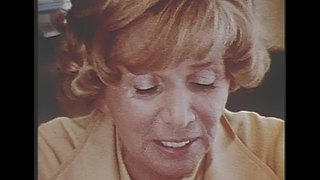
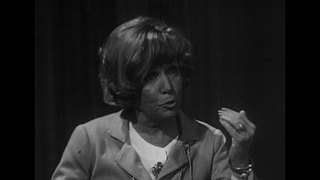
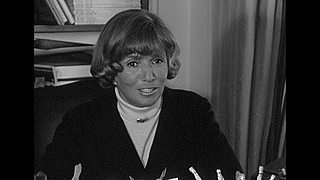
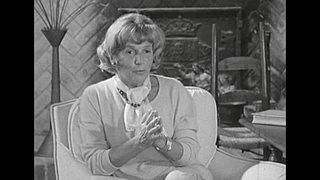
Interview with Hélène GORDON LAZAREFF, managing director of the magazine "Elle": for her, since its creation, the weekly "Elle" has helped to give a certain image of women, between frivolity and more serious interests. Her remarks are illustrated by photos, article titles and "unes" from the newspaper "Elle".
Images of Hélène LAZAREFF surrounded by her collaborators at the time of an editorial conference for the newspaper "Elle". In his "in", debate on the different lengths of skirts and dresses according to the fashion houses.
Hélène Lazareff, director of the magazine "Elle", talks about what she likes about her job as a journalist, especially the absence of monotony, and cites as an example the newspaper’s fight for the rise of swimming pools and compulsory swimming for children.
In her office at the newspaper "Elle", interview with Hélène Gordon Lazareff who discusses her beginnings as a journalist at "Paris Soir" for the children’s section with her husband Pierre Lazareff, the role of her husband during the weekly conference of the newspaper’s editorial staff. She herself takes care of the "strictly feminine part" of the magazine.
The editor-in-chief of the newspaper "Elle" Hélène Lazareff responds to the criticisms made about her women’s magazine by notably the editor-in-chief of the CGT women’s newspaper "Antoinette", Louisette Blanquart, because she is too focused on beautiful fashion photos and frivolity. However, other sections on the world of work, career guidance, articles about society or culture are indeed present in the magazine, but, presented -in a more austere way- they attract less the eye of the readers and are therefore much less read by them.
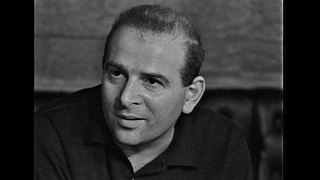
Animated debate in public between the fashion photographer Franck Horvat, the writer and journalist Edmonde Charles Roux and the journalist Jean Mauduit, secretary general of the newspaper "Elle" on the too big place of photos and advertising in women’s magazines. Franck Horvat deplores the desire to 'sell' women’s magazines thanks to beautiful images and photos while Edmonde Charles Roux recalls that a press magazine lives thanks to advertising and that the readers are intelligent enough to distinguish between the advertising and editorial parts of newspapers.
Hélène Lazareff, editor-in-chief of a women’s newspaper, justifies the absence of political articles in her magazine 'Elle' and the lack of commitment to a political figure: for her, women cannot succeed in politics because they are more 'vulnerable' and 'emotional'that a man, the role of the woman is not to try to do everything that the man does, the loss of his 'femininity' would be a disaster for her.
Hélène Lazareff, editor-in-chief of the women’s newspaper "Elle" evokes the increasingly important place of women in society both from the point of view of romantic life and politics, as well as in the world of work by practicing professions requiring a good level of university education. She recalls the role played by television: to open a window on the world for them. In this very rapid evolution, one thing remains however immutable and essential for women: their love life.
Hélène Lazareff, editor-in-chief of "Elle", explains how the women’s press influences women in terms of fashion: the choice of models and outfits, their highlighting by the journalists of this press is decisive: this makes readers want to identify with the model presented. The journalist gives an example of staging a hold-up inspired by a news story to take photos featuring fur coats.


 The INA Galaxy