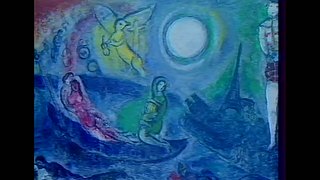
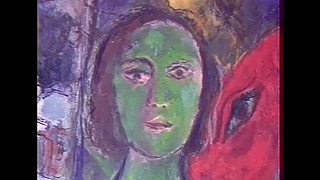
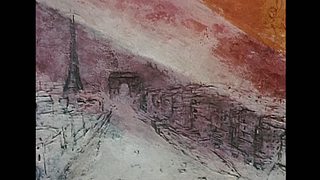
Report on the occasion of the opening of the retrospective devoted to the painted work of Marc Chagall held at the Maeght foundation in 1984. The paintings "The Apparition", "The Self-Portrait", The Poet", "Above Vitebsk", "The Blue House", "Homage to Apollinaire", "Over the Roofs", "The Concert" and "The War" are shown successively.
Report tracing the evolution of the pictorial practice of the painter Marc Chagall through a comment on the works "L'exode", "Hommage à Gauguin", "La Guerre", "Portrait de Vava", "Le grand cirque gris", "La chute d’Icare", and some of the master’s last paintings.
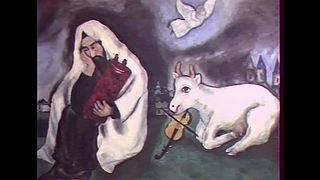
Report tracing the evolution of the pictorial practice of the painter Marc Chagall by a comment on the works " the Kermesse ", " La Chambre jaune ", "Le Soldat boit ", " Le Rabbin au citron ", " Anywhere out of the world ", " Bella with white collar ", " Solitude " " The Revolution".
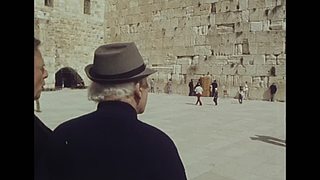
In his 90th birthday, Marc Chagall is invited to Israel for a series of ceremonies honoring the artist considered as the painter of Judaism. In this sequence, Igor Markevitch comments on the artist’s work and then Chagall visits the Wailing Wall accompanied by the mayor of Jerusalem. In 1931, the artist donated a painting that became the first work on the inventory of the Tel Aviv Art Museum.
The master glassmaker Charles MARQ evokes the sensitivity of the artist Marc CHAGALL with whom he collaborated on the stained glass windows of the chapel of the cathedral of Reims. To the question of a journalist who asks him if the stained glass windows asked him a lot of work time, Marc CHAGALL answers with humor: "80 years" Color images of the artist painting a stained glass window.
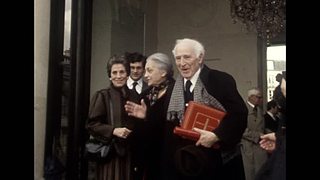
Marc CHAGALL received today the grand cross of the Legion of Honour from the hands of the President of the Republic, Valéry GISCARD D'ESTAING. Interview with the artist on his release, on the porch of the Elysée. For him, this distinction is a sign of love and he says that the President knows his work well. But he himself does not talk about it. Françoise Giroud, Secretary of State for Culture, stands by his side.
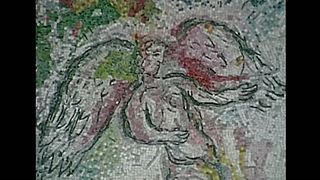
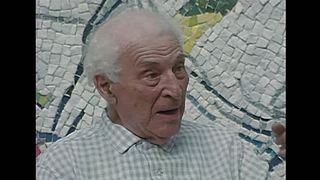
Marc Chagall has always been very discreet about his artistic practice and intentions. Here with José Artur, we can feel the embarrassment when he asks the artist about the links between his life and his work. Finally, Chagall gives himself up: "I doubt, I’m unhappy...and that’s it," then he says that he wants to give pleasure and love. Beginning of the sequence: details of the mosaic "Le repas des anges" from the chapel of Sainte-Roseline in Arcs-sur-Argens, commissioned to the artist by Marguerite Maeght.
In 1913, Blaise Cendrars dedicates to his friend Marc Chagall his fourth "elastic poem". Born in 1887, the two artists became friends following their meeting in Paris during this period. The text is here read by José Artur against a background of paintings by the painter of Russian origin.
Marc Chagall explains to José Artur that it was during a trip to Palestine in the 1930s that he really found his inspiration in the bible, whose universe will become characteristic of his work and inspiration. For the artist, it is not a religious issue but a poetic and spiritual one.
The painter Marc Chagall returns on the realization of the stained glass windows of the cathedral Notre-Dame of Reims. It recalls the major themes mobilized such as the great kings of France. It also evokes the predominance of blue, a color more resistant to the pangs of time. Finally, he delivers some enthusiastic words about the workshop of Charles Marq.
The painter of Russian origin Marc Chagall is based in France in Saint-Paul-de-Vence and it is here that he is filmed walking with his dog Pacha while he has just celebrated his 80th birthday. The report tells us that while he was still in Russia, his pictorial talent was already recognized and that his works embodied the Jewish daily life of the time.
The painter Marc Chagall evokes "the eternal tenderness of France" and the influence of his capital on painters who came to find exile, resulting in works that reflect this beneficial breath to their art. The artist of Russian origin even speaks of "magic" to describe this phenomenon which according to him is not explained.


 The INA Galaxy