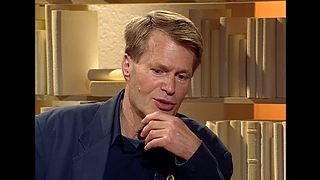
Jean-Marie Gustave Le Clézio, is present in Beirut in Lebanon, on the occasion of the salon du livre francophone. Interviewed, he talks about Beirut, the link between literature and war: "...I think that literature has a lot to do with war, because it is the anti-war par excellence...".
David PUJADAS talks in duplex with Jean-Marie Gustave LE CLEZIO, Nobel Prize for literature 2008. This award confers a certain international legitimacy on the author.
Excerpt from the retransmission of the press conference of Jean Marie Gustave LE CLEZIO, following the award of the Nobel prize for literature for his entire work.
Meeting with the writer Jean-Marie Gustave Le Clézio, at his home in Albuquerque, USA. Interviewed, he says of him: "I am someone who has no fixed domicile veritably, because I am from a family of people a little vagabond and one day I decided to stop here, one day I will leave...".
Jean-Marie Le CLEZIO wonders about the reasons to love the Mediterranean. He loves the Mediterranean, this anguish of light, this too much light that we find in the work of Albert CAMUS. It is an archaic society that juxtaposes archaic images combining Roman monuments, medieval monuments and the monstrous modern city. The Mediterranean is the native sea, more familiar and more literary. According to the writer, "Reading the pre-Sosocratic with the shimmering sea" is terrific.
Bernard Pivot receives the writer Jean-Marie Gustave Le Clézio to talk about his book "Hasard". Here the writer evokes his difficulty of living in the city. Interviewed on the rough places in which he lived as Mexico or among the Indians of Panama, he explains: "...when you’re in the forest you can’t move around with a lot of things, I would move around with writing and living for a few weeks, I wouldn’t go beyond a few weeks, so you have to reduce your baggage".
Bernard Pivot receives the writer Jean-Marie Gustave Le Clézio to talk about his book "Hasard". The writer recalls his first trip as a child, when he left with his mother to meet his father in Nigeria. It was on the boat the "Nigerstrom" that he began to write: "...it is true that a boat cabin is a good place to write, any boat, but preferably a cargo ship...cargo ships that carry goods, occasional passengers and then some passengers who are there to make the long journey, Here we are in a world that is secretive of literature...".
Interviewed by Bernard Pivot, the writer JMG Le Clezio thinks that the writer should not talk too much at the risk of not being accurate in his words. He considers writing superior to speech. And for him, a writer is first of all known by his books.
JMG The CLEZIO returns to a theme that is dear to him, silence. He explains that the human being must be able to silence his inner tumult in order to open himself to the beauty of the world. According to him, society imposes noise, it encourages "consumption and giving of noise". Writing is also noise, the whole of literature lies in " what it says outside of the words ".
Interviewed, Jean-Marie Le Clézio gives the reasons why he writes: "...unconsciously recall all the small tragedies, all the small oppressions, which form the bottom of being, this comes back unconsciously in the form of writing...".


 The INA Galaxy