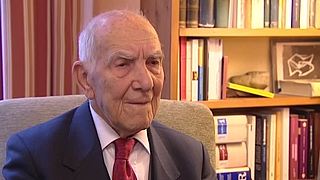
Stéphane HESSEL advocates for peace and the recognition of Palestine. To the criticisms that are made of him and to the allegations of anti-Semitism, he replies that he is happy that the Jews after the Shoah were able to find land to welcome them and build a state, but that he firmly condemns the colonialist policy and the occupation of the Palestinian territories by the Israeli government.
Catherine CEYLAC speaks with Stéphane HESSEL, on the occasion of the release of his book "Indignez-vous". He explains that to face the great challenges of society and the world, we must mobilize. Drawing on his experience as a resistance fighter, his participation in the programme of the National Council of Resistance and the drafting of the Universal Declaration of Human Rights, he affirms that civil disobedience can be beneficial. Legality, which induces the obedience of citizens, is justified only if it does not go against the legitimacy of humanist values.
Elise LUCET receives the author of the best-seller "Indignez-vous". Stéphane HESSEL strongly and convincingly encourages his fellow citizens to take action against poverty, inequality and social injustice, and to protect the planet from climate change. With his experience in the resistance, against fascism, the horrors of war and the Shoah, he is convinced that civic engagement can bear fruit.
Interview with Stéphane HESSEL, diplomat, writer and former French resistance fighter, who helped draft the 1948 Universal Declaration of Human Rights. Sixty years later, he still believes in this declaration and offers two messages to the younger generation: reread this declaration to make this world more livable, and to evolve it to work on the relations between man and the planet.
Stéphane HESSEL, spokesman of the College of Mediators, speaks about the evacuation by the police of immigrants from the church Saint Bernard in Paris. He called on the Ministry of the Interior to negotiate and regulate the greatest number. Convinced that the Pasqua laws are too restrictive, mediators want a major reform of immigration laws in France and Europe. The regularization of these undocumented Africans will not open the door to a flow of illegal immigrants, he concluded.
Stéphane HESSEL, former French ambassador to Africa, is interviewed on the report he gave to Michel Rocard on the situation in Africa. He believes that French cooperation in Africa over the past 30 years is, for the most part, akin to neocolonialism. The African continent is experiencing great changes that it is necessary to accompany. Philippe LEFAIT spoke of the words of the director of the central fund for economic cooperation, Mr Postel-Vinay, who denounced corruption. The former ambassador confirms that corruption is real, but that responsibility is shared between African leaders and western democracies who have turned a blind eye to embezzlement and patronage complacency.
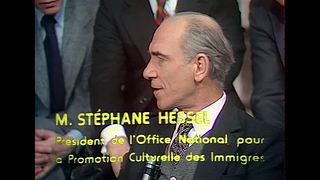
Stéphane Hessel, speaks about the role of the National Office for the Cultural Promotion of Immigrants, which he chairs. It is a question of encouraging relations with the communities present within the French population in order to develop cultural exchanges, thus preventing French culture from becoming sclerotic in "a purely national conforrmism".


 The INA Galaxy